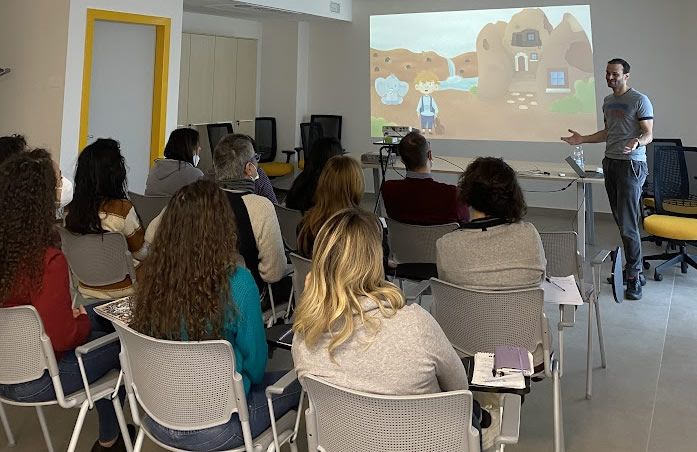

University of California, Berkeley & NTNU @ Mission Dolores Academy – San Francisco, USA
Context
In collaboration with University of California, Berkeley Graduate School of Education and Norwegian University of Science and Technology, SENSEi technology powered the system in an in-situ research study investigating hybrid teaching intelligence in mathematics education.
The study explored how AI-driven feedback and teacher instruction intertwine during embodied learning activities.
The Research Question
How can AI augment — rather than replace — the teacher?
What happens when automated formative feedback and human instruction operate simultaneously in a learning environment?
The research focused on understanding:
• Learning opportunities and challenges emerging from teacher–AI entanglement
• How students perceive those hybrid support moments
• How engagement, stress, and fatigue evolve during embodied interaction
The System
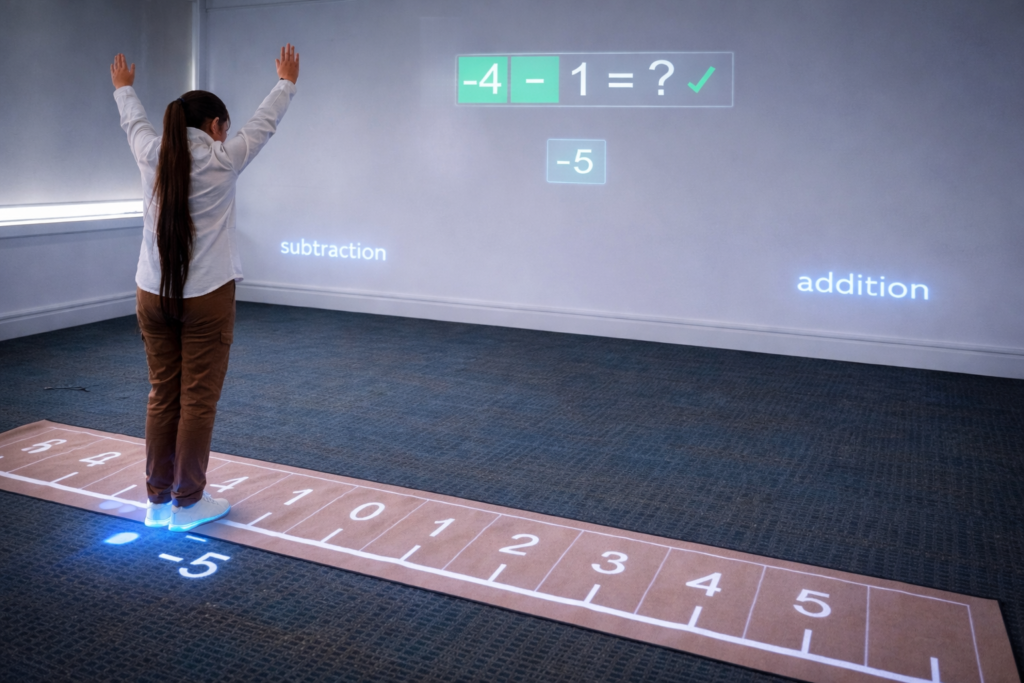
SENSEi transforms integer arithmetic into a whole-body experience.
Students solve arithmetic problems by physically walking along a projected number line, receiving:
• Real-time AI-driven formative feedback
• Multisensory visual and auditory cues
• Embodied motion tracking (skeleton data)
• Reflective questioning from a facilitator
• Optional mirrored avatar support
The system is built on SENSEi’s modular multisensory architecture.
Research Design
The study involved 28 students (ages 11–14) in a real classroom setting.
Data collection included:
• Qualitative video coding (200 interaction moments)
• Skeleton tracking (20 joints, 10 Hz)
• Physiological sensing (HRV, EDA, fatigue indicators)
• Statistical modelling (ANOVA, Markov state transitions)
This multimodal approach enabled a fine-grained analysis of cognitive–affective states during hybrid teaching moments.
Key Findings
- AI and teacher feedback were predominantly complementary.
- Engagement peaked during moments of aligned AI–teacher support.
- Embodied mirroring (avatar) enhanced spatial awareness and reflection.
- High stress levels corresponded to deeper conceptual processing.
- Hybrid intelligence enabled teachers to detect misconceptions in real time.
Impact
This research demonstrates that:
• AI can function as a collaborative agent in education.
• Multisensory embodied environments increase engagement.
• Hybrid intelligence supports conceptual understanding beyond procedural rule-following.
• Multimodal data can inform adaptive and responsive teaching strategies.
The findings contribute to the theoretical understanding of teacher–AI entanglement and offer practical insights for designing future AI-augmented learning environments.
Discover more at: https://bera-journals.onlinelibrary.wiley.com/doi/10.1111/bjet.13525