
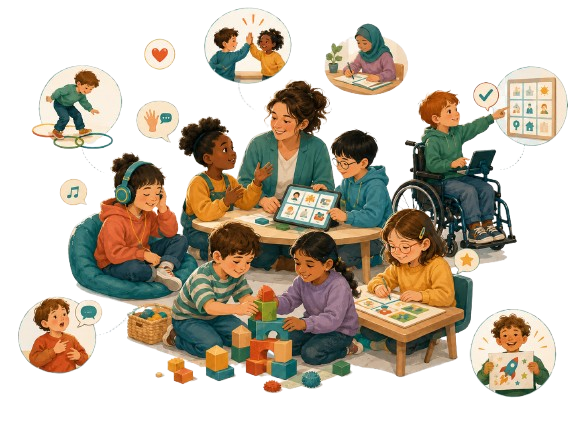
Today’s schools welcome students with very different characteristics, abilities, experiences, and ways of learning.
Within the same classroom, different learning times, special educational needs, neurodivergence, varying levels of attention and motivation, diverse communication and motor abilities, and different cultural, linguistic, and personal backgrounds coexist.
The challenge is no longer simply to guarantee access to school, but to enable every student to participate meaningfully, learn, and feel part of the educational community.
From Presence to Participation
Inclusion does not mean simply placing students in the same classroom.
A truly inclusive school must allow every student to understand through different modalities, communicate, collaborate, participate in activities, develop autonomy, and receive support that reflects their individual characteristics.
Students should not be required to adapt to a single way of teaching. The educational environment itself must become flexible enough to welcome diversity.
What Is Snoezelen?
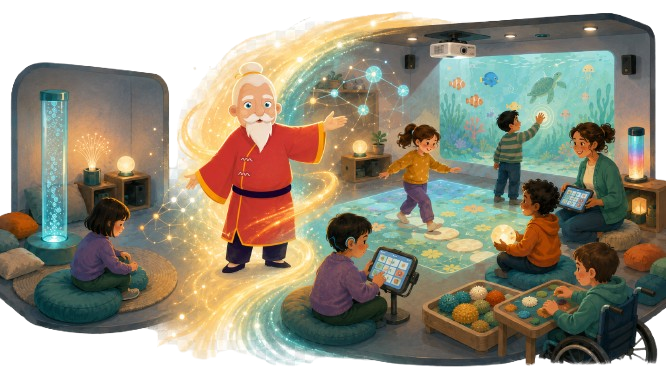
Snoezelen is an approach based on the creation of a controlled, safe, and welcoming multisensory environment.
The word combines two Dutch terms:
- snuffelen, meaning to explore and discover through the senses;
- doezelen, meaning to relax and reach a state of calm.
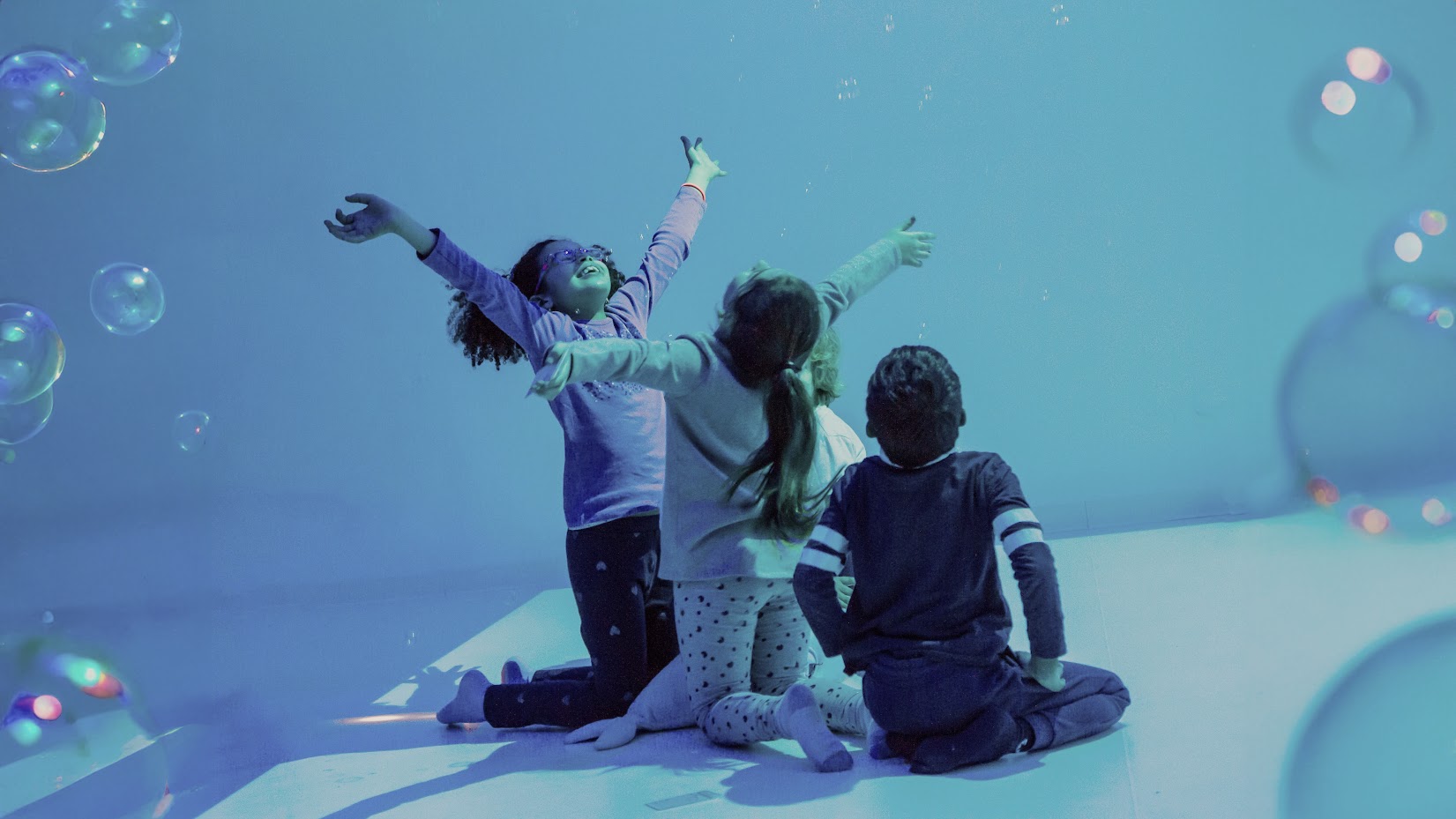
Inside a Snoezelen room, lights, sounds, colours, vibrations, tactile surfaces, and other stimuli are selected and adjusted to support well-being, relationships, exploration, and sensory regulation.
Its value does not depend on the number of devices in the room, but on the ability to create a coherent and personalised experience through the relationship between the person, the facilitator, and the environment.
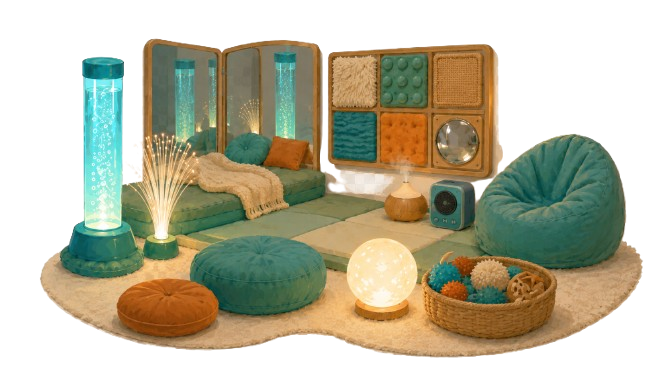
A Predominantly Individual Experience
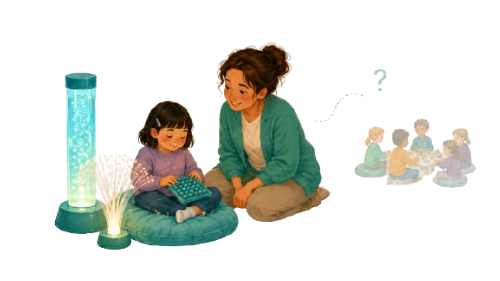
In its traditional application, the Snoezelen experience is often built around a one-to-one relationship between one person and one facilitator.
In schools, this configuration fits naturally within individualised pathways, where a student is supported by a special education teacher or another dedicated professional.
This approach enables close observation, personalised stimuli, respect for individual timing, and the development of a trusting relationship.
However, school is also a collective environment.
Students need to participate in shared experiences, collaborate with classmates, learn through different modalities, share activities and goals, and feel part of the group.
The challenge is therefore to extend the benefits of the multisensory experience beyond the one-to-one relationship.
From Snoezelen to SENSEi
SENSEi was created in response to this need.
It brings the principles of the multisensory environment into the school context, preserving the value of well-being, regulation, and personalisation, while adding interaction, learning, group participation, and adaptability.
SENSEi does not replace Snoezelen. It builds on its principles and extends them toward an interactive, inclusive, and shared educational environment.
A Responsive Environment
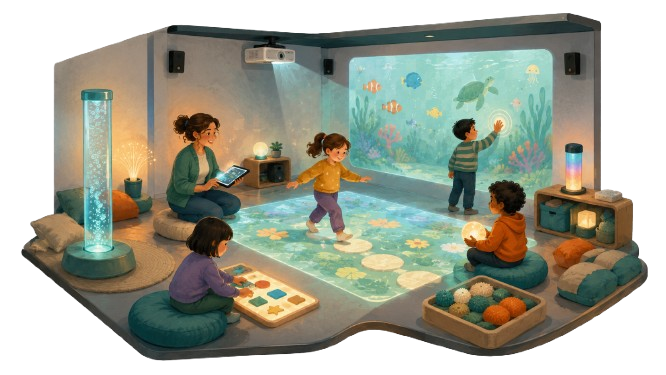
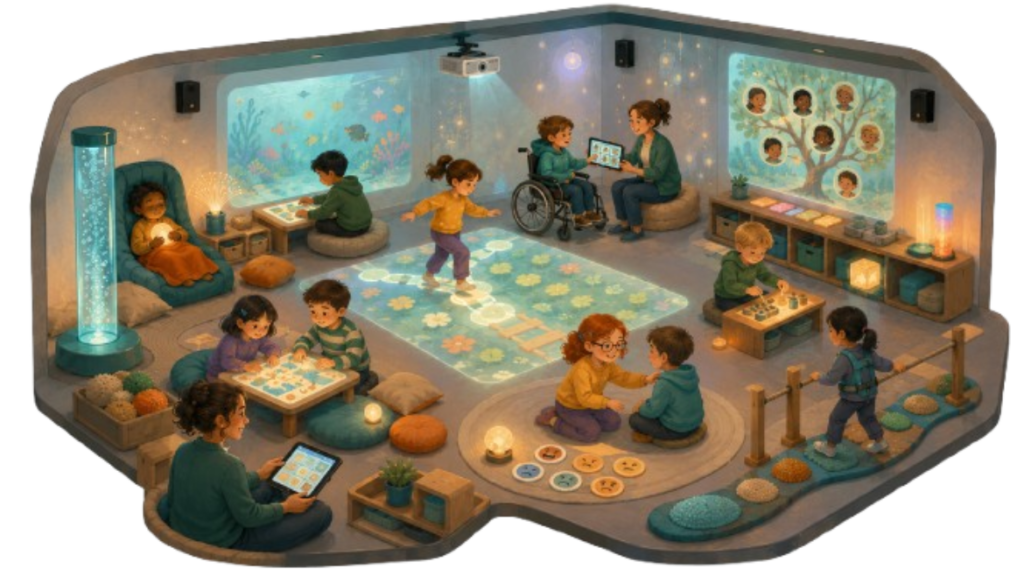
In SENSEi, lights, sounds, projections, interactive surfaces, and digital content are not separate elements, but parts of a single ecosystem.
Children can:
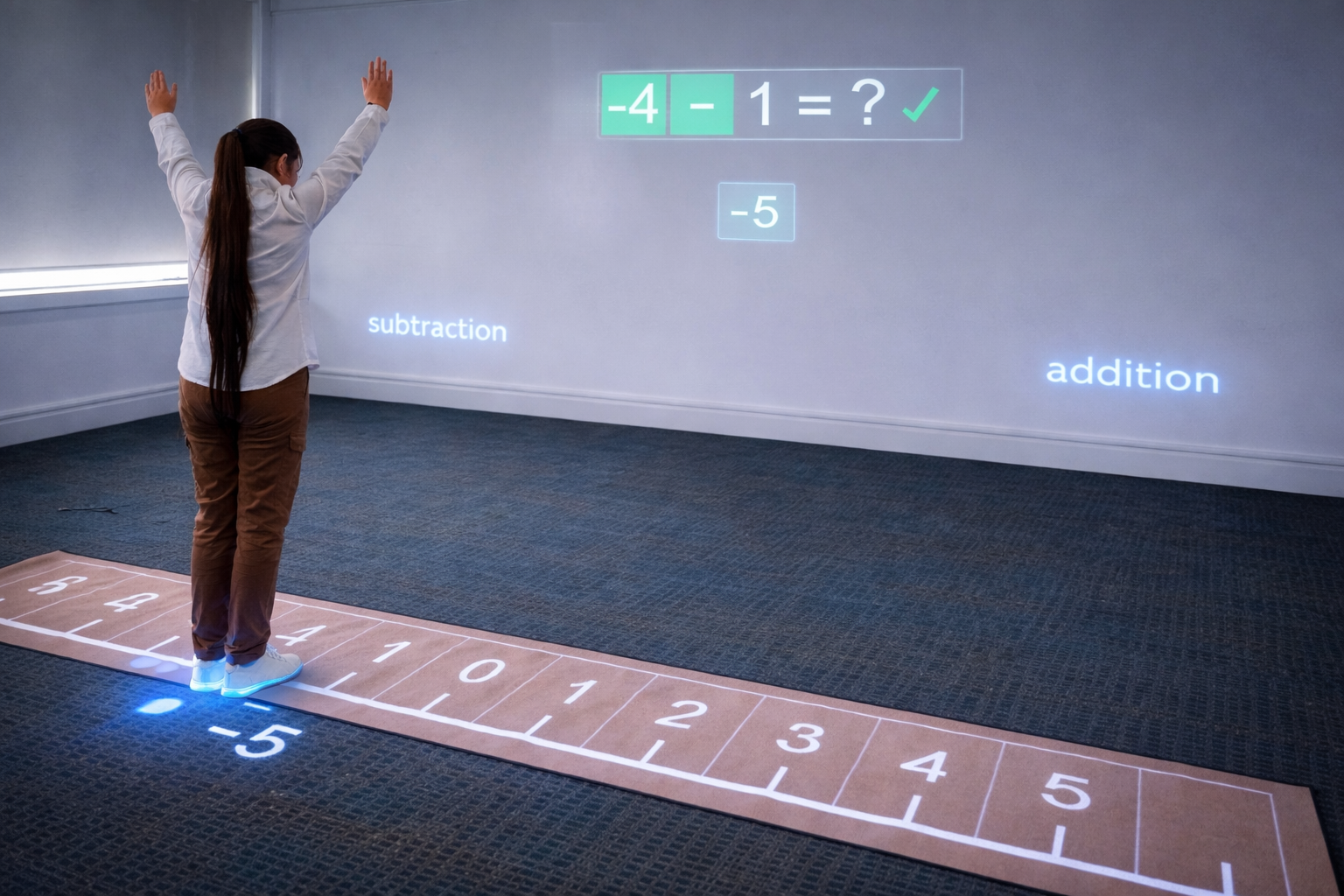
- move through the space;
- touch walls and surfaces;
- interact with projected content;
- use voice, gestures, and objects;
- collaborate with classmates;
- receive immediate feedback from the environment.
The body becomes a tool for exploration, communication, and learning.
The environment does not simply display content. It reacts, changes, and can adapt to users’ actions and educational goals.
From Individual Well-Being to Shared Educational Experience
SENSEi allows the same environment to support different purposes:
- well-being and regulation;
- curricular learning;
- motor development;
- communication and language;
- social skills;
- collaboration;
- emotional education;
- autonomy;
- rehabilitation and training.
The same space can therefore change according to the individual, the group, and the objective.
Reverse Inclusion
At the core of SENSEi is the concept of reverse inclusion: designing for the most complex needs in order to create effective experiences for everyone.
Rather than adapting a standard solution afterwards, SENSEi starts from the needs of those who face the greatest barriers to access, participation, and communication.
The result is a more flexible, accessible, and engaging environment for the entire school population.
A Change of Paradigm
SENSEi is not simply a technological evolution of the multisensory room.
It represents a change of paradigm:
- from passive experience to active interaction;
- from individual use to shared participation;
- from separate devices to an integrated system;
- from a static environment to a responsive environment;
- from individual well-being to inclusive learning.
SENSEi transforms the multisensory room into an active educational space where every student can participate, learn, and feel part of the community.
One environment. Many ways to learn.