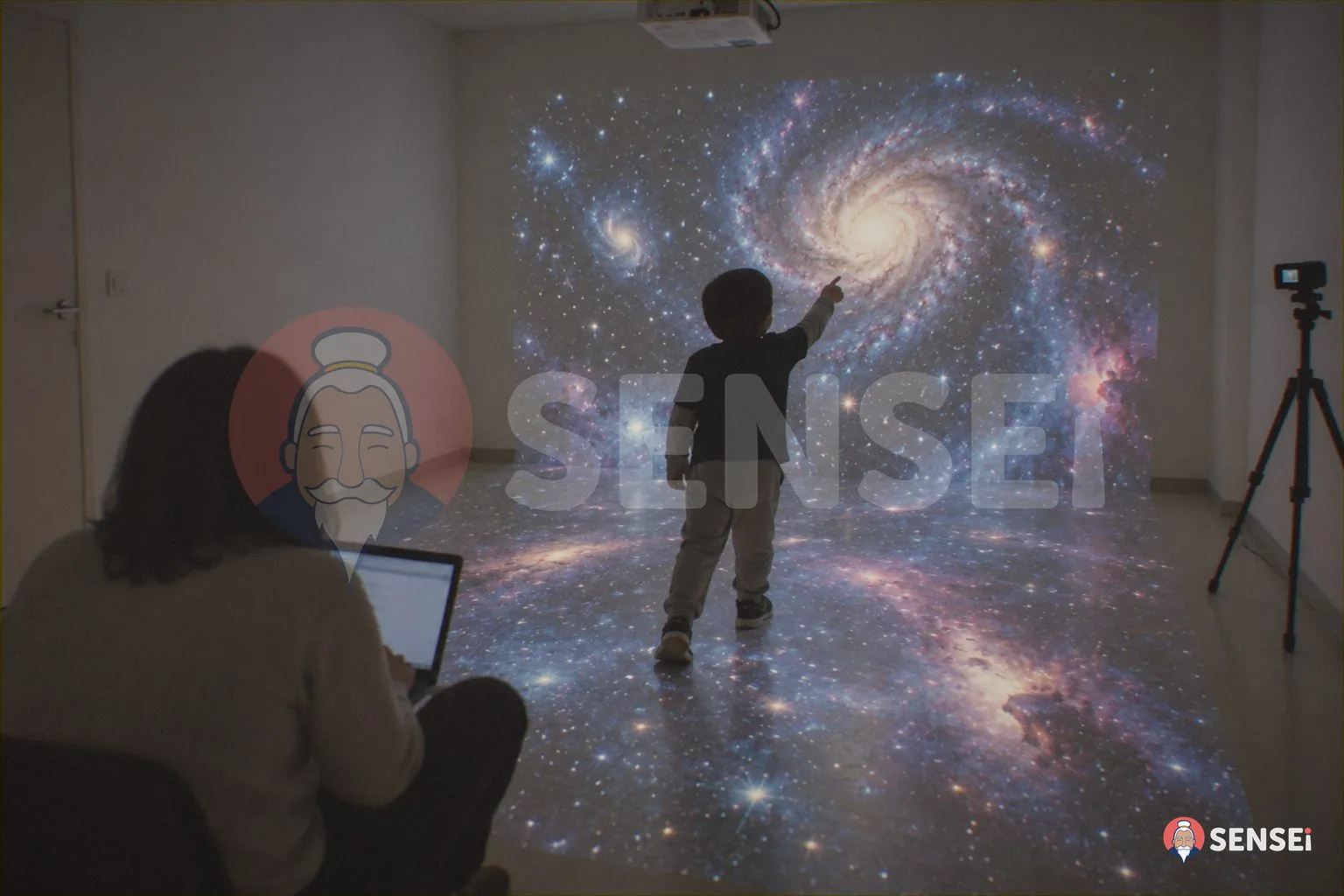
At the Fondazione Sacra Famiglia in Inzago, the multisensory room does not wait for people: it goes to them. A mobile SENSEi cart, named L’Aura, brings light, sound and interactive scenarios into the residence for adults and older people with disabilities, many of whom use a wheelchair. The project, now completed, shows that a multisensory environment can speak to adults, respecting their age and abilities.
The context: a residence for adults with complex needs
The Fondazione Sacra Famiglia is one of Italy’s leading organisations for people with disabilities and older people. In Inzago it runs a residential care facility for people with disabilities (RSD) that welcomes adults with complex needs.
Some residents need medical equipment in their own rooms. A fixed room in another wing is not enough: what is needed is an environment that can move.
The project: a room on wheels
This is how an experimental project built by many hands comes about. On one side, the Foundation’s multidisciplinary team, from management to the physiotherapist, from the doctor to the care staff. On the other, the SENSEi group, with expertise in engineering, communication and product design.
L’Aura is a lightweight cart, designed to fit even into rooms where the walls are taken up by medical equipment. With a single gesture it turns wall and floor into interactive scenarios, and it is controlled from a tablet or a phone. It also carries small sensory stimuli, such as bubbles, lights and gentle warmth.
The project includes training for the Foundation’s team, so that the care staff can use the cart independently.
How do the experiences change?
Most multisensory content is created for children. In Inzago the activities are reviewed with the care staff, one by one. The goal is to “redesign the experience by adapting it to the residents’ wheels”:
- accessible paths (a river, a lake, a gym) that can be crossed in a wheelchair;
- fewer elements at a time, for example only three or four animals per screen;
- more adult stories, with forks and choices;
- immersive videos of journeys and walks (sea, mountains, space) and moments of relaxation;
- musical instruments and effects such as water, bubbles and snow with relaxing music.
Bringing memories back to life
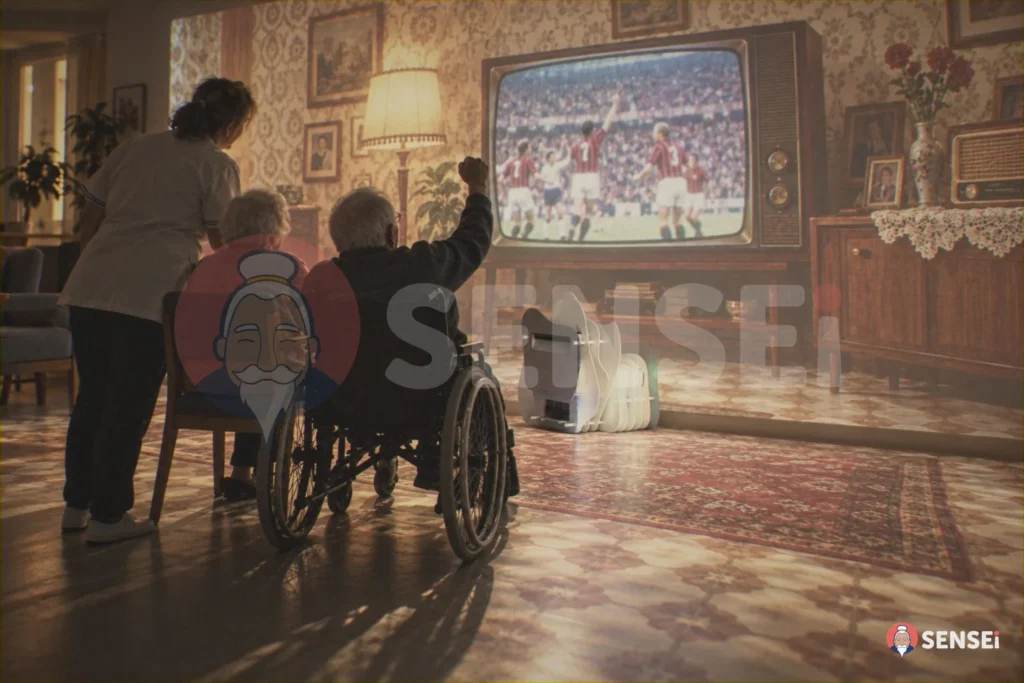
With older residents, L’Aura also becomes a reminiscence tool. The projections recreate places and moments from the past at life size, on wall and floor, all around the person.
One resident finds his living room again, with the wallpaper, the sideboard and the old cathode-ray television showing the European Cup final between Milan and Steaua Bucharest: and he cheers just as he did back then. Another resident returns to her mountain village, among the stone houses, the bell tower and the fountain in the square.
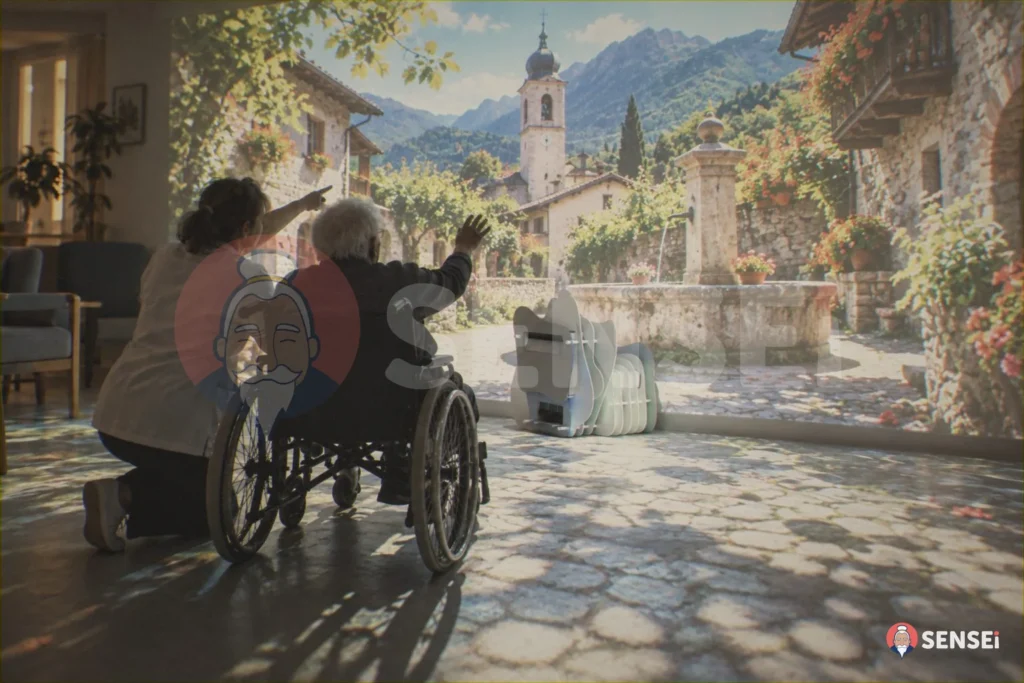
Recognising a familiar place opens up conversation: residents tell stories, point, recall names and habits. The care staff use these cues to stimulate memory, language and relationships. Each scenario is created with the care team and the families, starting from each person’s life story.
The link with research
The Inzago cart is a piece of applied research. The research group from which SENSEi originates, active from the Politecnico di Milano to SUPSI with more than forty published studies, has long been working on two questions that meet here.
The first: how to bring the multisensory experience to where people are, with nomadic solutions such as those analysed in On the Effects of a Nomadic Multisensory Solution. The second: how to make an interactive environment suitable for adults with intellectual disability, the topic of the exploratory study Phygital interfaces for people with intellectual disability. The L’Aura cart is also the subject of a thesis at the Politecnico di Milano.
The impact
- An experience that goes to people, including those who cannot leave their room.
- Content suited to adulthood, built with the care staff rather than adapted after the fact.
- A trained team, with different professionals learning to use the same tool.
- Memories that come back to life, with places and moments from the past recreated for each resident.
- A replicable method for other residences for adults and older people.
The Foundation also thanks SENSEi among those who help it pursue its social impact goals.
Why is this a significant case?
Inzago shows that, through co-design, the same technology can speak to adults, respecting their age and abilities. And that a dedicated room is not always needed: sometimes it is the room that has to move. It is the same principle that guides SENSEi CARE in centres for adults. To learn more, also read the article on the multisensory room for older people.
Frequently asked questions
Can SENSEi be used with adults with disabilities?
Yes. The activities need to be adapted to age and motor abilities, as happens in Inzago.
Is a dedicated room needed?
Not always: there are also mobile solutions that move between spaces.
What is L’Aura?
It is the Foundation’s mobile SENSEi cart: lightweight, it fits even into rooms taken up by medical equipment and carries interactive scenarios, bubbles, lights and gentle warmth.
How much does an environment like this cost?
It depends on the configuration: space, experiences, training and services. Contact us for an assessment.
Do you work in a school, a centre or a museum and want an environment like this? Tell us about your project: we start from the needs of the people who will use it.