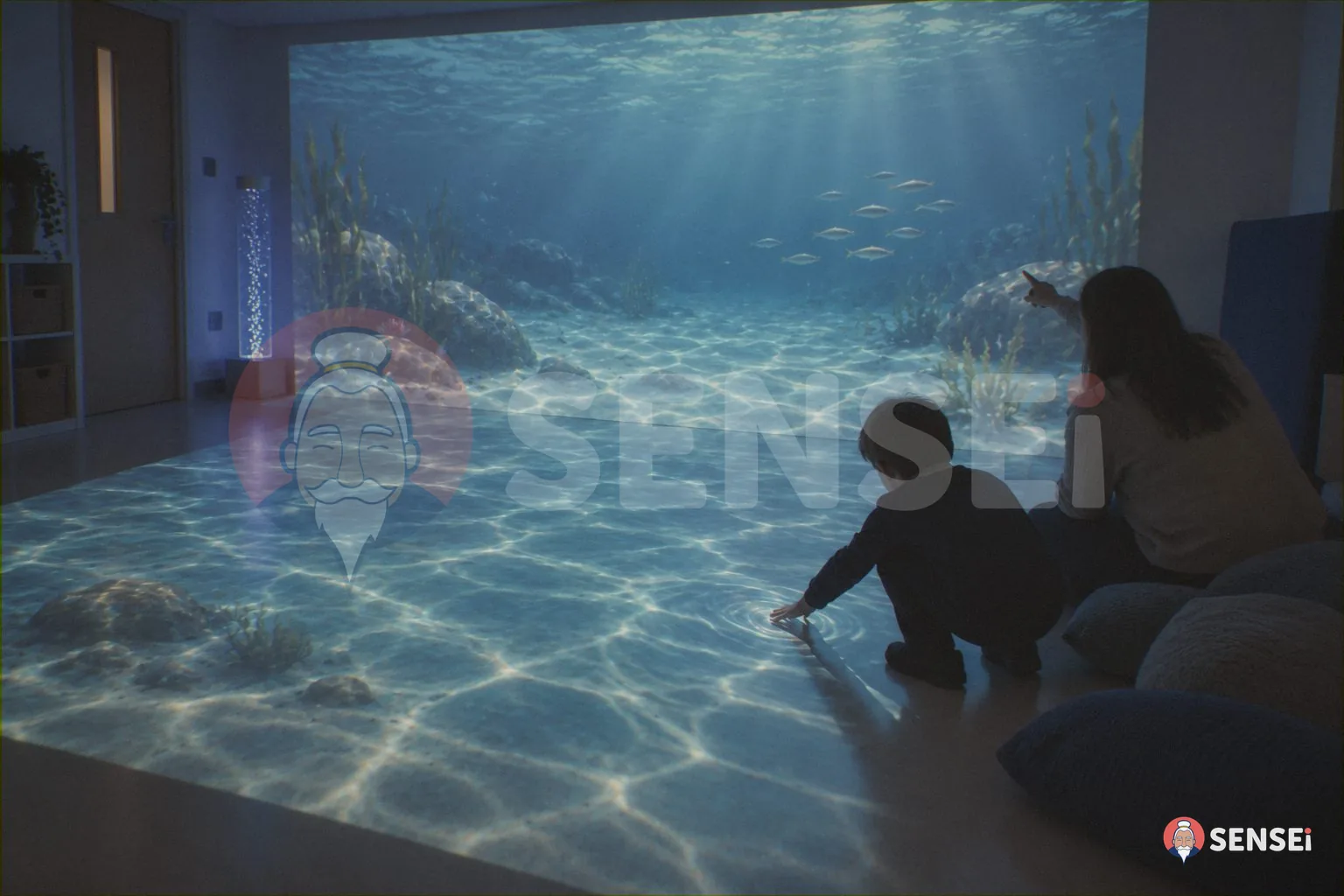

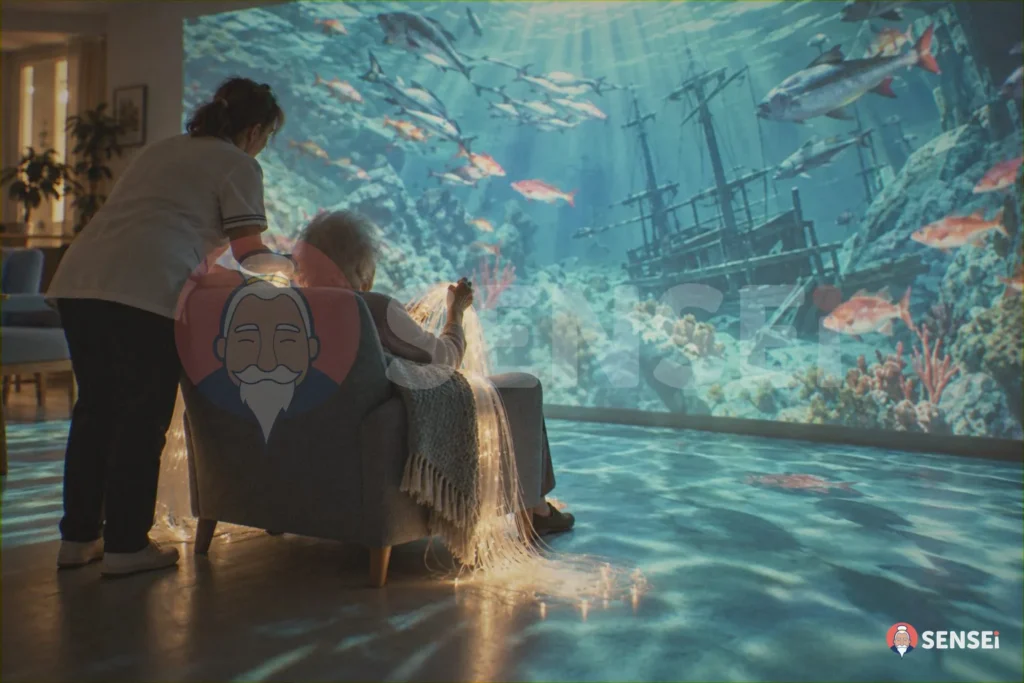
A multisensory room for older people and people with Alzheimer’s is a space with lights, sounds, images, scents and objects to touch, designed to offer moments of calm, pleasure and connection. Studies often report positive effects on mood and behaviour, but the evidence of effectiveness is still limited: it should be used as part of a care plan, not as a solution in itself.
This guide explains what the research says, which elements are useful, what to avoid, some sample activities and how to involve care staff and families.
What is a multisensory room for older people?
It is a controlled environment in which sensory stimuli are chosen and dosed. The best-known tradition is that of the Snoezelen® room, which originated in the Netherlands in the seventies: soft lighting, gentle visual stimuli, calm music, comfortable seating. In residences for older people and in day centres, these spaces are used for well-being, to manage moments of agitation and to stimulate memories and connection.
Today there are also interactive environments, in which images and lights react to movement and the care worker can change the scene and intensity in real time. Learn more about the origins in Snoezelen room: what it is, where it comes from, what the research says.
What does research say about dementia?
The evidence needs to be read carefully. The Cochrane review on multisensory stimulation in dementia, in its update, concludes that there is no evidence of effectiveness: the two studies added show no significant effects on behaviour, mood, cognition and communication. The authors call for more robust research.
A more recent systematic review gathers 62 studies on people with intellectual disability or dementia, 32 of them on dementia. The most frequently reported effects concern mental health, such as a reduction in challenging behaviour and an improvement in mood. The authors note, however, that details on how the room is used are often missing, which makes it impossible to understand which approaches work best.
In short: the multisensory room can offer moments of well-being, but it should not be presented as a cure. How it is used matters a great deal: who accompanies the person, for how long, with which stimuli and which goals. For a broader picture, read Multisensory stimulation in dementia: what the research says.
What can it be used for in practice?
- Calm: a place to lower stimuli and noise during moments of agitation.
- Pleasure: enjoyable experiences with no demands on performance.
- Connection: dedicated time between care worker, person and family.
- Memories: landscapes, music and objects linked to the person’s life story.
- Movement: small gestures, standing up, walking, touching.
Which elements are useful?
| Sense | Elements | Precautions |
|---|---|---|
| Sight | adjustable warm light, slow landscapes on the wall, small points of light | avoid flashing, strong contrasts, shadows that may frighten |
| Hearing | music from the person’s era, natural sounds | low volume, no sudden noises |
| Touch | fabrics, everyday objects, soft blankets | washable and safe materials |
| Smell | familiar scents (bread, lavender, coffee) | few scents, one at a time, attention to sensitivities |
| Movement | stable armchairs, space to walk | clear floor, safe supports |
Particular care is needed with projections on the floor: some people with dementia may perceive patches or shapes on the ground as obstacles or holes. It is better to favour the walls and introduce the floor cautiously, observing the reactions. A complete list of equipment is in What to put in a multisensory room, with a closer look at sensory fibre optics.
Six sample activities
1. The seaside of the past
A projected beach, the sound of the waves, a little sand in a bowl and shells to touch. The care worker invites the person to tell their story: where did they go to the seaside?
2. The garden of the seasons
A garden that changes with the seasons, accompanied by real flowers or dry leaves. It helps orientation in time.
3. The music of youth
Songs chosen with the family, with images from the period on the wall. People can tap along, hum, dance while seated.
4. The market
A projected market square, with scents and objects: fruit, fabrics, a set of scales. It stimulates familiar gestures and conversation.
5. Evening light
In the late afternoon, when some people become more restless, a warm light that slowly dims and calm music can help create a moment of quiet.
6. Hands of the trade
Objects linked to the work the person used to do (sewing, gardening or kitchen tools) and related images. It values skills and identity.
Interactive or passive?
For many older people the room needs to remain calm and predictable. Some interactivity can, however, give a sense of control: raising a hand and seeing a tree blossom, touching an object and hearing music. In an exploratory study at a day centre, the research group from which SENSEi originates compares interfaces that combine physical objects and digital content with purely digital or paper-based approaches, with 17 adults with intellectual disability and 8 specialists: participants enjoy interacting with physical objects and the specialists say they are in favour of adopting it. These results still need to be tested with older people, but they point in a direction. We describe it in Physical and digital objects for adults with intellectual disability; it is one of the more than 40 scientific publications in the SENSEi research programme. Find out more in Interactive or passive room.
How to use it well?
- Start from the person: life story, tastes, fears, habits.
- Short sessions: 15-30 minutes, with a care worker always present.
- Freedom to leave: nobody has to stay if they do not want to.
- Observe: facial expression, posture, words, signs of discomfort.
- Take notes: what works and what does not, to adapt the following sessions.
- Involve the family: they can suggest music and images and take part in the sessions.
With SENSEi, the care worker guides the environment from a tablet, adjusts the intensity in real time and can document the sessions. Discover SENSEi for therapy and well-being.
What changes for residents, care staff and families?
For residents, the room is time of their own, with no demands on performance, in which to recognise a landscape or a song. For care staff, it is one more tool for the difficult moments of the day and for getting to know the person better. For families, it is a place to come together around a memory.
At the Fondazione Sacra Famiglia in Inzago SENSEi becomes a mobile cart, L’Aura, which brings the experience into the rooms of adults and older people with disabilities, many of them in wheelchairs. The activities are reviewed one by one with the care staff: fewer elements at a time, more adult stories, accessible paths, immersive journeys and moments of relaxation.
Frequently asked questions
Does the multisensory room cure Alzheimer’s?
No. It can offer moments of well-being and connection, but the evidence of effectiveness is limited and it does not replace clinical care.
How long should a session last?
Usually between 15 and 30 minutes, adapting the duration to the person and their day.
Are trained staff needed?
Yes. Care staff need to know the person, be able to read signs of discomfort and adjust the stimuli.
Can it be set up in a care home without building work?
Often, yes: SENSEi uses the existing walls, without building work, and can also be mobile. The space should nevertheless be assessed for light, noise and safety.
How much does it cost?
It depends on the configuration and the space. Contact us for an assessment.
Want to design a space for your facility?
We help you assess the space, the residents and the goals. Book a demo.
Sources
- Chung, Lai, Snoezelen for dementia, Cochrane Database of Systematic Reviews
- Testerink, ten Brug, Douma, van der Putten (2023), Snoezelen in people with intellectual disability or dementia: A systematic review, International Journal of Nursing Studies Advances
- Gelsomini, Spitale, Garzotto (2021), Phygital interfaces for people with intellectual disability: an exploratory study at a social care center, Multimedia Tools and Applications
Snoezelen® is a registered trademark of its respective owners.