
An interactive sensory room is an environment in which lights, sounds and images change in response to what the child does; in a passive room the stimuli run on their own and the child watches them. The difference is not just technical: a study published in the journal Autism suggests that when autistic children control the sensory changes themselves, repetitive and sensory-seeking behaviours decrease and attention increases.
In this article we explain the study, its limitations, what the research from which SENSEi was born says and what it means for those who design and use a multisensory room every day.
Passive room and interactive room: what is the difference?
The classic multisensory room, in the Snoezelen® tradition, is designed mainly for relaxation and free exploration: the bubble tube changes colour, the mirror ball turns, the music plays. The child receives the stimuli. It is a valuable approach, which has brought attention to the senses into schools and care centres all over the world.
An interactive room adds one step: cause and effect. If the child touches, raises an arm or takes a step, something changes. This turns the spectator into the protagonist.
| Aspect | Passive room | Interactive room |
|---|---|---|
| Who decides the change | The equipment (automatic cycles) or the adult | The child, with the adult in charge |
| Predictability for the child | Low: stimuli change whenever they change | High: the stimulus changes when the child acts |
| Typical use | Relaxation, free exploration | Play, learning, self-regulation, group work |
| Role of the adult | Accompanying | Accompanying, dosing, setting goals |
| What can be observed | Reactions to stimuli | Reactions, choices, response times, progress |
What does the study on control of sensory changes say?
The study by Katy Unwin, Georgina Powell and Catherine Jones, published in Autism, involves 41 autistic children aged 4 to 12, recruited through the Wales Autism Research Centre. The authors describe it as the largest study to date on the use of multisensory environments with autistic children (Unwin, Powell and Jones, Autism).
How it was done
Each child experienced two conditions, in counterbalanced order, in the same multisensory room and with an adult always present:
- Active change: the child controlled the equipment, with a tablet or by pressing buttons.
- Passive change: the equipment changed automatically every 3 seconds.
In each condition the child spent 3 minutes with each of five pieces of equipment, for 15 minutes in total. The sessions were video-recorded and coded; the researchers also measured physiological arousal and activity level.
What emerged
In the active condition, compared with the passive one:
- repetitive motor behaviours were less frequent and shorter;
- sensory behaviours, especially sensory seeking, were fewer and their total duration was about half;
- vocalisations and stereotyped language were reduced;
- the level of physical activity was lower;
- attention to the task was greater.
No differences emerged between the two conditions for social behaviours, gestures, imitation, anxiety, positive affect and heart rate. An interesting finding: in both multisensory conditions, physiological arousal was lower than during the initial play with non-sensory toys.
The authors conclude that giving children control may create better conditions for learning. Among the possible explanations they point to meeting sensory needs, greater predictability and a stronger sense of choice and autonomy.
The limitations stated by the authors
The study is solid but not definitive, and the authors say so clearly:
- the number of sensory changes was not the same in the two conditions;
- the tablet was present only in the active condition and may have had an influence;
- the people coding the videos knew the condition;
- the children worked one-to-one with an adult, so the results may not apply to group sessions;
- the study does not say whether a multisensory environment is better than a non-sensory environment;
- the autistic community was not involved in designing the study.
Why can control make a difference?
Let us try to translate the results into practical terms. For an autistic child, an environment that changes every 3 seconds without warning can be unpredictable. If, instead, the child is the one who triggers the change, they know what will happen and when. They can repeat what they like, stop when it is too much, choose.
A similar principle also emerges in different contexts. In hospital, a meta-analysis of 13 studies observed that active distraction, in which the child interacts, tends to reduce anxiety and pain as rated by parents and staff more than passive distraction (Shen and colleagues, Italian Journal of Pediatrics). We discuss this in the post on the multisensory room in hospital.
What does the research from which SENSEi was born say?
Control of stimuli is at the heart of the Politecnico di Milano projects from which SENSEi derives, and of a body of work that today counts more than 40 scientific publications.
- The Magic Room was designed with specialists in neurodevelopmental disorders to offer controllable stimuli for movement, balance and touch, through images, sounds, scents, lights and objects (IEEE Pervasive Computing).
- Magika, designed with more than 30 specialists, gives educators control over the level of stimuli and their progression and makes it possible to personalise activities to each child’s needs (CHI).
- The Magic K-Room explored automatic adaptation: the space read brain signals linked to relaxation and attention and adapted the stimuli to the child (CHI).
- A study with 175 children aged 6 to 10 compared five ways of interacting (feet, hands, cards, wand, voice), showing that each has different advantages and trade-offs (IDC).
How does this translate into the SENSEi room?
In the SENSEi magic room, control is shared between child and adult:
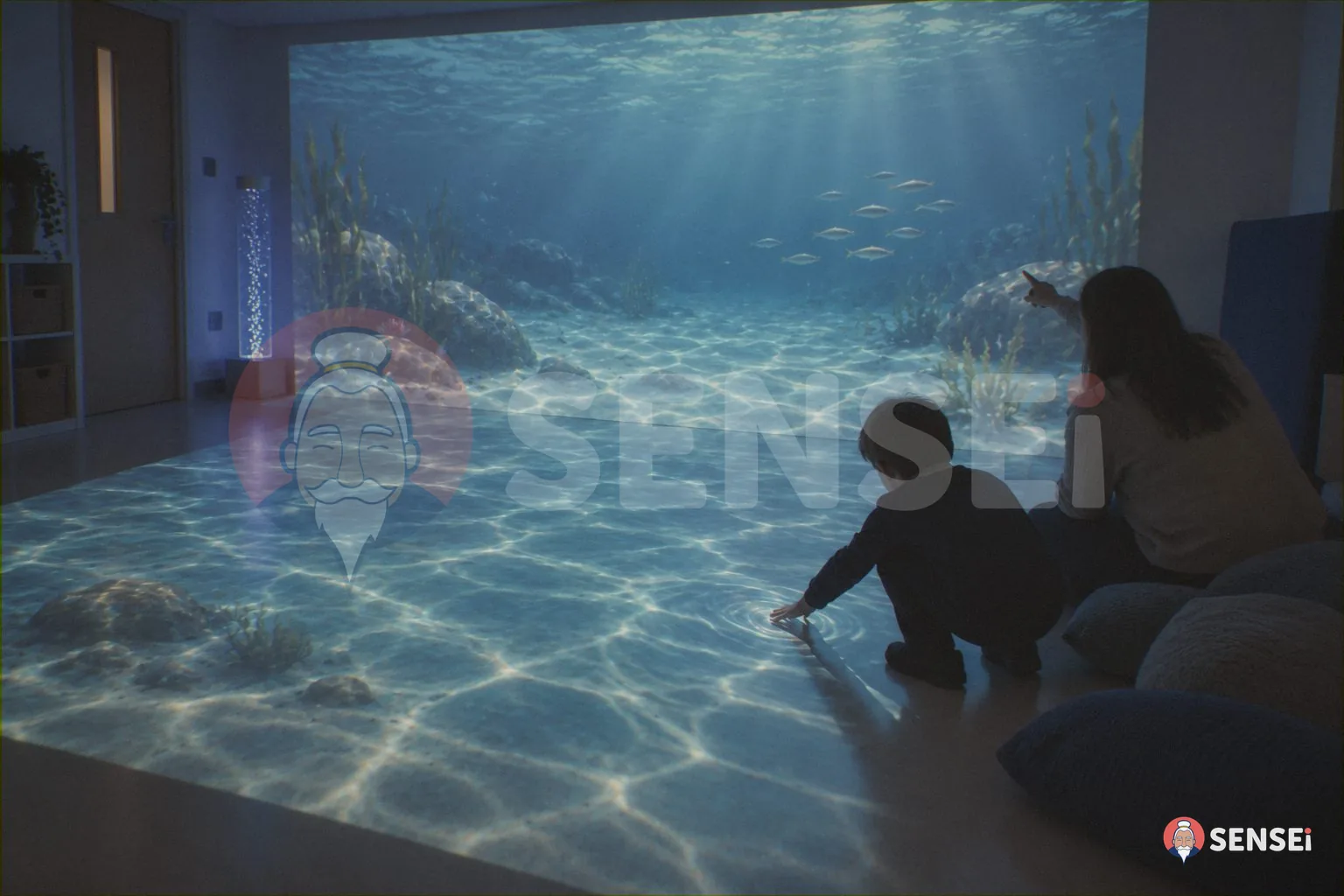
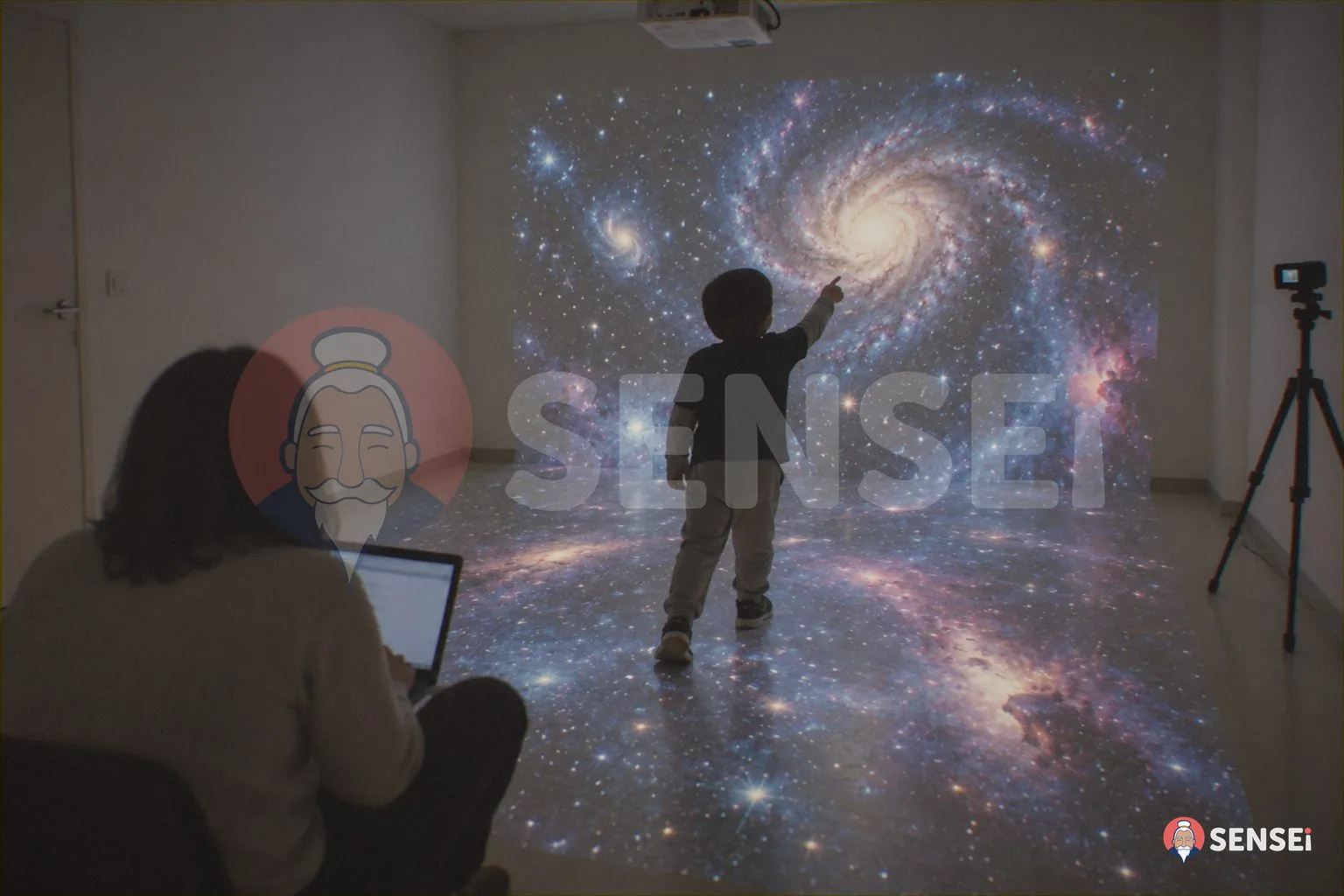
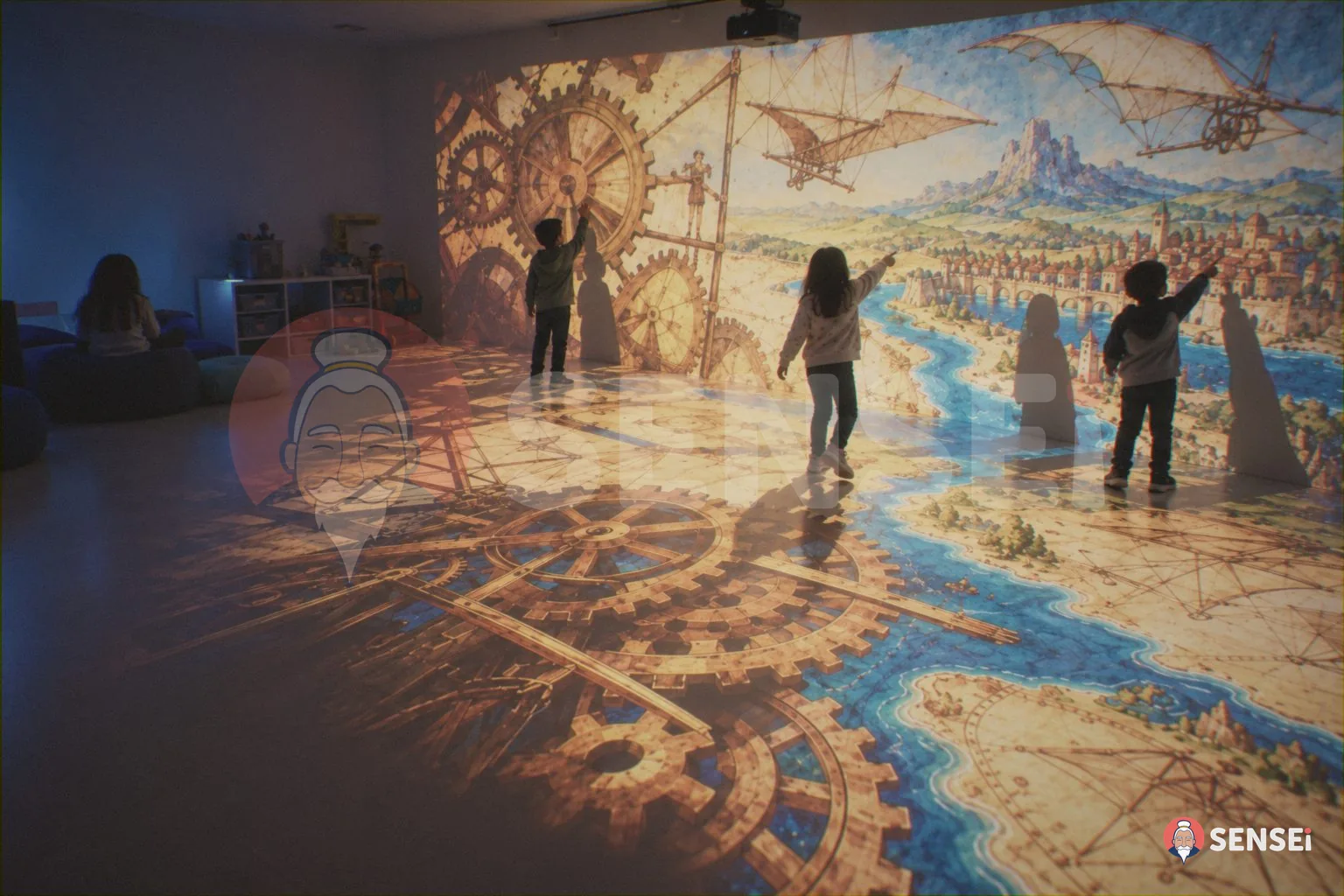
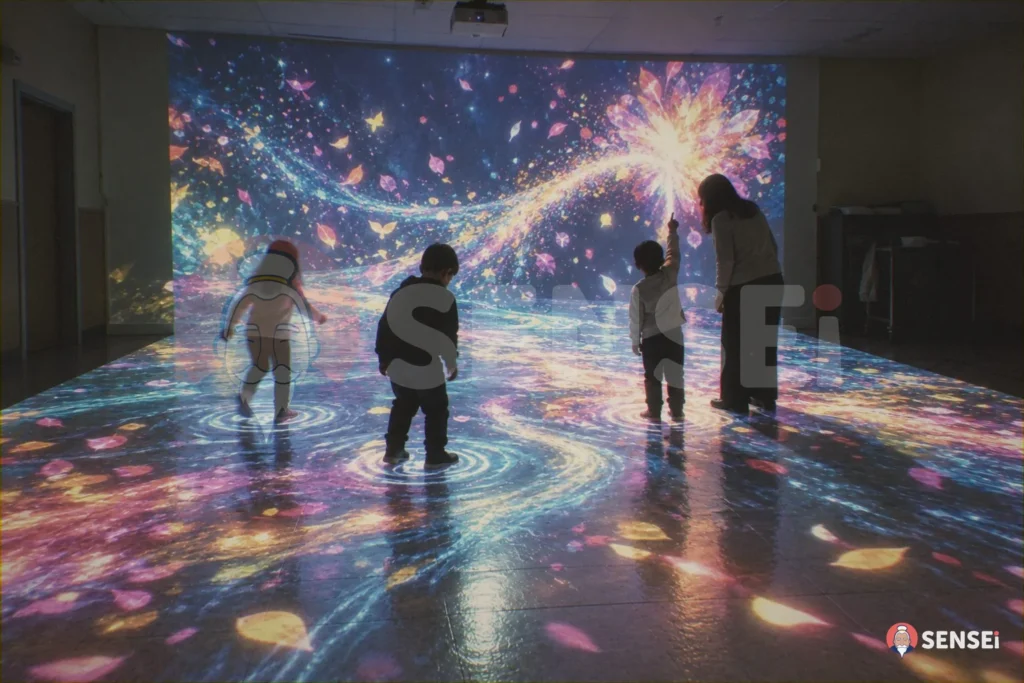
- The child changes images, lights and sounds with their body (gestures, steps, position), with nothing to wear, or with objects and their voice.
- The educator or therapist adjusts intensity, speed and number of stimuli from a tablet, and can stop everything at any time.
- The system records interactions and produces interpretable reports, useful for observing progress.
Interactive does not mean more stimuli. Often it means the opposite: an almost dark environment in which a single gesture by the child turns on a light. It is the child who decides when they want more.
What changes for children and therapists?
When the child is in control, the session changes rhythm. The therapist no longer has to “entertain”: they observe, suggest, wait for the choice. Pointing, a step, a glance become ways of making oneself understood. And every small achievement is documented.
At the Fondazione Angelo Custode in Bergamo, four SENSEi environments are part of the daily work of therapists and educators, with cause-and-effect activities in which pointing becomes a way of communicating; children who work in the room report clearly higher satisfaction with their sessions than with the usual programme. At Gigli del Campo, the room is a safe place where young people with autism aged 13 to 25 practise autonomy.
When should you choose a passive room?
The passive mode remains useful in many situations:
- relaxation at the end of the day or after a crisis;
- people with severe motor disabilities who cannot yet act on the environment, until a suitable mode of interaction is found;
- older people with advanced dementia, for whom the priority is wellbeing (see multisensory stimulation in dementia);
- moments of free exploration, without goals.
The best choice is often an environment that can do both. For a broader comparison, read the differences between an immersive classroom, a Snoezelen room and an interactive floor.
Frequently asked questions
Is an interactive room suitable for all autistic children?
Every child is different. The study points to positive average effects, but individual observation remains essential. What matters is being able to adjust the stimuli and leaving the child the option to stop.
Does the study prove that the interactive room is a therapy?
No. The study compares two ways of using the same room and measures behaviours during short sessions. It suggests that control can create better conditions for learning, not that it cures anything.
Does the child need to know how to use a tablet?
No. The study also used buttons. In a SENSEi room, interaction happens mainly through the body, for example by raising an arm or taking a step.
Can an existing passive room be made interactive?
Often yes. SENSEi integrates with the existing space without building work, and the equipment already there, such as a bubble tube or a soft corner, can stay.
What should be measured to see whether it works?
Attention, participation time, sensory-seeking behaviours, the child’s choices. Noting them before and after a period of use helps to see the change.
Want to see how shared control between child and educator works? Book a demo.
Sources
- Unwin K. L., Powell G., Jones C. R. G. (2022). The use of Multi-Sensory Environments with autistic children: Exploring the effect of having control of sensory changes. Autism, 26(6), 1379-1394. DOI 10.1177/13623613211050176
- Magic Room: A Smart Space for Children with Neurodevelopmental Disorder. IEEE Pervasive Computing
- Gelsomini M. et al. (2019). Magika, a Multisensory Environment for Play, Education and Inclusion. CHI EA 2019
- Garzotto F., Gelsomini M. et al. (2016). Using Brain Signals in Adaptive Smart Spaces for Disabled Children. CHI EA 2016
- Cosentino G., Gelsomini M., Sharma K., Giannakos M. (2023). Interaction Modalities and Children’s Learning in Multisensory Environments. IDC 2023
- Shen T. et al. (2023). Active versus passive distraction for reducing procedural pain and anxiety in children. Italian Journal of Pediatrics
Snoezelen® is a registered trademark of its respective owners.