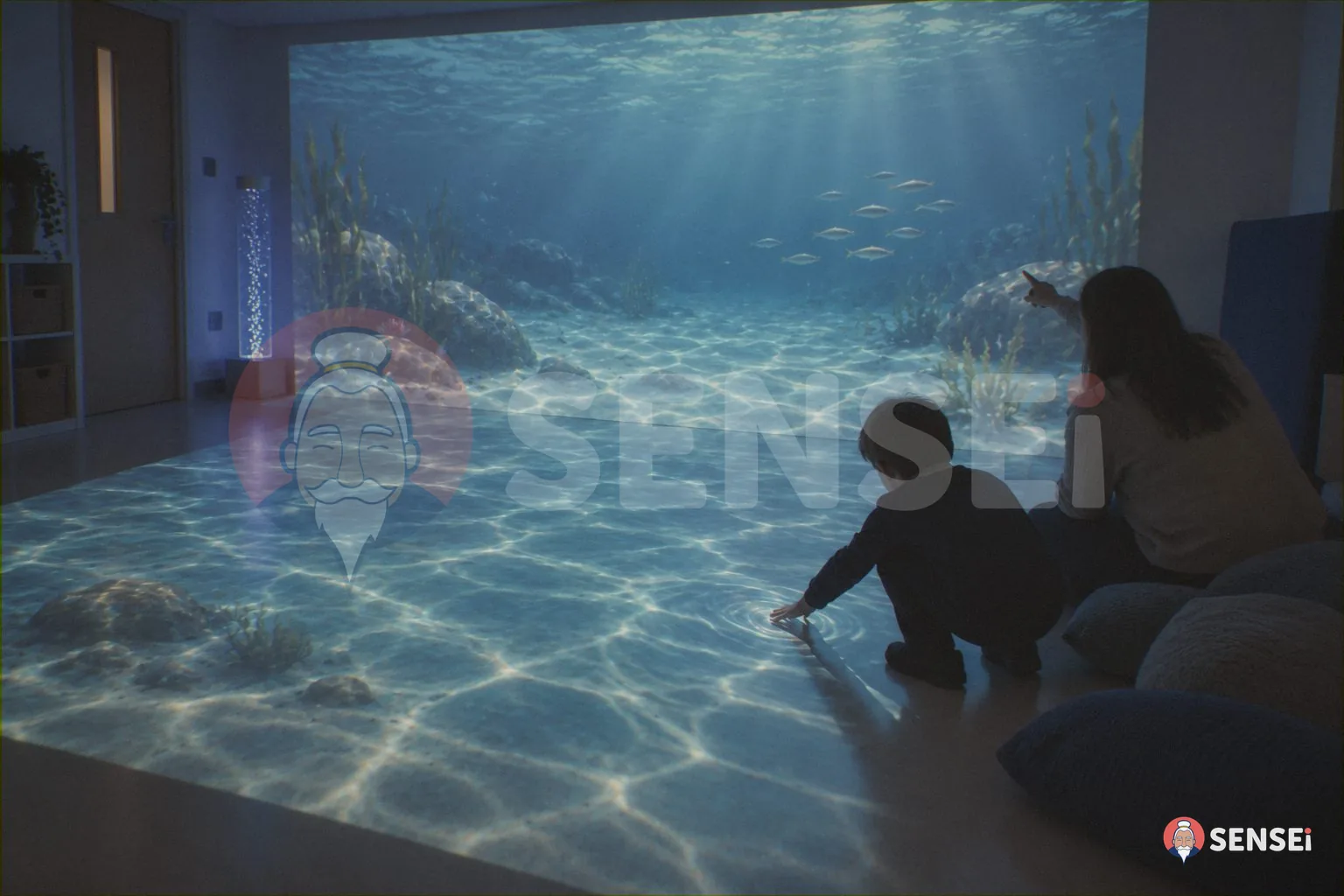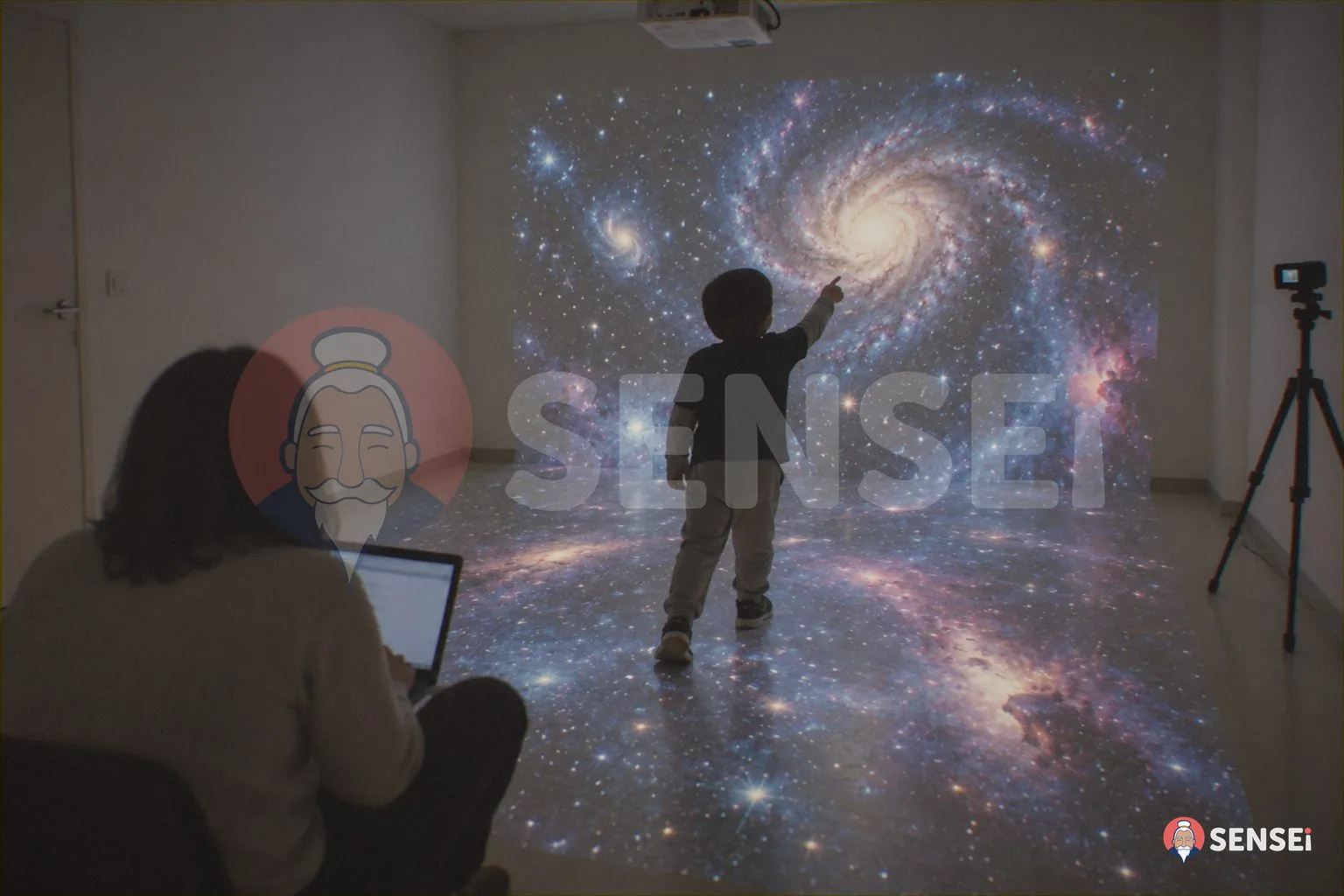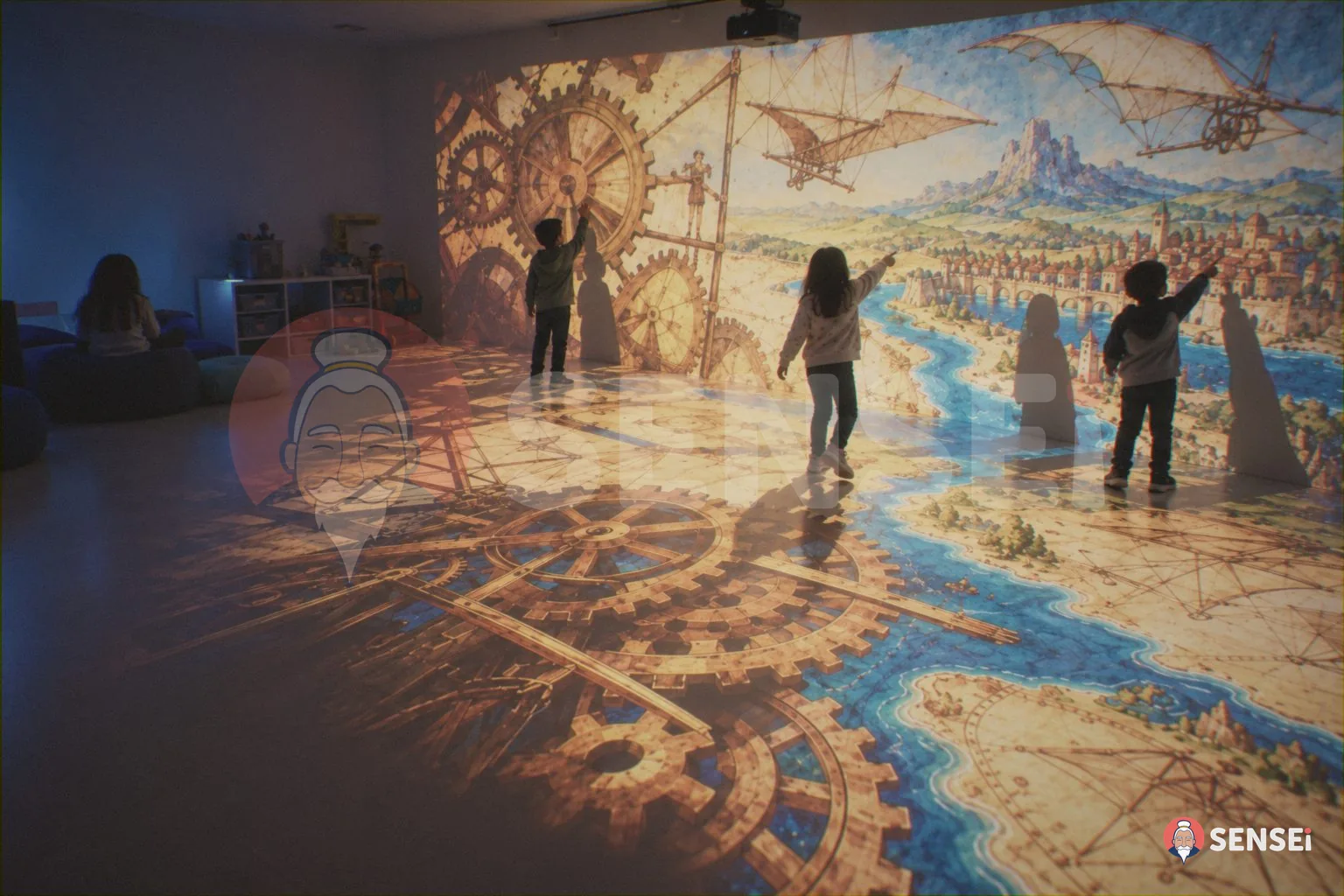

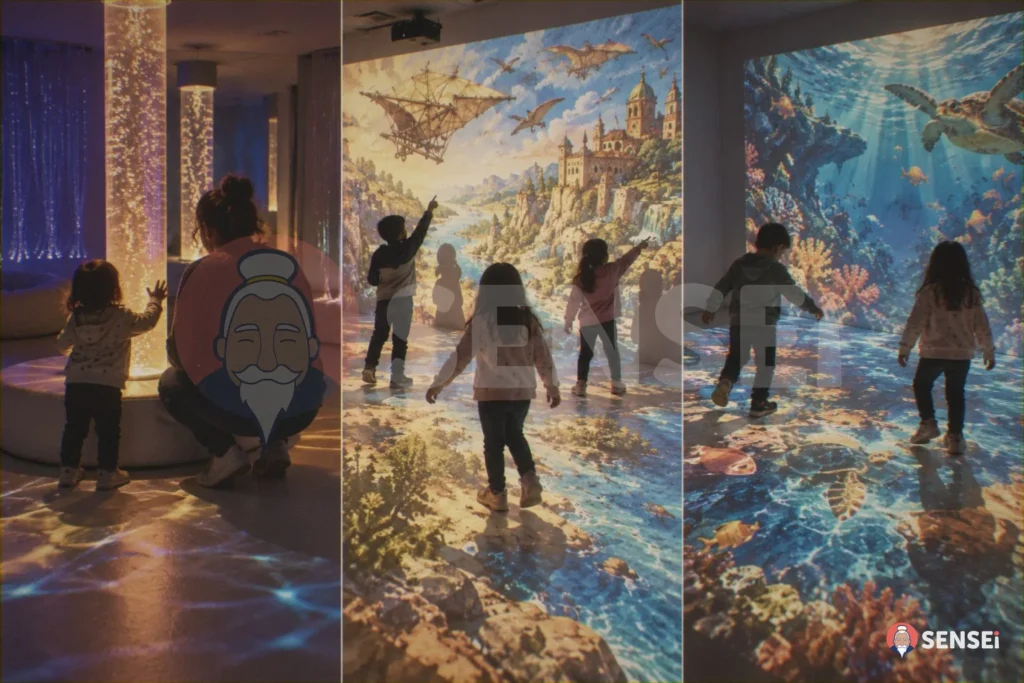
The main difference is the purpose: the Snoezelen® room is designed for relaxation and sensory exploration, the immersive classroom for teaching inside projected content, and the interactive floor for playing and moving on a surface that reacts to footsteps. The number of people involved, the degree of interaction and the role of the adult also change.
This guide compares the three types without going into commercial brands. It is intended for head teachers, teachers, therapists and technical departments who need to choose a space and want to understand what each solution offers, and when it makes sense to combine them.
What is the difference between an immersive classroom and a Snoezelen room?
In short: the Snoezelen room offers sensory stimuli chosen and adjusted by the adult, at a slow pace and often one to one. The immersive classroom turns the walls, and sometimes the floor, into a projected environment in which the class explores educational content. The former works above all on well-being and regulation, the latter above all on learning and participation.
The two are not in competition. Many recent projects, such as SENSEi, start from Snoezelen principles and extend them towards interaction and group work. We discuss this in the article SENSEi: from the Snoezelen sensory room to the inclusive educational experience.
What is a Snoezelen room
The term originated in the Netherlands and combines two Dutch words: snuffelen (to explore) and doezelen (to relax). A typical Snoezelen room is enveloping and slow: soft lighting, gentle visual and tactile stimuli, calm music, sometimes aromas. The aim is to offer a safe and pleasant environment where the person explores at their own pace.
It is used in disability services, in schools and in residences for older people. A systematic review gathers 62 studies on people with intellectual disability or dementia: the most frequently reported effects concern mental health, such as a reduction in challenging behaviour and an improvement in mood. The authors note, however, that details on how the room is actually used are often missing. To learn more: Snoezelen room: what it is, where it comes from, what the research says.
What is an immersive classroom
An immersive classroom is a school space in which the walls and sometimes the floor become an environment to inhabit. The class steps inside the content: an ecosystem, an archaeological site, the solar system. The classroom can be projection-only, showing 360-degree videos and images, or interactive, reacting to gestures, touches and movements.
The difference between the two versions matters a great deal. A projection-only classroom works like a large wraparound screen. An interactive classroom lets pupils act on the content with their bodies, and this opens the way to embodied learning. You will find a complete guide in Immersive classroom at school: what it is, how it works, examples.
What is an interactive floor
An interactive floor is a ground-level surface that comes to life and reacts to footsteps and movements. When a child steps on a projected leaf, the leaf flies away. It is a compact solution, widely used in preschools and rehabilitation centres, because it invites movement and also works with young children who do not yet use tools such as a mouse or a tablet.
The floor is often a single element: one surface, a library of games, use in turns. An interactive wall works in a similar way but vertically, and lends itself to pointing and group games. Find out more in Interactive floor and wall: how they work at school.
The differences in a table
| Aspect | Snoezelen room | Immersive classroom | Interactive floor |
|---|---|---|---|
| Main purpose | Relaxation, exploration, regulation | Learning inside content | Active and cooperative play |
| Interaction | Low: stimuli chosen by the adult | From none (video only) to high (gestures, body) | High, limited to steps and movements |
| People | Often one at a time or a small group | Class or group | Small group, in turns |
| Space | Dedicated, equipped room | Existing or dedicated classroom | A ground-level surface |
| Role of the adult | Accompanies and observes | Leads the lesson | Starts the games and observes |
| Content | Gentle sensory stimuli: light, sound, touch, aromas | Videos, images, educational scenarios | Predefined games |
| Documentation | Usually manual observation | Depends on the software | Depends on the software |
The table describes typical configurations. There are of course many variations: Snoezelen rooms with interactive elements, immersive classrooms with a soft corner, floors integrated into larger rooms.
What research says about interaction and control
A study published in the journal Autism observes 41 autistic children aged 4 to 12 in a multisensory room, with and without the ability to control changes in light and sound. When children are in control, attention increases and some repetitive behaviours decrease. No differences emerge in anxiety and social behaviour.
The research group from which SENSEi originates, in a study with 175 children aged 6 to 10 presented at the ACM IDC conference, compares different ways of interacting in an educational multisensory environment: moving, touching, using objects, speaking. The study describes the advantages and trade-offs of each modality and concludes that the choice of interaction should be designed together with the learning goal. We describe it in the case Touching, moving, speaking: which interaction helps learning.
These results do not say that one type is better in absolute terms. They are, however, the starting point of a body of work that today counts more than 40 scientific publications, available in the Research section. They indicate that the degree of control and the way of interacting are important variables, to be chosen according to the person and the goal. We also discuss this in Interactive or passive room: why the child’s control matters.
Which one to choose for your school or centre?
Before looking at solutions, it is worth answering five questions.
- Who will use the space? A whole class, small groups, one person at a time.
- To do what? Calm down and self-regulate, learn content, move, communicate.
- How much space is there? A dedicated room or a classroom that is also used for other things.
- Who will lead it? Class teachers, support teachers, educators, therapists.
- How will it be documented? Progress needs to be observed and shared with families and services.
If the priority is regulation and one-to-one work, the Snoezelen approach remains very useful. If the priority is teaching the whole class, an interactive immersive classroom is needed. If space is limited and you work with the youngest children, an interactive floor can be a first step. For a complete list of elements, see What to put in a multisensory room.
Can the three types be combined?
Yes, and this is the direction research has taken in recent years. The SENSEi magic room turns an existing room into an adaptive multisensory environment: walls and floor become interactive, light, sound and scents accompany the activity, and everything responds to the gestures and movements of several people at once, with no sensors to wear. The adult guides the experience from a tablet.
The same space can be calm and low-stimulation for an individual session, and become an immersive classroom for a science lesson an hour later. It is designed starting from the most complex needs, and the whole group benefits.
For people, this changes a great deal. The child who needs calm is not separated from the others: they use the same space at a different intensity. The teacher does not have to choose between well-being and teaching. The therapist finds activities co-designed with their own team. At the IC Perlasca in Bareggio the immersive environments accompany pupils from preschool to lower secondary school; at the Autism Centre of the Ospedale San Paolo the same room is both a place for activities and a refuge for self-regulation.
Immersive and multisensory classrooms in Sicily: a concrete example
Sicily shows how widely these types are spreading. With two regional funding calls on immersive teaching (Circular 24 of 2024 and Circular 6 of 2025), around 247 first-cycle schools have already obtained funding for an immersive classroom. In 2026 the Region opened a separate call, dedicated to multisensory classrooms and entitled “Benessere e Inclusione: Realizzazione di Aule Multisensoriali (Snoezelen Room)” (Well-being and Inclusion: Creating Multisensory Classrooms).
Many schools therefore find themselves having, or planning, both an immersive classroom and a multisensory classroom. Understanding the differences helps avoid duplicating equipment and use both spaces consistently. Find out more in Multisensory classrooms in Sicily: guide to the Region’s funding call and in How to fund a multisensory classroom.
Frequently asked questions
Is an immersive classroom a Snoezelen room?
No. The Snoezelen room focuses on relaxation and sensory exploration; the immersive classroom on learning inside projected content. A well-designed space can, however, offer both modes.
Is an interactive floor enough for teaching?
It can be enough for active games and short activities, especially at preschool. Lessons with the whole class usually also require walls and broader educational content.
Is an immersive classroom suitable for autistic pupils?
It can be, if it allows stimuli to be reduced, gives the child control and alternates calm and active moments. Studies indicate that control over sensory changes can support attention.
Is a dedicated room needed?
For a classic Snoezelen room, usually yes. A SENSEi environment, on the other hand, uses the walls and floor of an existing classroom, without building work.
How much does each solution cost?
It depends on the configuration, the space and the services included. Contact us for an assessment of your case.
Want to understand which solution is right for you?
Tell us about your spaces, users and goals: we will show you how the same room can be calm, interactive and educational. Book a demo.
Sources
- Unwin, Powell, Jones (2022), The use of Multi-Sensory Environments with autistic children: Exploring the effect of having control of sensory changes, Autism
- Cosentino, Gelsomini, Sharma, Giannakos (2023), Interaction Modalities and Children’s Learning in Multisensory Environments, ACM IDC
- Testerink et al. (2023), Snoezelen in people with intellectual disability or dementia: A systematic review, International Journal of Nursing Studies Advances
- Regione Siciliana, Scuola: 5 milioni per la didattica immersiva (Circolare 24/2024)
- Regione Siciliana, Istruzione: stanziati altri 3,5 milioni per aule immersive (2025)
- Regione Siciliana, Circolare n. 11 del 30/03/2026, Aule Multisensoriali (Snoezelen Room)
Snoezelen® is a registered trademark of its respective owners.