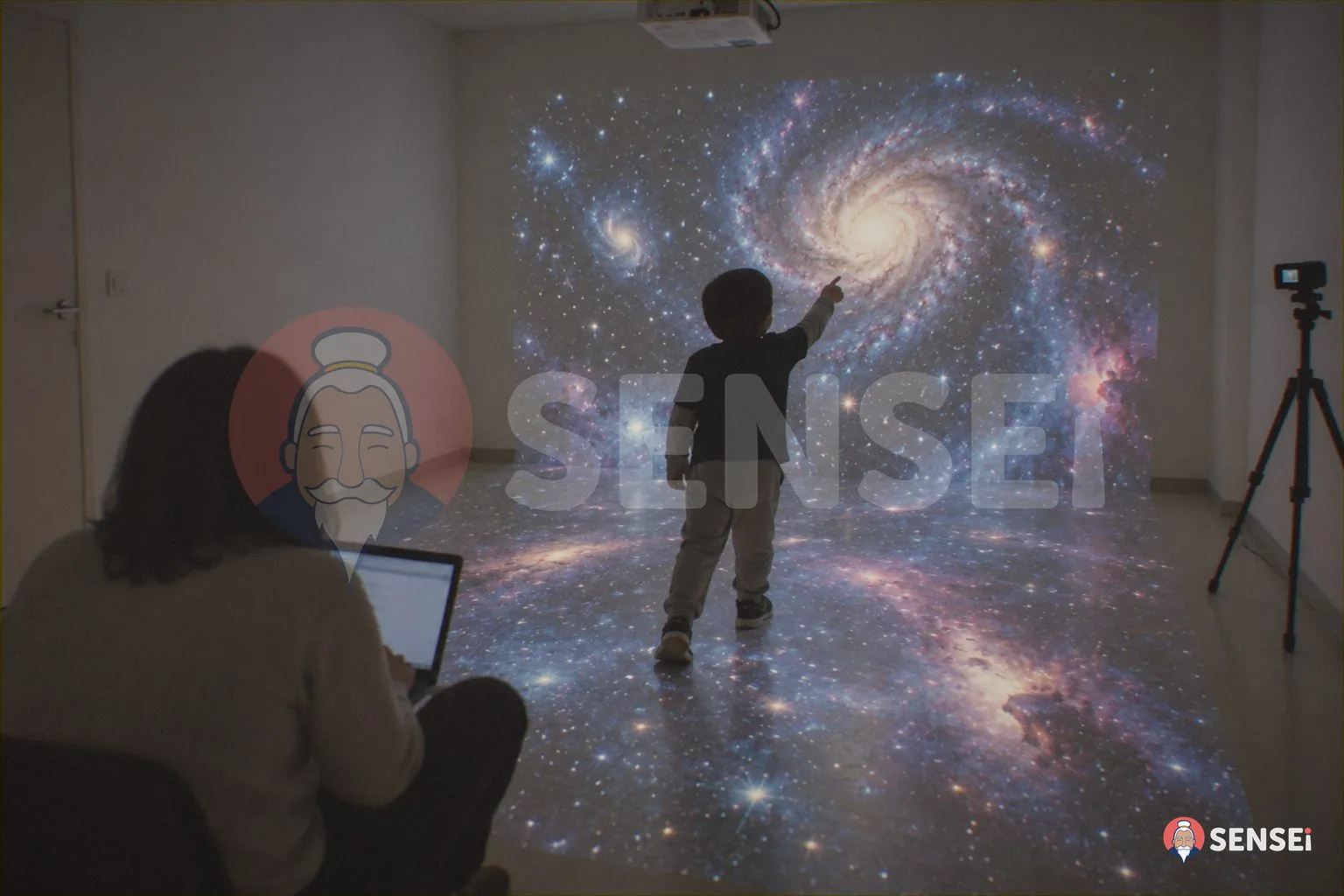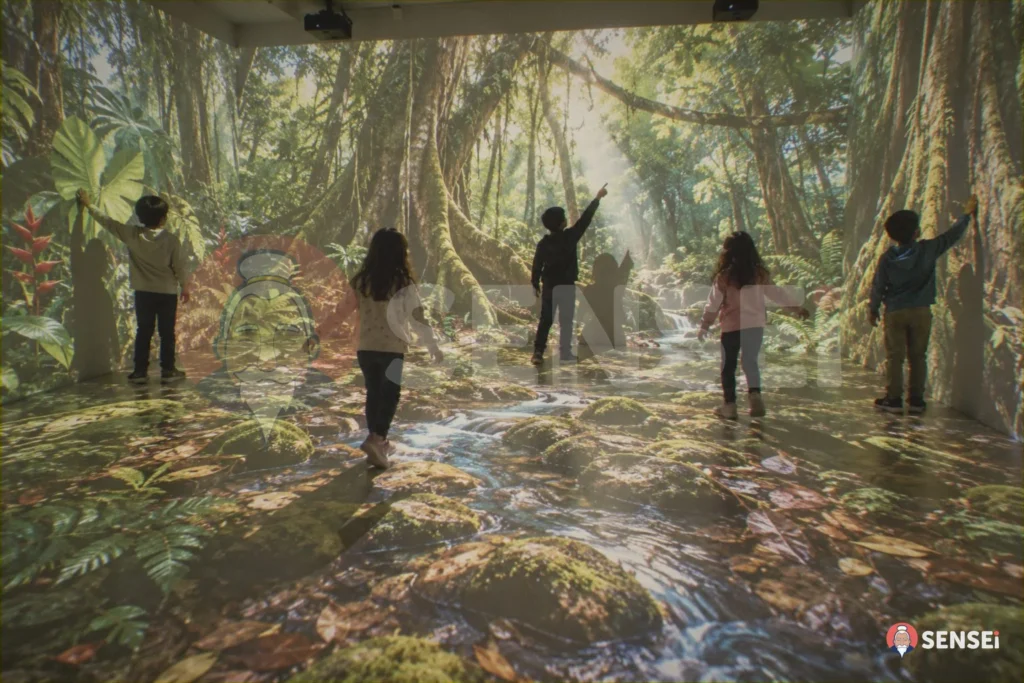
An immersive classroom is a classroom in which the walls and floor become surfaces for projecting content that responds to pupils’ movements, together with synchronised lights and sounds. The class does not watch a screen: it steps inside the lesson and explores it with the body, individually or in groups, guided by the teacher.
In this guide we look at what an immersive classroom is, how it works, what you need to set one up and how it differs from interactive whiteboards and virtual reality. You will then find six lesson examples by school level, guidance on including pupils with special educational needs (SEN), on teacher training and on funding channels.
Immersive classroom: what is it and what does it mean?
Immersive means that the experience surrounds the person living it. In an immersive classroom the whole environment becomes learning material: a seabed on the floor, a historical map on the wall, a sequence of numbers to walk along step by step.
The point is not just the visual spectacle. An educational immersive classroom is interactive: it recognises pupils’ movements, gestures or choices and reacts. This makes it possible to learn by doing, with the body, as the perspective of embodied learning suggests.
When the environment also includes stimuli for the other senses (scents, materials to touch, bubbles), we speak of a multisensory classroom. The two ideas are closely related: for an overview, read the guide to the multisensory room.
What is the difference between an immersive classroom, an interactive whiteboard and virtual reality?
They are different technologies, useful for different purposes. The table helps you find your way.
| Aspect | Interactive whiteboard or display | Virtual reality headset | Immersive classroom |
|---|---|---|---|
| Where you look | A surface in front of the class | A display in front of the eyes | Walls and floor all around the class |
| Who interacts | Usually one person at a time | One person per headset | Several pupils together |
| Use of the body | Limited to hand and pen | Head movements and controllers | Whole body: steps, gestures, jumps, voice |
| Relationship with classmates | The group watches | Each person isolated in their own headset | The group sees each other and collaborates |
| Teacher’s role | Leads from the board | Hard to see what the pupil sees | Guides the experience and sees everything |
The immersive classroom replaces neither the interactive whiteboard nor virtual reality. It is the most suitable choice when you want to combine movement, group work and everyone’s participation, including pupils who struggle with individual or wearable tools.
How does an immersive classroom work?
The principle is simple: the room sees what pupils do and responds. A step, a gesture, a choice change images, sounds and lights in real time. The technology stays in the background; in the foreground are the class, the content and the relationships.
In SENSEi the teacher guides everything from a tablet: choosing the activity, adjusting difficulty and pace, pausing, changing scene. Several pupils play together, with nothing to wear, and the system helps to document the learning pathway. For the teacher, this means being able to watch the class, not the screen: observing who takes the initiative, who helps a classmate, who needs more time. You can see the configurations on the page The magic room.
What do you need for an immersive classroom at school?
You do not need a new classroom. You need a suitable space, a reliable interactive environment and, above all, a shared educational project.
- An environment that responds: walls and floor become surfaces for play and learning, with lights and sounds that accompany the activity.
- Activities designed for teaching: the real heart of the classroom, to be chosen or created according to the curriculum and the class.
- The teacher in charge: the teacher leads the lesson moving among the pupils, without sitting behind a computer.
- A shared project: goals, timetables and ways of use decided together by the teaching staff, so that the classroom belongs to the whole school.
- Space: an area free of bulky furniture, light-coloured walls and the ability to control natural light with curtains or blackout blinds.
- Training: so that the tool becomes everyday teaching and not an occasional event.
With SENSEi the technology is installed on the ceiling and the existing walls are used, with no building work. For a reasoned list of multisensory elements, see the guide on what to put in a multisensory room.
Immersive classroom examples: six lessons by school level
Here are six concrete ideas. They are design examples, to be adapted to the class and the curriculum goals.
Preschool: the journey of colours
Large patches of colour appear on the floor. The teacher calls out a colour and the children jump to reach it. The room’s lights change colour with each discovery. The focus is on colour recognition, listening and coordination. More ideas are on the page about preschool.
Preschool: the seasons in the woods
The wall shows a wood that changes with the seasons. The children move their arms to make the leaves fall or the snow come down, and listen to the sounds of each season. It is an observation and language activity, which can be enriched with materials to touch.
Primary school: a number line to walk along
A number line appears on the floor. Pupils solve additions and subtractions by moving forwards and backwards with their bodies. The system confirms the correct position with a sound. Movement makes reasoning visible.
Primary school: inside the water cycle
The walls show sea, clouds and mountains. In groups, pupils trigger the phases of the water cycle with gestures: evaporation, condensation, precipitation. Each group then explains one phase to the class. For more ideas see the page about primary school.
Lower secondary school: integers with the body
Students move along a projected line to represent operations with positive and negative numbers. This is the type of activity studied with UC Berkeley and NTNU, described further on.
Secondary school: an ancient city to explore
The walls show the reconstruction of an ancient city. Students choose a route, gather clues and discuss hypotheses in groups. They practise critical thinking, collaboration and subject-specific vocabulary. Find out more on the page about secondary school.
How do you organise a lesson in the immersive classroom?
An effective lesson has three moments, just like a good lesson in the classroom.
- Before: the teacher defines the goal, chooses or creates the activity and decides how to divide the class. It is often best to work in groups, alternating between those who act and those who observe.
- During: the rules are explained calmly, there is a trial run and then off you go. The teacher observes, follows up with questions and adjusts the difficulty from the tablet.
- After: back in the classroom, the class discusses what they discovered. Reworking it verbally, in writing or in drawings consolidates the learning.
Mistakes to avoid
- Using the classroom only as a reward or for fun, without an educational goal.
- Offering too many stimuli at once: lights, sounds and images must serve the activity.
- Bringing the whole class in at the same time when the activity requires space and turn-taking.
- Forgetting documentation: without observations it is hard to understand what works.
What does research say about learning in an immersive classroom?
The research on which SENSEi is based offers some useful insights, always to be read with caution.
- In the IMAGINE project, presented at the ACM CHI conference, children interact with content on walls and floor using their bodies and gestures. A controlled study with 48 pupils aged 6 to 8 points to educational potential, including in comparison with traditional teaching.
- With MOVES the research group conducts a field study with 175 children aged 6 to 10 and compares five ways of interacting (feet, hands, cards, wand and voice). Differences emerge in how children engage, along with concrete guidance for designing activities.
- A study published in the British Journal of Educational Technology, with UC Berkeley and NTNU, involves 29 lower secondary students across the three year groups working on integer arithmetic by moving around the room, with feedback from the system and support from a teacher. The work analyses how artificial intelligence and the teacher can work together.
The common message is that technology works best when the teacher stays at the centre. These are just some of the more than 40 scientific publications by the research group from which SENSEi was born, which began at Politecnico di Milano with the Magic Room and Magika projects. We discuss this in the article on hybrid teaching intelligence. All publications are in the Research section.
Immersive classroom and inclusion: how to involve pupils with SEN
An immersive classroom can be a tool for inclusion, provided it is well designed. SENSEi follows the principle of reverse inclusion: design starts from the most complex needs, so that the activities work for the whole class.
- Multiple channels: every piece of content is offered through images, sounds, text and, where needed, pictograms for augmentative communication.
- Multiple ways to take part: one pupil can move across the whole floor, another can interact with a gesture or with their voice.
- Adjustment: the teacher can reduce lights, sounds and speed for those who are sensitive to stimuli.
- Roles in the group: everyone has a task, so no one is left as a spectator.
- Consistency with individual plans (PEI and PDP): individual goals translate into activities and observations that can be documented.
A practical example. In the number line activity, a pupil with motor difficulties can indicate the answer with a hand gesture while a classmate moves for them; a pupil who cannot read yet can count using sounds; a quicker pupil can become the group’s tutor. The same activity, with small adaptations, involves the whole class. Research on movement-based activities in classes with autistic pupils observes, among other things, more social initiatives towards classmates during collaborative play.
What changes for the school: real examples
When an immersive classroom truly becomes part of school life, the way people are together changes. Pupils wait their turn, help each other, tell their classmates what they have discovered. Teachers find a place to try new forms of lessons and to observe the class from a different perspective.
At IC Perlasca in Bareggio, SENSEi immersive environments are rethought together with the teachers for an entire school institute, from preschool to secondary. In Sicilian primary and lower secondary schools, immersive classrooms are built with local technicians and also host activities that tell the story of the island. Two different ways of turning the classroom into a project for the whole school community.
Teacher training: why it is decisive
An immersive classroom is not just a bigger projector. Using it well requires skills in instructional design, group management and observation. Training should include practical use of the system, creating activities and documenting results.
SENSEi supports schools with training pathways and with Eureka, the platform for creating and sharing activities, also with the help of artificial intelligence.
How is an immersive classroom funded?
Schools have used various channels. Italy’s Piano Scuola 4.0, linked to investment 3.2 of Mission 4 of the PNRR (National Recovery and Resilience Plan), has funded the transformation of classrooms into innovative environments and explicitly mentions technologies that support the immersive experience. Some Regions have published dedicated calls: the Regione Siciliana, for example, funded immersive classrooms with two circulars in 2024 and 2025.
Calls change often and have precise rules on expenses, timelines and reporting. We have collected practical guidance in the guide on how to fund a multisensory classroom.
Frequently asked questions
What is an immersive classroom, in simple terms?
It is a classroom in which the walls and floor show content that reacts to pupils’ movements. The class learns by moving inside the lesson instead of watching it on a screen.
How much space does an immersive classroom need?
It depends on the chosen configuration. In general you need an area free of bulky furniture and controllable lighting. We assess the space together with the school.
Is an immersive classroom suitable for preschool?
Yes, with short activities based on movement and play, and with carefully adjusted stimuli. The teacher guides and adapts the experience to the children’s age.
How much does an immersive classroom cost?
It depends on the configuration, the training and the services chosen. Contact us for a tailored proposal.
Do you need a technician to use it every day?
No. The teacher starts and guides the activities from a tablet. The initial training is there so you can use it independently and design new lessons.
Does an immersive classroom replace traditional teaching?
No. It is an additional tool, useful for certain activities and goals. It works best when integrated into the class’s planning.
Would you like to try an immersive classroom with your school?
We will show you how it works and which activities you can do with your classes. Book a demo.
Sources
- Gelsomini M., Leonardi G., Garzotto F. Embodied Learning in Immersive Smart Spaces. ACM CHI 2020
- Cosentino G., Gelsomini M., Sharma K., Giannakos M. Interaction Modalities and Children’s Learning in Multisensory Environments. ACM IDC 2023
- Cosentino G., Gelsomini M., Giannakos M. MOVES: Going beyond hardwired multisensory environments for children. ACM IDC 2023
- Cosentino G. et al. Hybrid teaching intelligence: Lessons learned from an embodied mathematics learning experience. British Journal of Educational Technology, 2024
- Bhattacharya A., Gelsomini M., Pérez-Fuster P., Abowd G.D., Rozga A. Designing motion-based activities to engage students with autism in classroom settings. ACM IDC 2015
- Italian Ministry of Education, Piano Scuola 4.0
- Regione Siciliana, Education: a further 3.5 million allocated for immersive classrooms (2025)