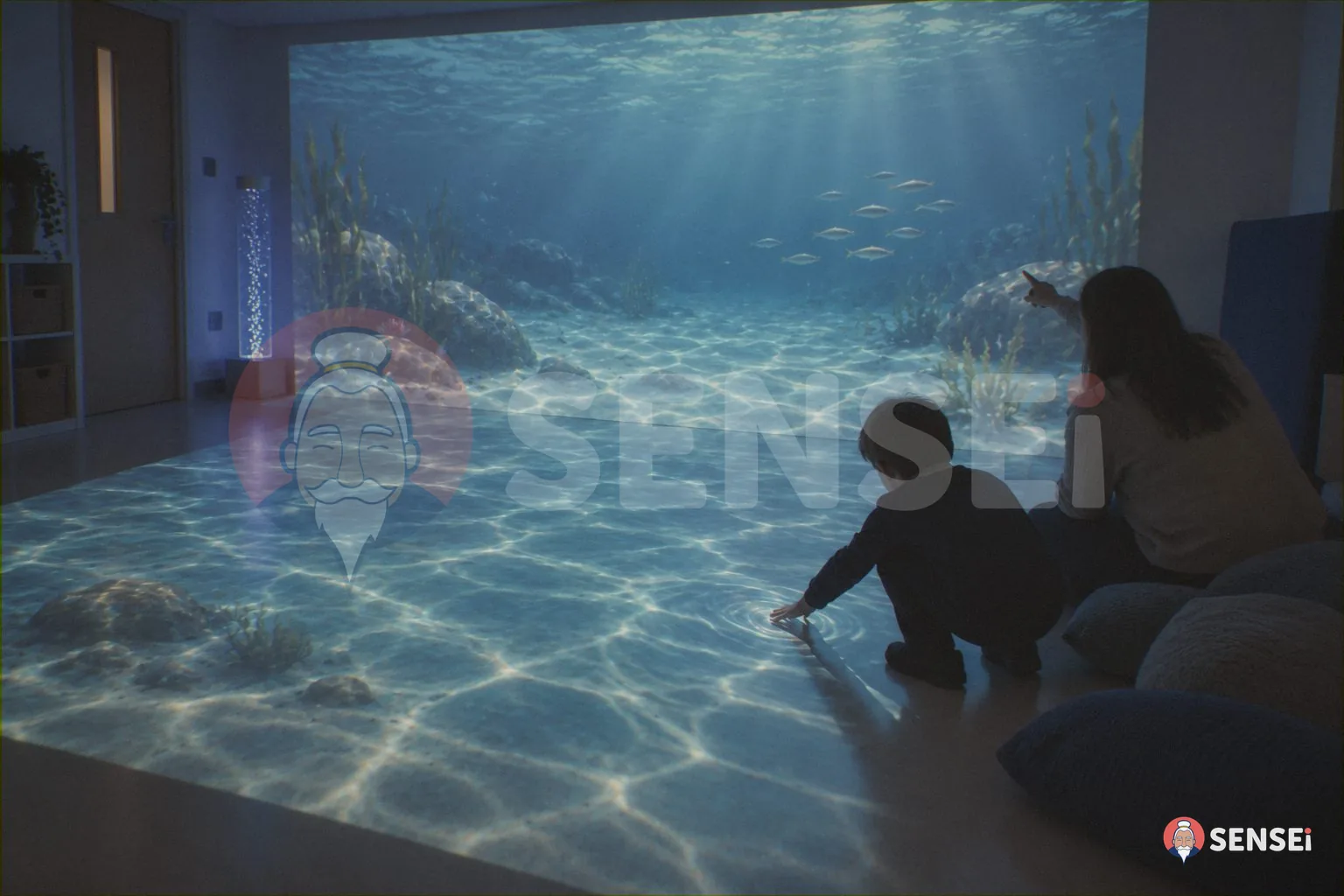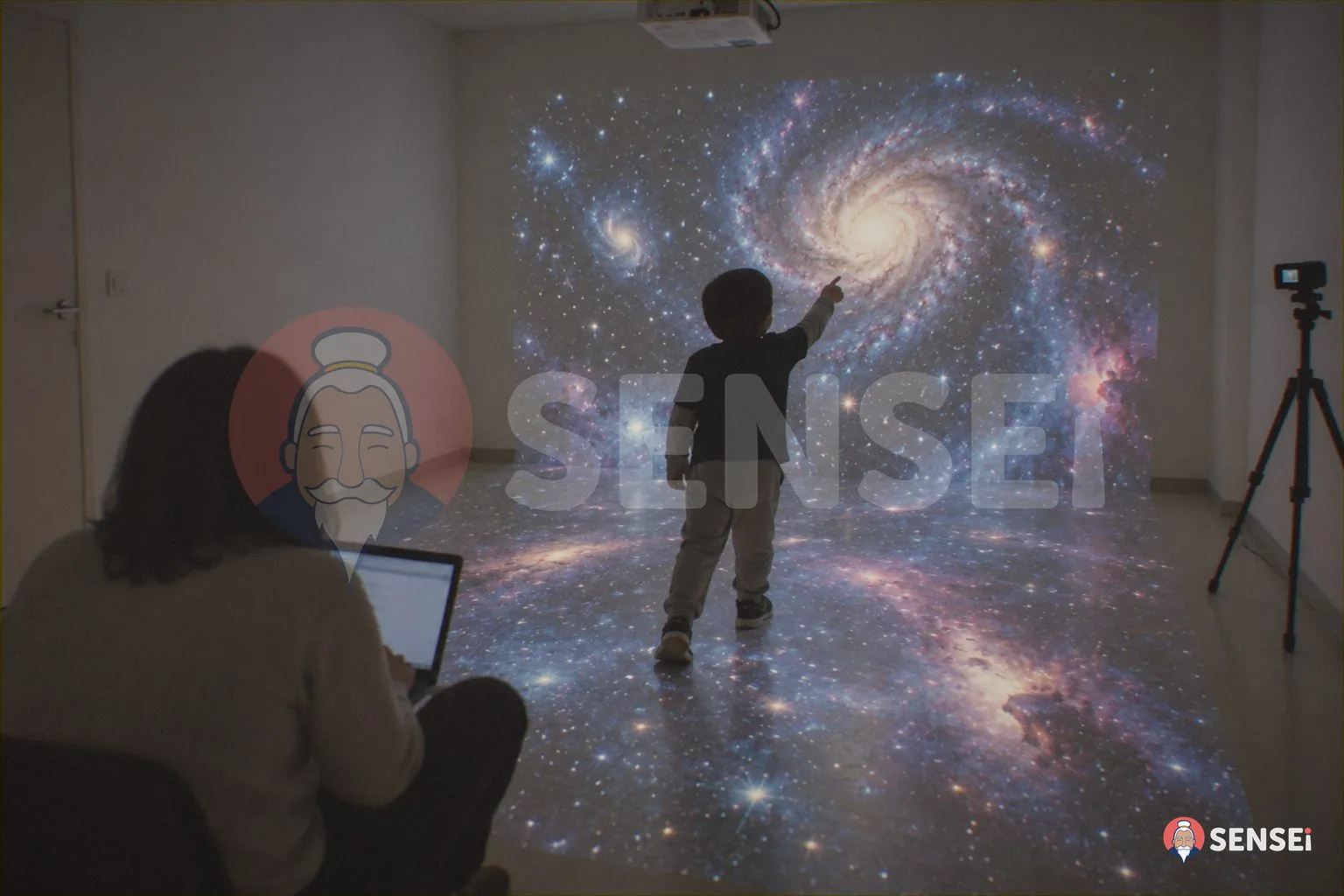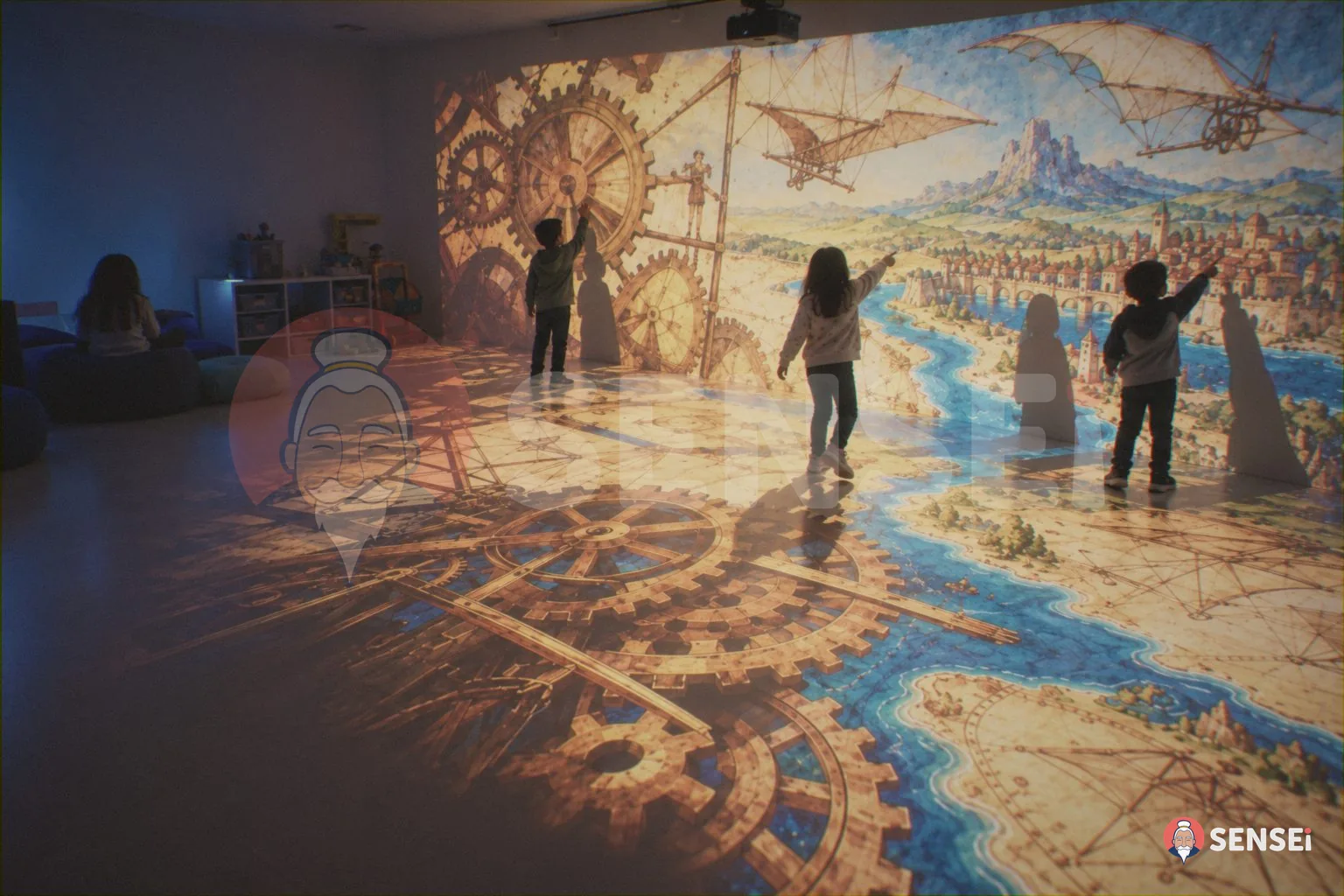

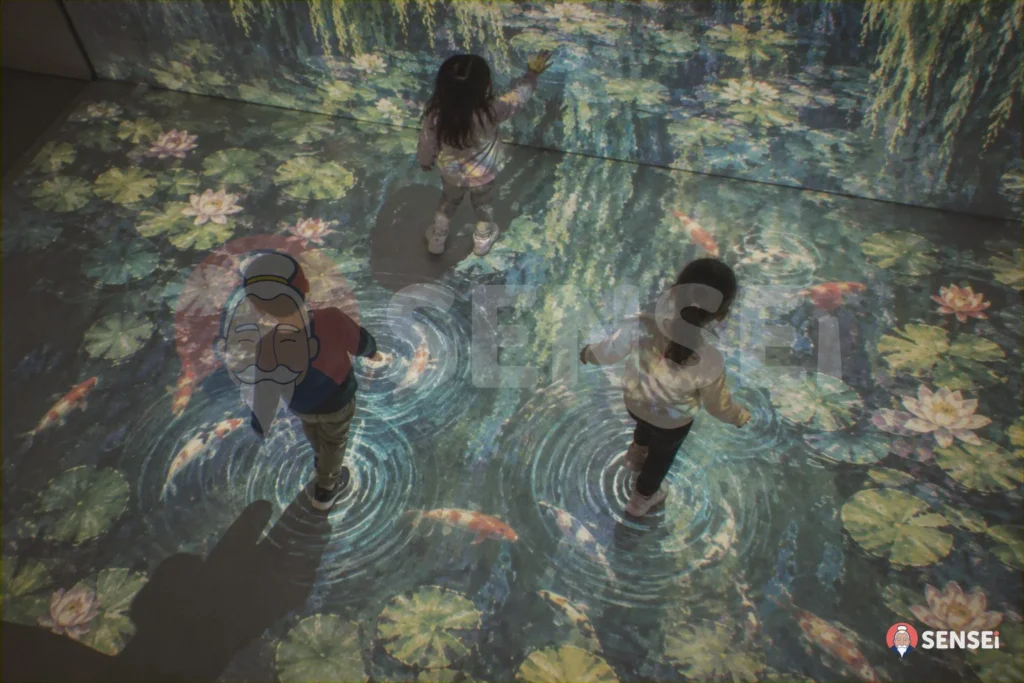
An interactive floor is a projection on the ground that reacts to children’s steps and movements; an interactive wall does the same with gestures and touch. The image “sees” whoever moves and responds with colours, sounds and animations, with nothing to wear.
At school they are used for learning through movement: counting by jumping, recognising letters by walking, exploring a natural environment with the whole body. In this guide we look at how they work, how they are used in preschool and primary school, what the research says and what changes for children and teachers.
How does an interactive floor work?
From a child’s point of view it is very simple: they come in, walk and the floor responds. Underfoot the water ripples, a leaf flies away, a number lights up.
Behind it lies a simple idea. An image projected from above, a system that recognises where the children are and how they move, and software that turns those movements into visual and sound responses. The technology stays up high, the floor stays clear.
What matters at school is that the teacher always stays in control: they choose the activity, adjust the difficulty, pause. The MOVES research project, on which the SENSEi research group is working, studies precisely how to take these experiences beyond permanently wired rooms, while leaving teachers in control.
And the interactive wall?
The interactive wall uses the same principles, but the image is vertical. Children interact with arm gestures, with their whole body or by touching the surface. It is suited to activities of exploration, storytelling, choosing between options and group games in front of a large screen.
Unlike an interactive whiteboard, the interactive wall does not require a single child to come up to the board. Several children move together and the system recognises them at the same time. For the differences between the various environments, read immersive classroom, Snoezelen® room, interactive floor: the differences.
Floor or wall: which to choose?
You do not have to choose just one. Many schools start with one surface and add the other later.
| Aspect | Interactive floor | Interactive wall |
|---|---|---|
| Main interaction | Steps, jumps, body position | Arm gestures, touch, whole body |
| Most suitable ages | Nursery, preschool, primary | Preschool, primary, secondary |
| Strengths | Movement, spatial orientation, path games | Storytelling, choice, richer content to observe |
| Things to watch | Flat, non-slip surface | Clear space in front of the wall |
| For people with reduced mobility | Must be designed to respond to wheelchairs and small movements too | Often more accessible, even when seated |
When wall and floor work together, the room becomes a true immersive environment. This is what we describe in the guide to the immersive classroom.
How is the interactive floor used in preschool?
In preschool the interactive floor is often the most natural surface. Young children learn by walking, jumping, rolling. Some examples:
- The pond. Ripples and fish darting away appear underfoot. Goals: cause and effect, attention.
- The colours of the meadow. The educator calls out a colour and the children run onto the right flowers. Goals: colours, listening, rules.
- The animal trail. Following the footprints to reach the den. Goals: orientation, coordination.
- Autumn leaves. Kicking the leaves and watching them fly. Goals: free movement, language (“many”, “few”, “near”).
For seasonal ideas, see the activities for Carnival and for autumn.
And in primary school?
In primary school the floor and wall become teaching tools for the different subjects:
- Maths. A number line on the floor to move along for addition and subtraction.
- Italian. Letters and syllables to reach in order to build words.
- Science. An ecosystem on the wall to explore with gestures.
- Geography and history. Maps to walk across, historical scenes to move around in.
At ICS Leonardo da Vinci in Cornaredo teachers work with more than 27 activity templates in which the content changes but not the format: the same game works for Italian, maths, science or geography. You will find more ideas in the article on the multisensory classroom in primary school.
What does research say about interactive floors and walls?
The research from which SENSEi originates has been studying these environments for more than ten years, with real children in real schools, and counts more than 40 scientific publications.
- Learning with the body. The study Embodied Learning in Immersive Smart Spaces uses a controlled design to evaluate a space in which 48 children aged 6 to 8 use their bodies to interact with content on the walls and floor. The research group highlights its educational potential compared with traditional methods.
- Which interaction? The study Interaction Modalities and Children’s Learning in Multisensory Environments involves 175 children aged 6 to 10 and five ways of interacting: feet, hands, cards, wand and voice. The results show differences between the modalities and offer design guidance: each modality has advantages and limitations.
- The floor that travels. The Ahù project brings cooperative and competitive games to school floors with a portable solution, to encourage engagement, collaboration and learning.
The message for schools is clear: the value lies not in the projection itself, but in how the activity is designed and led by the teacher.
How can they be used safely?
Interactive floors and walls invite movement. That is why safety is mainly about the space.
- A flat, matt, non-slip floor surface.
- Non-slip socks or indoor shoes, according to the school’s rules.
- Clear space in front of the wall, to avoid collisions when children run.
- No cables on the floor: the technology stays on the ceiling.
- Group sizes suited to the space, taking turns if necessary.
- Animations without rapid flashing: according to the Epilepsy Society, lights flashing between 3 and 30 times per second can cause problems for people with photosensitive epilepsy.
For the full set-up, read how to set up a multisensory classroom.
How do floor and wall fit into a SENSEi environment?
In a SENSEi environment, floor and wall are not two separate games. They are parts of a single magic room, in which lights, sounds, scents, bubbles and physical objects also follow the same story.
The room recognises the gestures, movement, touch and voices of several people at once, with nothing to wear. The teacher or therapist leads the experience from a tablet and, at the end, reads reports that help them understand what happened. Activities are created with Eureka and can use content such as WordWall, YouTube or ARASAAC pictograms.
The impact is most visible in accessibility. In Cava de’ Tirreni, in the room at La Nostra Famiglia, the wall responds to the whole body and even a child in a wheelchair plays with the others. It is the educators themselves who ask to extend the interaction to the floor, to enrich the motor activities.
For the full picture, go back to the guide what to put in a multisensory room. For configurations, visit The magic room and the SENSEi for schools page.
In the SENSEi room
Interactive wall
In a SENSEi room the wall is not just a screen: it is connected to the floor, the lights and the sensory devices. The same scene continues from the wall to the floor and changes together with the sounds and colours of the room, so the whole body enters the experience.
- An aquarium to stroke: the fish come closer to those who move their hand slowly and swim away from sudden movements: a concrete way to practise regulating gestures.
- Cause and effect: each touch produces a different sound and colour: it is the first activity for those who are discovering that their actions change the world.
- Memory and matching: giant cards to turn over by hand, with images chosen by the teacher or therapist.
- Letters and numbers to catch: for primary school, recognition games in which you answer by touching the right answer.
- Finger drawing: colours and traces that stay on the wall, to be erased with a wide sweep of the arm.
- Branching stories: the class chooses how the story continues by touching one of the characters.
Interactive floor
In the SENSEi room the floor continues the scene on the wall and turns the space into a single environment. It is the device that most invites movement, including for those who use a wheelchair: the paths can be crossed on wheels just as on foot.
- Autumn leaves: kick and gather the leaves, then count them by colour.
- The river with stepping stones: jump from one stone to the next without falling into the water: balance, motor planning, turn-taking.
- Hopscotch and paths: jumping and coordination games for gross motor skills.
- Chasing the light: a spot of light moves and the child follows it: joint attention and spatial orientation.
- Wheelchair route: roads, bridges and rivers to cross on wheels, designed for users with motor disabilities.
- Maps to explore: the class walks across the map and discovers places, rivers and cities.
Discover all the tools in the guide to the tools of the SENSEi room.
Frequently asked questions
Does the interactive floor work with many children at once?
Yes, if the system recognises several people at the same time, as SENSEi does. The right number depends on the space and the activity.
Is a special floor needed?
No, but it must be light-coloured, flat, matt and non-slip. Soft mats should be kept in the calm area.
Can a child in a wheelchair use the interactive floor?
Yes, if the activities are designed to respond to wheelchairs and small movements too. The wall is often more accessible.
Are an interactive floor and an interactive whiteboard the same thing?
No. The interactive whiteboard is designed for one child at a time at the board. Interactive floors and walls engage the whole body and several children together.
How much does an interactive floor cost?
It depends on the configuration and the space. Contact us for a tailor-made proposal.
Want to see children and projections interacting live? Book a demo of a SENSEi environment.
Sources
- Cosentino, Gelsomini, Giannakos, MOVES: Going beyond hardwired multisensory environments for children, IDC 2023.
- Cosentino, Gelsomini, Sharma, Giannakos, Interaction Modalities and Children’s Learning in Multisensory Environments, IDC 2023.
- Gelsomini, Leonardi, Garzotto, Embodied Learning in Immersive Smart Spaces, CHI 2020.
- Gelsomini et al., On the Effects of a Nomadic Multisensory Solution for Children’s Playful Learning, ISS 2018.
- Epilepsy Society, Minimising risk from flashing lights.
Snoezelen® is a registered trademark of its respective owners.