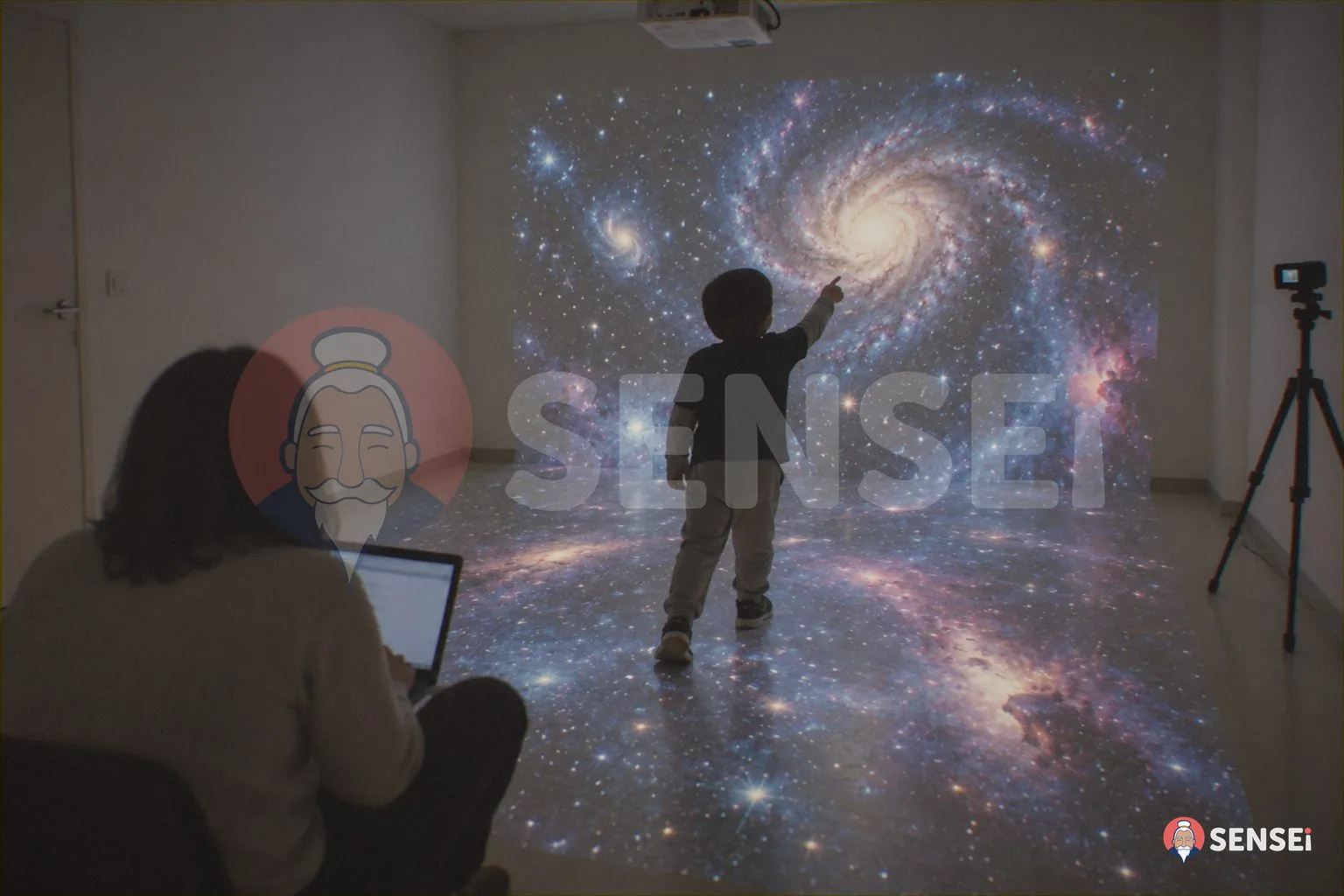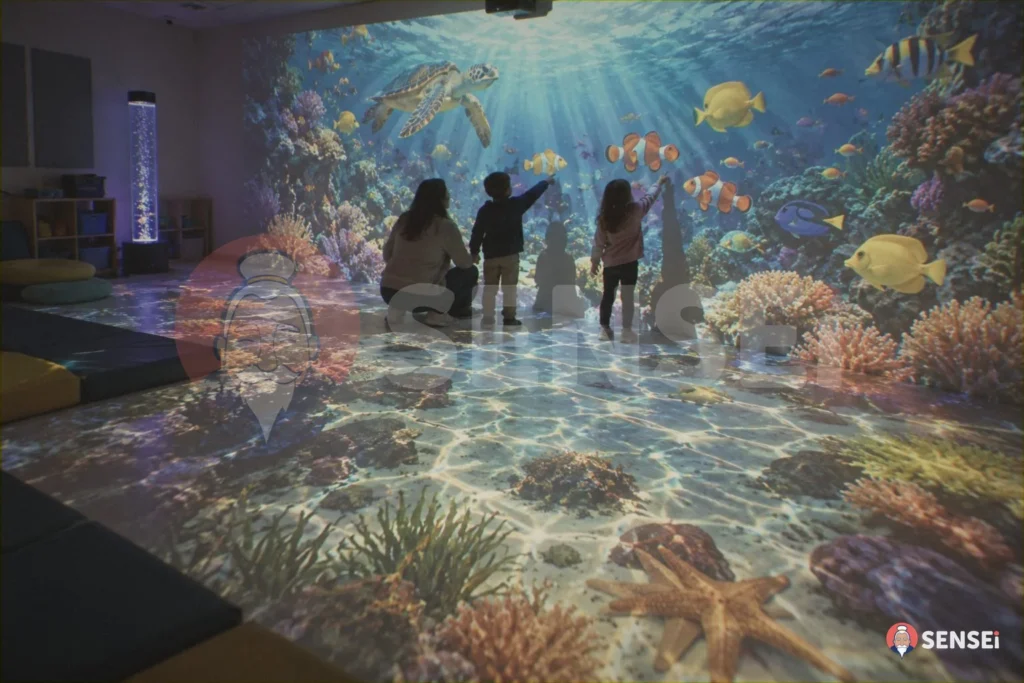
A multisensory room is an environment designed to stimulate sight, hearing, touch, smell and movement in a controlled way, with lights, sounds, projections, scents and materials to touch. It is used to support well-being, emotional regulation, communication and learning, at school, in therapy centres, in hospitals and in care settings for older people.
In this guide we explain what a multisensory room is, what experiences it offers, who it is for and how a session unfolds. We look at the difference between a passive room and an interactive room, what the research really says (without promises and with the limits of the evidence) and what changes, every day, for children, teachers and therapists.
What is a multisensory room?
It is a space in which sensory stimuli are not random but chosen, dosed and regulated by an adult. The light can be dimmed or coloured, sounds can be turned up or switched off, materials can be explored with the hands and the body. The aim is to create an experience tailored to the person living it.
In everyday language many names are used: sensory room, multisensory environment (multisensory environment, MSE), multisensory classroom, immersive room. The differences are more a matter of usage than of substance. When the room is in a school it is often called a classroom; when it is designed for therapy it is called a room or environment.
The idea has its roots in the Snoezelen® method, developed in the Netherlands in the late seventies by Jan Hulsegge and Ad Verheul to offer well-being and sensory experiences to people with intellectual disabilities. We discuss it in detail in our in-depth article on the Snoezelen room. Today, alongside traditional rooms, there are interactive environments in which the room responds to the movements and choices of the people inside it.
Which senses does it engage and what experiences does it offer?
A well-designed multisensory room works on five areas: sight, hearing, touch, smell and the body senses (proprioception and the vestibular system, that is, the perception of position and balance). The table summarises the most common experiences and what they can be used for.
| Sense | Examples of experiences | What it can be used for |
|---|---|---|
| Sight | A world that appears on walls and floor, a light that changes colour, bubbles rising slowly | Attracting and sustaining attention, relaxing or activating |
| Hearing | Music, sounds of nature, voices, a sound that responds to a step or a gesture | Creating an atmosphere, signalling beginning and end, giving feedback |
| Touch | Fabrics, soft objects, rough and smooth surfaces to explore with the hands | Exploring, discriminating, regulating through contact |
| Smell | A scent that accompanies a scene: the forest, the sea, freshly baked bread | Making the experience richer and more memorable |
| Body and movement | Jumping, walking, lying down, curling up in a soft corner, playing with the whole body | Supporting balance, coordination and body awareness |
You do not need everything. What matters is coherence between experiences and goals: a few well-chosen activities are better than a room full of effects. We have put together a reasoned list, with guidance on safety and priorities, in the guide on what to put in a multisensory room.
Multisensoriality: why engage several senses together?
In everyday life we learn with our whole body: we look, listen, touch and move at the same time. The embodied cognition perspective holds that cognitive processes are also built through the body and interaction with the environment. The multisensory room tries to make use of this link.
There is also the question of accessibility. Offering the same information through several channels (an image, a sound, an object to touch) increases the chances that every person finds their own way to take part. It is one of the principles of Universal Design for Learning, which SENSEi adopts when designing activities.
What is a multisensory room for, and who is it for?
The uses vary and depend on the context. In every case the room is a tool: it works if there is a trained adult, a clear goal and constant observation.
At school
In preschool and primary school, the room becomes a space for playing, moving and learning together. It can host activities in language, maths, science or emotional education. It is also useful as a place of regulation for those who need a break. Find out more on the page dedicated to education.
Autism and neurodevelopmental disorders
Many children with autism, intellectual disabilities or other neurodevelopmental disorders have a particular sensory profile: some stimuli disturb them, others attract them. A predictable, adjustable environment can encourage exploration, communication and relationships. You will find a specific guide in the article on the multisensory room for children.
Older people and dementia
In care homes for older people, the room is used mainly for moments of well-being, relaxation and contact. It is an area in which research calls for caution, as we will see later.
Hospitals and therapy centres
In hospitals and rehabilitation centres, the room can support therapeutic programmes, make a place of care more welcoming and offer activities co-designed with the care team. For these settings there is the SENSEi CARE line.
Passive room or interactive room: what is the difference?
In a traditional room the stimuli are chosen by the adult and the person receives them: the lights change, the music plays, the objects are available. It is a valuable model, especially for relaxation and one-to-one relationships.
In an interactive room the environment responds to what the person does. A step on the floor makes a wave appear, a gesture changes the colour of the light, a choice starts a story. The child is not just a spectator: they become the author of the experience.
| Aspect | Passive room | Interactive room |
|---|---|---|
| Role of the person | Receives and explores the stimuli | Acts and sees the effect of their own actions |
| Group | Often one-to-one or small groups | Also groups and whole classes |
| Typical goals | Relaxation, well-being, relationships | Also learning, collaboration, independence |
| Adaptation | Manual, by the adult | Manual or automatic, guided by the adult |
| Documentation | Observation and logbook | Observation plus data recorded by the system |
The two modes are not mutually exclusive. A good interactive room can also become calm and slow when needed. SENSEi was created precisely to combine the tradition of sensory stimulation with interactivity, group work and the measurement of progress.
What does research say about multisensory rooms?
This is the most important question, and the answer requires honesty. Literature reviews point to promising results but evidence that is still weak.
- A recent systematic review by Alito, Quartarone and colleagues analysed 10 studies on autistic children and adults. Four studies report a reduction in stereotyped behaviours and others suggest positive effects on attention and sensory behaviours. However, the authors judge the evidence insufficient, because of the small number of studies, the small samples and the wide variety of interventions.
- A review by Stephenson and Carter on people with developmental disabilities (excluding autism) found studies that were largely of low quality and mixed results. According to the authors, multisensory environments cannot be recommended as a therapeutic intervention, but they may have a role as a leisure activity.
- A Cochrane review by Chung and Lai on dementia found no evidence of the effectiveness of Snoezelen stimulation on behaviour, mood and interaction, and calls for more robust studies.
What does this mean for those who run a room? That the room should be used with clear goals, carefully observing what changes for each person. It is also why research on interactive environments seeks to better measure what happens.
The research group from which SENSEi originates has been working on this for more than ten years, first at Politecnico di Milano and now also with SUPSI, and has collected its work in more than 40 scientific publications. In the Magic Room, co-designed with specialists and used in two therapy centres in Italy, an exploratory study with 19 children with severe impairments and 8 practitioners over four months produced encouraging results. In the IMAGINE project, a controlled study with 48 children aged 6 to 8 indicated the educational potential of learning with the body in an immersive space, including in comparison with traditional teaching. All the publications are collected in the Research section.
What changes for children, teachers and therapists?
Beyond the data, those who use a multisensory room every day describe concrete changes. For a child it is a predictable place, where they can choose, try and immediately see the effect of what they do. Those who stay on the margins in class find a different way to take part: with their body, a gesture, their voice.
For teachers and educators, the room becomes a space for observation: you can see how a pupil explores, collaborates, asks for help. For therapists it is an adjustable setting in which the goals of the programme become motivating activities. For the school or centre it is a place that brings together different people and professional skills around the same project.
What does a typical session look like?
Every session is different, but a predictable structure helps everyone, especially children who struggle with change. Here is a starting outline.
- Before: the adult chooses a goal (for example, staying in the activity, making a choice, working with a classmate) and prepares the scene.
- Entry: a ritual that is always the same, such as a light that slowly comes on or a song, signals that the room is ready.
- Activity: one experience is offered at a time. The adult observes and adjusts the intensity, pace and number of stimuli.
- Closing: lights and sounds gradually fade. Everyone says goodbye to the room with the same ritual.
- After: what happened is noted down. In an interactive room, part of the documentation is recorded by the system.
The duration depends on the age and profile of the person. With the youngest children or with those who are very sensitive to stimuli, it is best to start with short sessions and lengthen them only when the person is at ease.
How does a SENSEi interactive multisensory room work?
SENSEi transforms an existing room into an adaptive multisensory environment, the magic room. No building work or dedicated room is needed: the technology remains discreet, on the ceiling, and the walls and floor come alive, ready to respond to whoever enters.
- An enveloping environment: images, lights, sounds, scents and bubbles change together, like a single scene.
- A room that responds: the gestures, movements and voices of several people at once become actions in the game, with nothing to wear.
- Body and objects: you play by moving and handling real objects, so the experience stays concrete.
- Direction: the educator or therapist leads the experience in real time from a tablet and can adapt it at any moment.
- Activities: with Eureka you create and share activities, including by using content from platforms such as YouTube, WordWall or ARASAAC pictograms.
- Reports: readable progress reports help document the journey and share it with families and colleagues.
Where it is used today: real examples
SENSEi is the evolution of the Magic Room and Magika research projects at Politecnico di Milano, later brought into schools and therapy centres. Today more than 50 SENSEi rooms are installed in schools, therapy centres, hospitals and museums. At the San Paolo Hospital in Milan the room is a tool of the autism centre’s care team, with about 50 co-designed activities; at IC Perlasca in Bareggio it supports an entire school, from preschool to lower secondary.
A recent example comes from the collaboration with UC Berkeley and NTNU: in a San Francisco school, 29 students from sixth to eighth grade worked on integer arithmetic by moving around a room-scale environment, with feedback from the system and the support of a teacher. It is described in the article on hybrid teaching intelligence. Other cases are collected on the Projects page.
How to choose: five questions before you start
- Who will use the room? Young children, whole classes, adults, people with complex needs?
- What goals do you want to achieve: relaxation, learning, communication, independence?
- What space do you have available and how much can you control the light?
- Who will lead the activities and what training is planned? Discover our training programmes.
- How will you document what happens, to understand whether the room is working?
Frequently asked questions
What is the difference between a sensory room and a multisensory room?
In practice the two terms are used as synonyms. Multisensory emphasises that the stimuli involve several senses together: sight, hearing, touch, smell and movement.
Does a multisensory room cure autism?
No. It can support well-being, regulation and participation, but it is not a cure. Scientific reviews point to promising results with evidence that is still limited, so it should be used with clear goals and observation.
Is a dedicated room needed?
Not necessarily. With SENSEi the technology is installed on the ceiling and the existing walls and floor are used, with no building work. You need a clear space and controllable light.
How much does a multisensory room cost?
It depends on the configuration, the training and the services chosen. Contact us for a tailor-made proposal.
Who can use the room?
Trained educators, teachers, therapists and care staff. The activities can be adapted to every age, from nursery to adulthood.
Would you like to see an interactive multisensory room in person?
We show you how it works and how it adapts to your spaces and your goals. Book a demo.
Sources
- Garzotto F., Gelsomini M. Magic Room: A Smart Space for Children with Neurodevelopmental Disorder. IEEE Pervasive Computing, 2018
- Gelsomini M., Leonardi G., Garzotto F. Embodied Learning in Immersive Smart Spaces. ACM CHI 2020
- Alito A., Quartarone A. et al. The use of multisensory environments in children and adults with autism spectrum disorder: A systematic review, 2025
- Stephenson J., Carter M. The use of multisensory environments with individuals with developmental disabilities: a systematic review. Journal of Developmental and Physical Disabilities
- Chung J.C.C., Lai C.K.Y. Snoezelen for dementia. Cochrane Database of Systematic Reviews
- Cosentino G. et al. Hybrid teaching intelligence: Lessons learned from an embodied mathematics learning experience. British Journal of Educational Technology, 2024
- Regione Siciliana, Circolare n. 11 of 30/03/2026 (origins of the Snoezelen method in the preamble)
Snoezelen® is a registered trademark of its respective owners.