
Sensory lights are adjustable lights, often coloured, used to create atmosphere, guide attention and support emotional regulation; projections add images and movement on walls, ceiling and floor. Together they form the visual channel of a sensory room and work best when they are controllable, slow and free of flashing.
Good lighting changes the way a child experiences the space: it can calm them, invite them to move, help them understand what happens next. In this guide we look at the experiences lights and projections create, who they help, what the research says, the safety rules and how they are controlled in an interactive environment.
What types of lights are used in a sensory room?
More than the individual objects, what matters is the moment when the light comes into play. Here are the most common uses:
| Moment | How the light is used | Goal |
|---|---|---|
| Entry | Soft, steady light, always the same | Predictability, welcome |
| Movement game | Projections that respond to gestures, brighter colours | Activation, cause and effect |
| Exploration | Points of light to follow, contrasts, materials that glow | Visual attention, discovery |
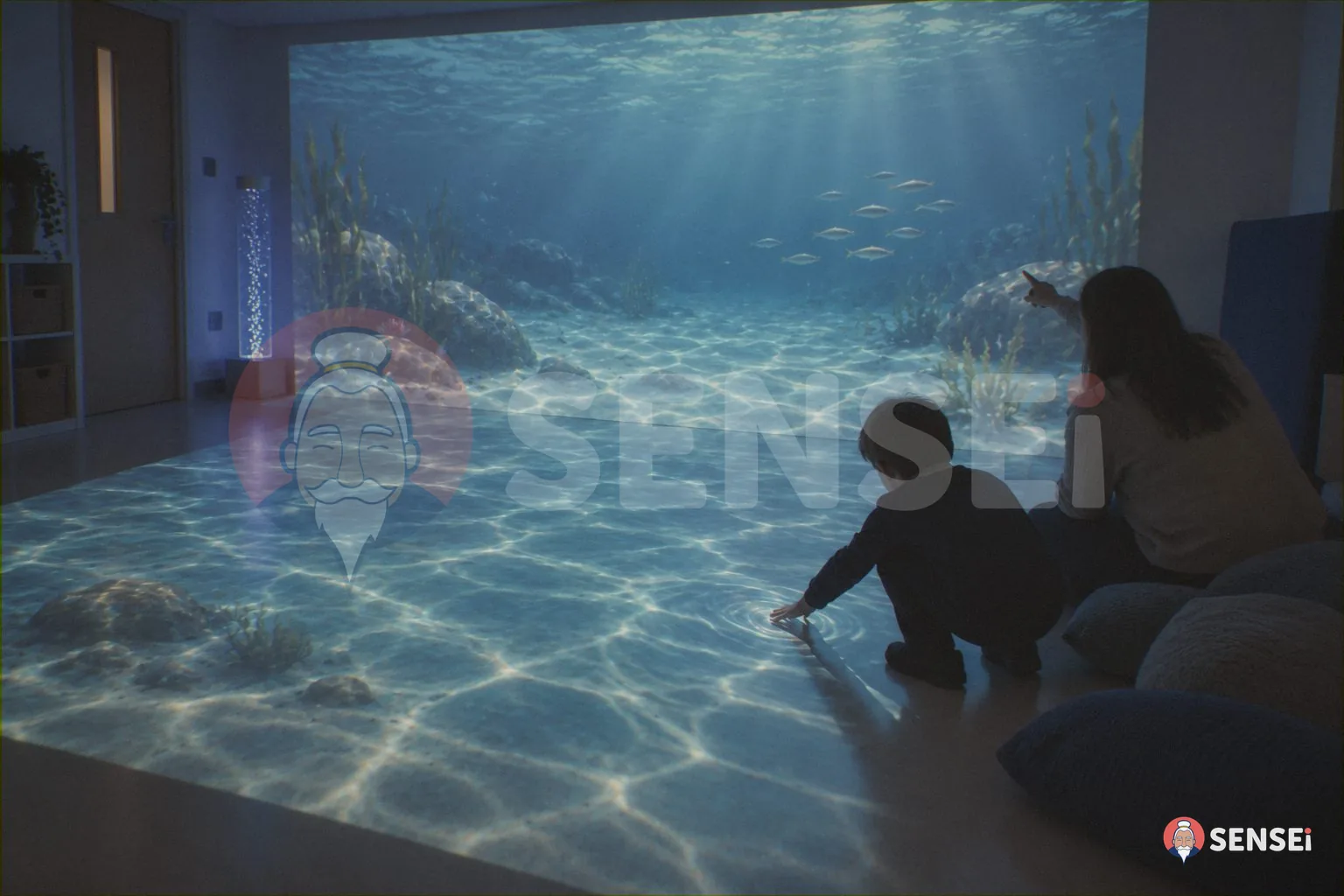
| Storytelling | The colour of the room follows the story: blue for the sea, green for the forest | Immersion, understanding |
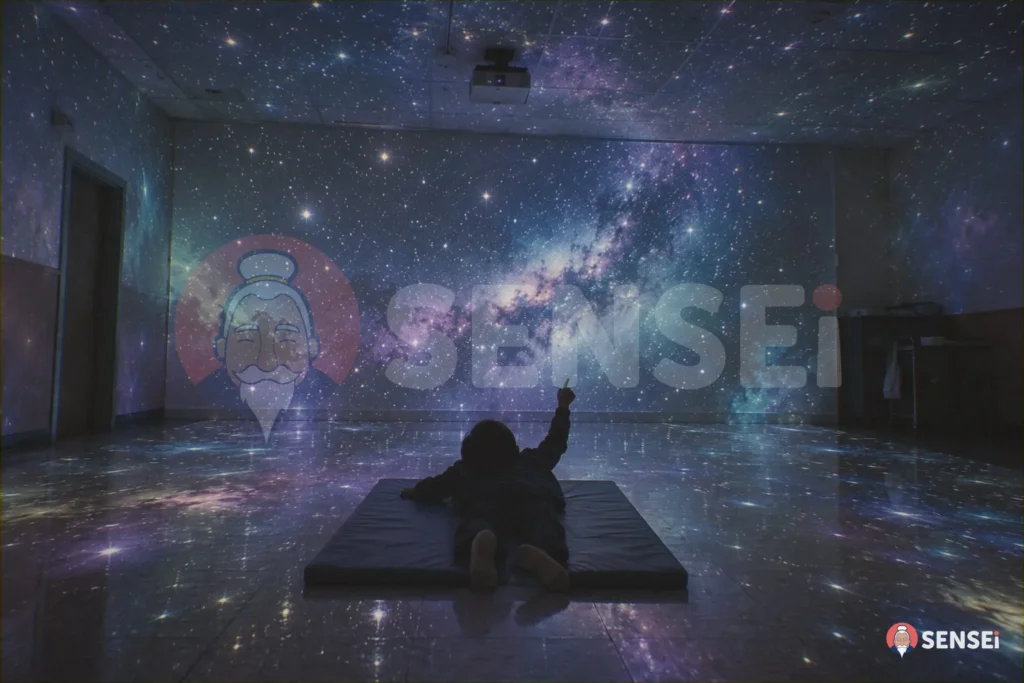
| Pause | Low, warm light, starry sky, few stimuli | Regulation, relaxation |
| Closing | The light dims slowly before leaving | Calm transition |
Light elements with strands and water have dedicated guides: sensory fibre optics and the bubble tube.
What are sensory lights and projections for?
Light changes the way a room is perceived. In a sensory room it has specific functions:
- Regulating arousal. Low, warm light to calm, brighter light to activate.
- Guiding attention. A point of light shows where to look or where to go.
- Signalling transitions. A change of colour announces that the activity is about to end, before any words.
- Creating a context. The blue of the sea, the green of the forest, the yellow of the sun make the experience more immersive.
- Training vision. Following a moving light, distinguishing colours and contrasts.
- Giving control. When the person can change the colour, the light becomes a tool for communication and choice.
Who do they help?
Sensory lights are used in schools, therapy and care. Some examples:
- young children, to discover colours and cause and effect;
- pupils with autism, to create a predictable, adjustable environment;
- people with partial visual impairment, who can benefit from strong contrasts and spot lights;
- people with complex disabilities, for whom light is one of the most accessible stimuli;
- older people and people with dementia, for moments of calm and orientation.
The same light does not suit everyone. Some people seek intense stimuli, others avoid them. That is why being able to adjust it in the moment matters.
What does research say about controllable lights?
The study by Unwin, Powell and Jones, published in the journal Autism, compares two ways of using the same room with 41 autistic children aged 4 to 12. The room has coloured lights, a bubble tube, fibre optics, a button panel and a mirror ball.
When the children control the changes, the authors observe fewer repetitive behaviours and more attention than with automatic changes. No differences emerge in anxiety or physiological arousal. The study has acknowledged limitations, such as the individual sessions, but the practical indication is useful: lights that can be controlled are worth more than lights that change on their own. We discuss this in interactive or passive room.
The research from which SENSEi originates goes beyond manual control. In the Magic K-Room project, the SENSEi research group studies a room with smart objects and lights that adapts to the person in real time, by reading their signals (Monitoring and Adaptation in Smart Spaces for Disabled Children). It is a research prototype, but it points the way: a light that adapts to whoever is in the room. It is one strand of a body of work that counts more than 40 scientific publications.
How to use lights and projections safely?
Photosensitivity
This is the most important rule. According to the Epilepsy Society, lights flashing between 3 and 30 times per second can cause problems for people with photosensitive epilepsy. Light and dark patterns that move quickly or change direction also increase the risk, as does tiredness.
In practice:
- no strobe lights;
- slow, gradual colour changes;
- smooth animations, without rapid alternation of light and dark;
- care when several effects flash at the same time.
If there is a person with epilepsy in the class, talk to the family and to those who support them before using the room.
Glare and visual comfort
The English Department for Education’s guidance on inclusive school buildings recommends even, adjustable, glare-free lighting, with controls for intensity and colour. It advises against lights that flash, change colour or are activated by movement in learning and circulation spaces. In a sensory room, where these effects are used on purpose, they must remain under the adult’s control.
Projectors and light sources
- Everything on the ceiling must be installed by qualified technicians, with cables out of reach.
- Nobody should look at an intense light source for a long time.
- Light sources and power supplies out of children’s reach and away from liquids.
- A basic light that the adult can always switch on, including in an emergency.
For setting up the room, read how to set up a multisensory classroom.
Passive lights or interactive lights?
A passive light follows a programme: it changes colour every few seconds, regardless of who is in the room. An interactive light responds to people’s actions or to the adult’s choices.
Both have their place. A slow, predictable cycle can help during a pause. During an activity, on the other hand, a light that responds to gestures makes the link between action and effect clear. The choice depends on the goal, not on the technology.
How are lights and projections managed in a SENSEi environment?
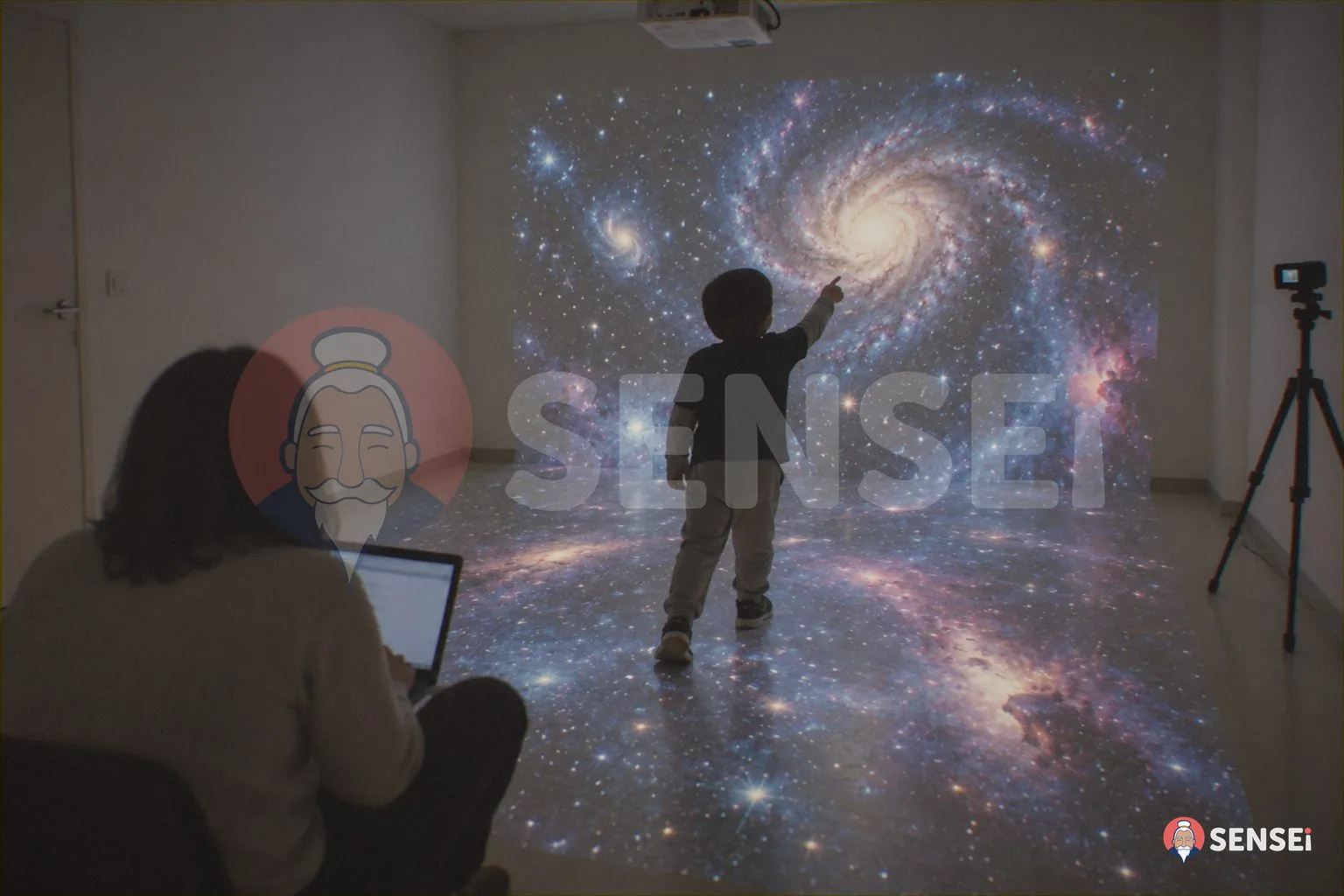
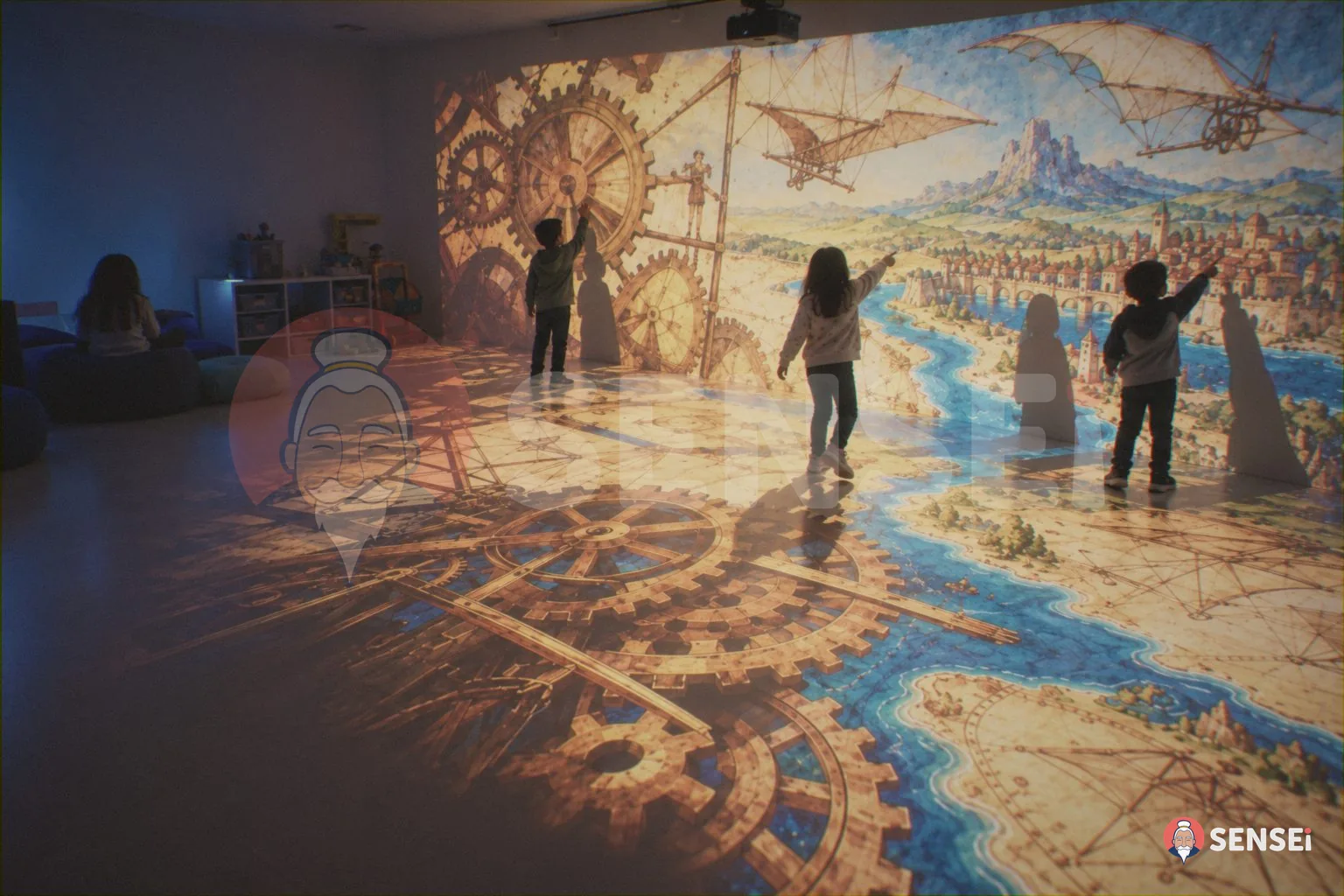
In a SENSEi environment, lights, interactive projections, sounds, scents, bubbles and physical objects tell the same story. If the wall shows a seabed, the room turns blue; when the activity ends, the light dims to accompany the closing. The educator or therapist controls everything from a tablet: they choose the scene, adjust the intensity, pause.
This idea comes from research. Magika combines projected worlds, ambient lights and smart objects, with an interface for adjusting the intensity and progression of the stimuli to suit the child.
In the centres the effect is concrete. At I Gigli del Campo, with young people with autism aged 13 to 25, lights and bubbles respond to actions and a co-designed activity lets the educator control lights, screens and bubbles from the tablet: the room becomes a safe place to practise independence. At the autism centre of ASL Salerno in Bracigliano, the practitioner adjusts stimuli and difficulty in real time, within the programmes the centre already offers.
Activities with lights and projections are created with Eureka. The full picture, sense by sense, is in the guide what to put in a multisensory room. To see the configurations, visit The magic room.
Frequently asked questions
Can coloured lights cause epileptic seizures?
Lights flashing between 3 and 30 times per second can cause problems for people with photosensitive epilepsy. Slow colour changes and no strobe effects reduce the risk.
Which light colour is most relaxing?
There is no colour that works for everyone. Many people prefer warm, low tones to relax, but it is best to observe the person and let them choose.
Does the room need to be completely darkened?
Projections need good blackout. For safety, a basic light must always be available to switch on.
Can an ordinary projector be used?
A projector on its own shows images, but it does not respond to movement. In an interactive room the images react to children’s gestures thanks to the software that drives them.
How much does it cost to light a sensory room?
It depends on how many lights and projections are needed and on the space. Contact us for a tailor-made proposal.
Want to see lights and projections responding to children’s gestures? Book a demo of a SENSEi environment.
Sources
- Epilepsy Society, Minimising risk from flashing lights.
- Department for Education, Inclusive education estates (June 2026), GOV.UK.
- Unwin, Powell, Jones, The use of Multi-Sensory Environments with autistic children: Exploring the effect of having control of sensory changes, Autism 2022, doi 10.1177/13623613211050176.
- Garzotto et al., Monitoring and Adaptation in Smart Spaces for Disabled Children, AVI 2016.
- Gelsomini et al., Magika, a Multisensory Environment for Play, Education and Inclusion, CHI EA 2019.