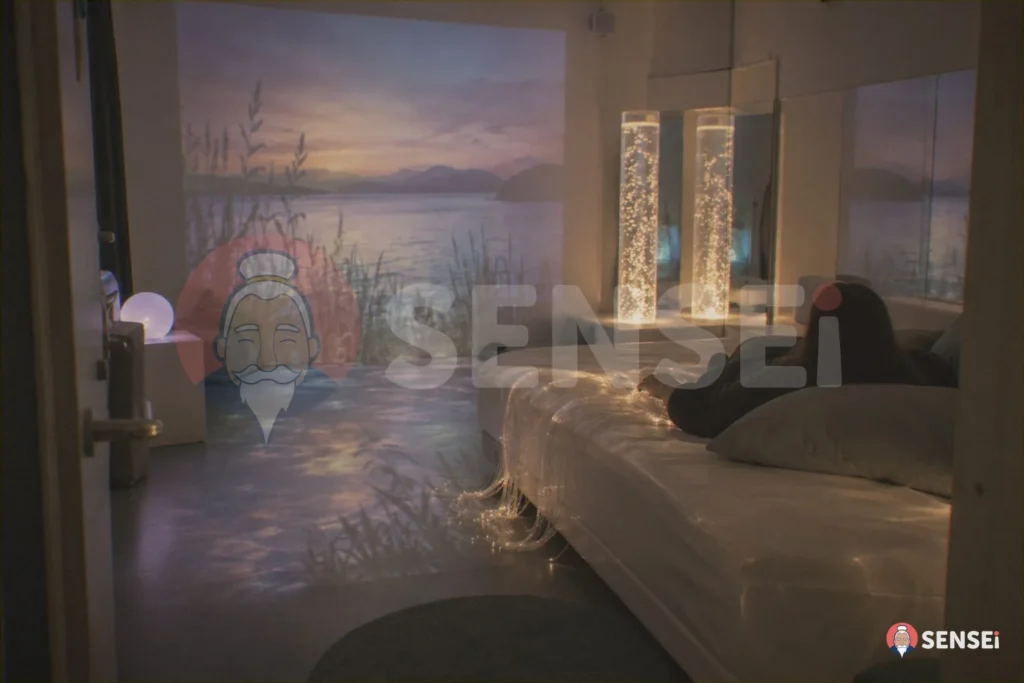
The Snoezelen® room is a controlled multisensory environment, with soft lighting, sounds, tactile materials and scents, designed to offer pleasant and relaxing sensory experiences. It originated in the late 1970s in the Netherlands, from the work of two therapists, Jan Hulsegge and Ad Verheul, with people with intellectual disabilities.
Since then the approach has spread to day centres, care homes for older people, hospitals and schools all over the world. In this guide we look at where it comes from, the principles it is based on, the equipment it contains, what research really says and how the idea has evolved, from the passive room to the interactive one.
What is a Snoezelen room?
A Snoezelen room is a dedicated space in which sensory stimuli are chosen, measured and controlled. Light, sound, touch, smell and sometimes movement are combined to create a welcoming atmosphere. The original goal was not to teach or to rehabilitate, but to offer people with severe disabilities a place of pleasure, discovery and relaxation.
The name combines two Dutch verbs: snuffelen, to explore, to sniff, and doezelen, to doze, to relax. The whole philosophy is in a single word: exploring calmly, without hurry and without demands.
In Italy people also often speak of a “stanza sensoriale” (sensory room), “aula multisensoriale” (multisensory classroom) or “ambiente multisensoriale” (multisensory environment, MSE). They are not perfect synonyms: Snoezelen refers to a specific approach and a registered trademark, while “multisensory room” is a general term. For a broader overview, read the guide to the multisensory room.
Where does Snoezelen come from?
In the late 1970s, Jan Hulsegge and Ad Verheul work at a Dutch institution for people with intellectual disabilities, De Hartenberg. They experiment with a sensory tent with lights, sounds and different materials, open for a weekend during a fair. The reactions of the participants, verbal and non-verbal, are very positive, and from that experience the term Snoezelen is born.
The idea spreads rapidly across Europe in the 1980s and 1990s, first in services for people with intellectual disabilities, then in care for older people with dementia, in psychiatry and in schools. Today we also find it in public documents: the Regione Siciliana, for example, with Circular no. 11 of 30 March 2026, funded “multisensory classrooms (Snoezelen Room)” in primary and lower secondary schools, explicitly referring to the Dutch origin of the method.
What are the principles of Snoezelen?
The Snoezelen approach rests on a few key ideas, which remain valid for anyone designing different kinds of rooms:
- Freedom of choice: the person decides what to explore and for how long.
- No performance: there are no tasks to complete and no results to achieve.
- Controlled stimuli: intensity is adjusted to avoid overload.
- Relationship: a practitioner accompanies attentively, without directing.
- Pleasure and well-being: the experience must be enjoyable and safe.
- Slow time: sessions follow the person’s pace.
Over time the approach has been enriched with more goal-oriented variants (communication, emotional regulation, attention), but its heart remains the same: respect for the person’s pace and preferences.
What is in a traditional Snoezelen room?
Equipment varies a great deal, but the experiences it creates matter more than the objects. Some have become almost symbolic:
- Looking: bubble columns that change colour, strands of light to hold in your hand, slow images flowing across walls and ceiling, reflections moving around the room.
- Touching: surfaces with different textures, light fibres that do not get hot, the vibration of water to feel by leaning against it.
- Listening: relaxing music and nature sounds that create a peaceful atmosphere.
- Smelling: light scents associated with the experience.
- Feeling the body: soft or vibrating mattresses, beanbags and cushions that envelop, contain and help to relax.
For those who live them, these are experiences of pleasure and discovery; for the practitioner, they are opportunities for relationship, in which to observe what attracts, what calms, what disturbs.
For a complete list, with safety and priorities, see the guide on what to put in a multisensory room.
What does research say about Snoezelen rooms?
Multisensory rooms are very widespread and much loved by practitioners and families. The scientific evidence, however, is more cautious than is often claimed. It is right to know it, in order to use these rooms with realistic expectations.
Dementia
A Cochrane review by Chung and Lai on Snoezelen in dementia concluded that there is not enough evidence of its effectiveness: the included studies were few and found no significant effects on behaviour, mood or interaction. The authors call for more robust research before recommending its use.
A later systematic review by Lorusso and Bosch, published in The Gerontologist, covering 12 studies, is somewhat more encouraging: sensory stimulation in multisensory environments appears to be a useful non-pharmacological aid for some dementia-related symptoms. However, compared with other individual interventions, the differences are not significant, and the long-term results are inconsistent.
In short: the room can offer moments of well-being and relationship, but it should not be presented as a therapy with proven effects.
Autism
A recent systematic review published in the journal Autism (Leonardi and colleagues) analyses 10 studies on multisensory environments with autistic people. Four studies report a reduction in stereotyped behaviours; others suggest positive effects on sustained attention and on aggressive or sensory behaviours. The authors nevertheless conclude that the evidence is insufficient, because of the limited number of studies, the wide variety of interventions and the small samples.
Intellectual disability
A scoping review by Breslin and colleagues (American Journal of Occupational Therapy), covering 13 studies, finds preliminary support for the use of multisensory environments in clinical settings to reduce anxiety and challenging behaviour in people with intellectual and developmental disabilities. Here too, the authors call for further research.
What we take from this
The picture is consistent: studies point to possible benefits for well-being, calm and some behaviours, but the evidence remains limited. Recent guidance from England’s Department for Education on inclusive school spaces points in the same direction: it suggests investing in sensory rooms only when there is a clear and specific need, with specialist support, and not as a generic intervention for all pupils.
This does not mean that multisensory rooms are useless. It means they must be designed with clear goals, used by trained people and observed over time. For the most vulnerable, even a single moment of well-being has value in itself.
From the passive room to the interactive room
In the traditional Snoezelen room many stimuli are “passive”: the bubble tube changes colour on its own, the projector always runs the same way. The person watches, touches, relaxes. It is a valuable experience, but partly independent of what the person does.
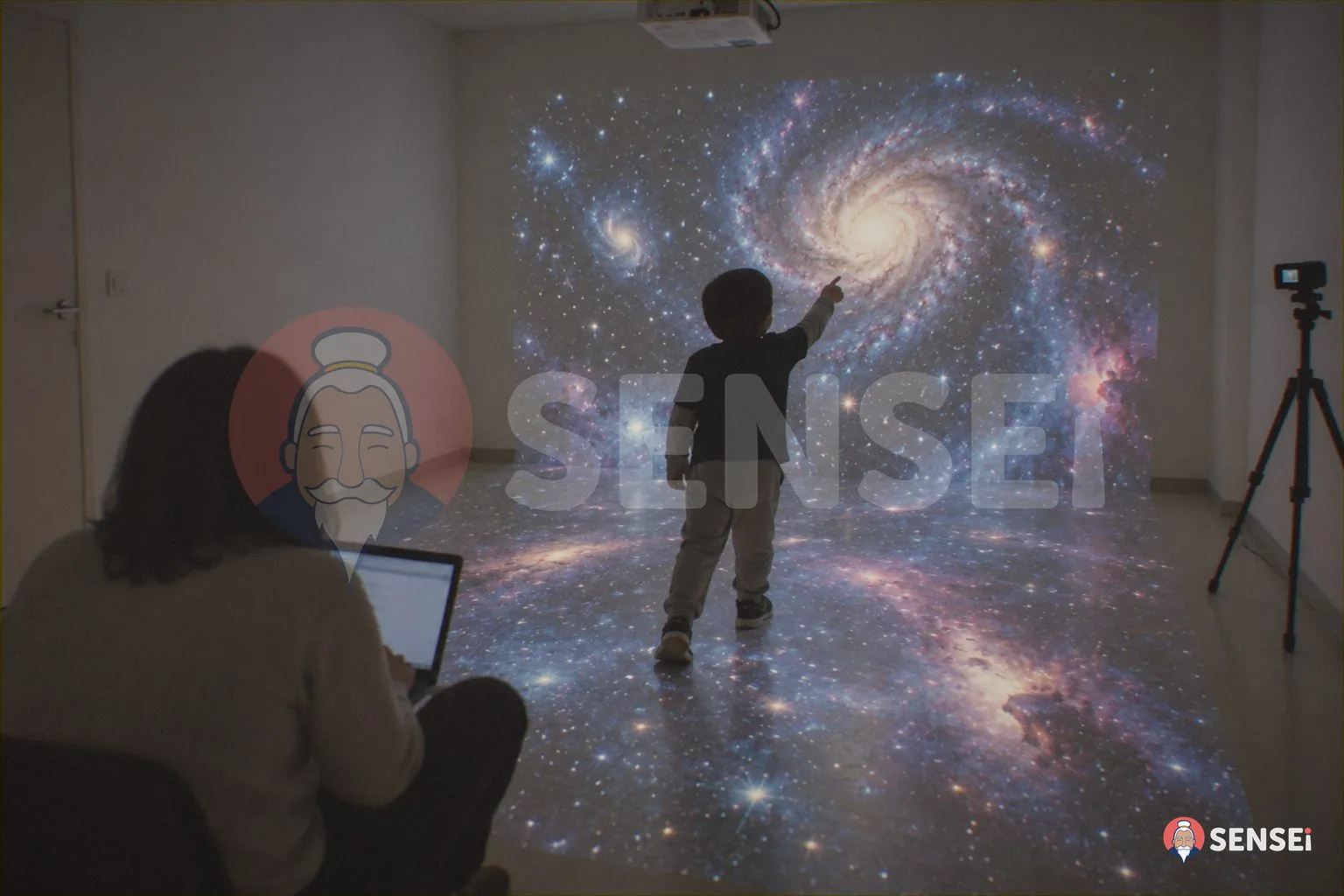
In recent years research has been exploring interactive rooms, in which the environment responds to movements, gestures, voice and objects. At Politecnico di Milano, the Magic Room project creates a smart space for children with neurodevelopmental disorders, designed with specialists and used in two therapy centres in Italy. An exploratory study with 19 children with severe impairments and 8 practitioners, lasting four months, gives encouraging results.
The subsequent Magika project, designed with more than 30 specialists from care centres and primary schools, combines digital worlds on walls and floor with real objects to touch and handle. Educators adjust the stimuli and their progression, adapting them to each child. These are two milestones in a journey described in more than 40 scientific publications.
From this research SENSEi was born. It does not replace the Snoezelen tradition, it complements it: it keeps the focus on well-being and on control of stimuli, and adds interactivity, group activities, automatic adaptation and progress reports. We told the story of this journey in the article SENSEi, from the Snoezelen sensory classroom to the inclusive educational experience.
What changes in practice? Practitioners do not lose the calm and care of the tradition, but gain new ways of engaging people, including in groups. At Fondazione Angelo Custode in Bergamo, four SENSEi environments are part of the teams’ daily work; at Sacra Famiglia in Inzago, a mobile environment goes directly to the adult residents, with content designed for them.
Passive and interactive compared
| Aspect | Traditional Snoezelen room | Interactive room (e.g. SENSEi) |
|---|---|---|
| Role of the person | Explores, observes, relaxes | Acts and sees the environment respond |
| Ratio | Often one to one | One to one or small group, even a whole class |
| Stimuli | Mainly fixed or cyclical | Programmable and adaptive |
| Typical goal | Well-being, relaxation | Well-being, but also learning, communication, participation |
| Space | Dedicated room with fixed equipment | Can transform an existing room |
| Documentation | Practitioner observation | Observation plus system-generated reports |
When to choose one or the other?
There is no answer that fits everyone. Here are some practical criteria.
A Snoezelen-type room is suitable if
- the main goal is relaxation and well-being;
- you mainly work with people with very severe disabilities, older people with dementia or people who need slow, contained stimuli (in these settings it is also worth knowing SENSEi CARE);
- the room will almost always be used one to one;
- you need a stable, predictable environment that is always the same.
An interactive room is suitable if
- you also want to work on learning, communication, motor skills, shared attention;
- the room will be used by groups or whole classes, as in a school;
- you want to change content and activities often;
- documenting progress over time is important;
- the available space must remain usable for other purposes too.
Often the answer is “both”
Many facilities combine a calm corner with traditional elements (soft lighting, fibre optics, soft seating) and an interactive area with projections on wall and floor. In this way the same room can host a moment of regulation and, straight afterwards, a group activity. To explore the differences further, also read immersive classroom, Snoezelen room and interactive floor: the differences.
Frequently asked questions
What does Snoezelen mean?
It combines the Dutch verbs snuffelen (to explore) and doezelen (to relax). It refers to an approach based on calm, enjoyable sensory exploration.
Who invented the Snoezelen room?
Two Dutch therapists, Jan Hulsegge and Ad Verheul, in the late 1970s, while working with people with intellectual disabilities.
Is the Snoezelen room a therapy?
It is better considered an environment for well-being and relationship. Scientific reviews point to possible benefits, but evidence of effectiveness remains limited.
Are Snoezelen and a multisensory room the same thing?
No. “Multisensory room” is a general term; Snoezelen is a specific approach and a registered trademark.
Does an interactive room replace the Snoezelen room?
No, it complements it. The interactive room adds responsiveness to movement, group activities and documentation, while keeping the focus on controlling stimuli.
Can a Snoezelen room be used at school?
Yes, and some public funding calls provide for it. At school it is useful to combine moments of calm with educational and inclusive activities for the whole class.
Book a demo
Are you considering a multisensory room for your service or your school? Book a demo and discover how an interactive room can coexist with the well-being of the multisensory tradition. You will also find all our publications in the Research section.
Sources
- Snoezelen Multi-Sensory Environments: History
- Regione Siciliana, Circular no. 11 of 30/03/2026, Multisensory classrooms (Snoezelen Room)
- Chung JCC, Lai CKY. Snoezelen for dementia. Cochrane Database of Systematic Reviews, CD003152
- Lorusso LN, Bosch SJ (2018). Impact of Multisensory Environments on Behavior for People With Dementia: A Systematic Literature Review. The Gerontologist
- Leonardi S et al. (2025). The use of multisensory environments in children and adults with autism spectrum disorder: A systematic review. Autism
- Breslin L et al. (2020). Clinical Utility of Multisensory Environments for People With Intellectual and Developmental Disabilities: A Scoping Review. Am J Occup Ther
- Department for Education (2026). Inclusive education estates
- Garzotto F, Gelsomini M (2018). Magic Room: A Smart Space for Children with Neurodevelopmental Disorder. IEEE Pervasive Computing
- Gelsomini M et al. (2019). Magika, a Multisensory Environment for Play, Education and Inclusion. CHI EA 2019
Snoezelen® is a registered trademark of its respective owners.