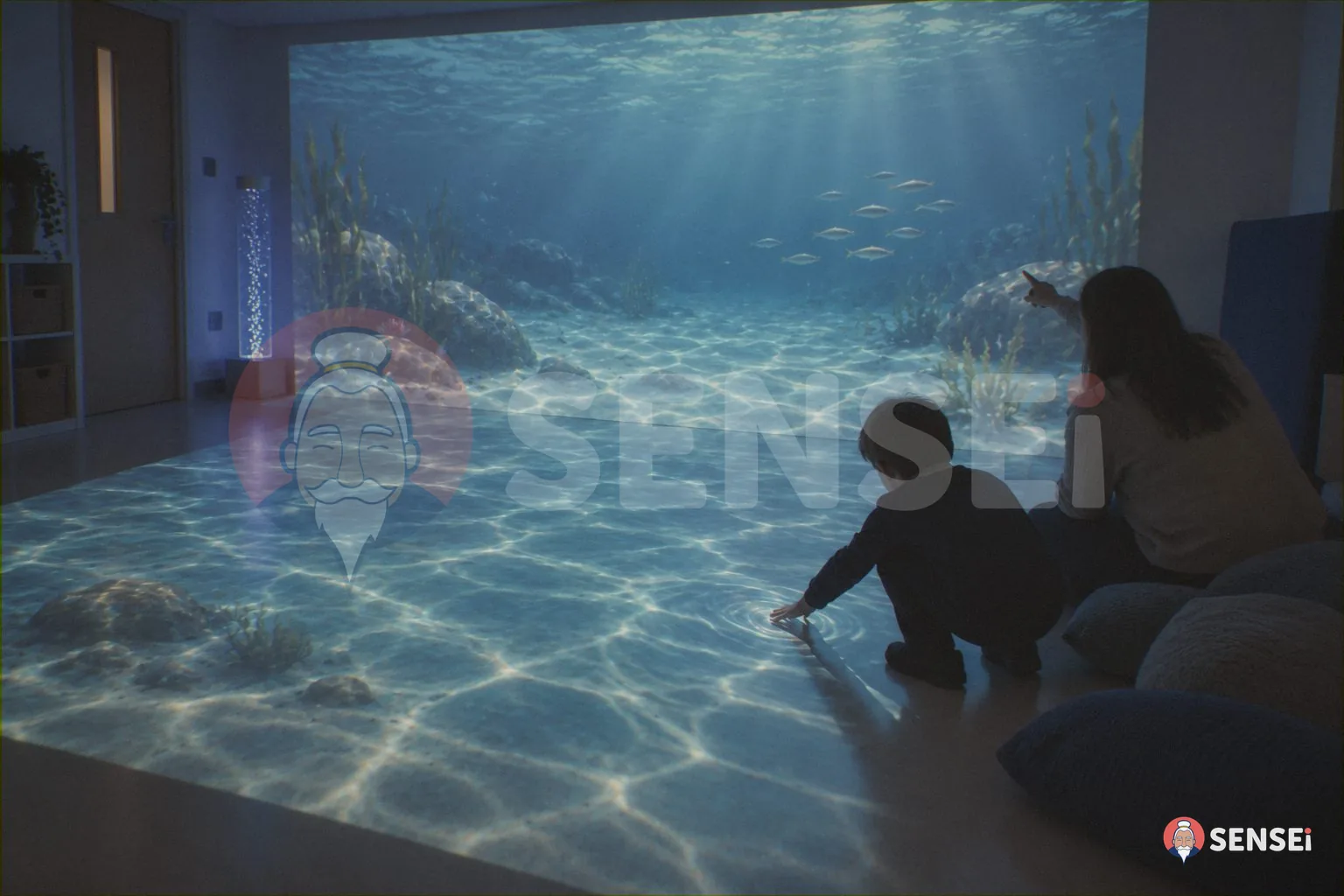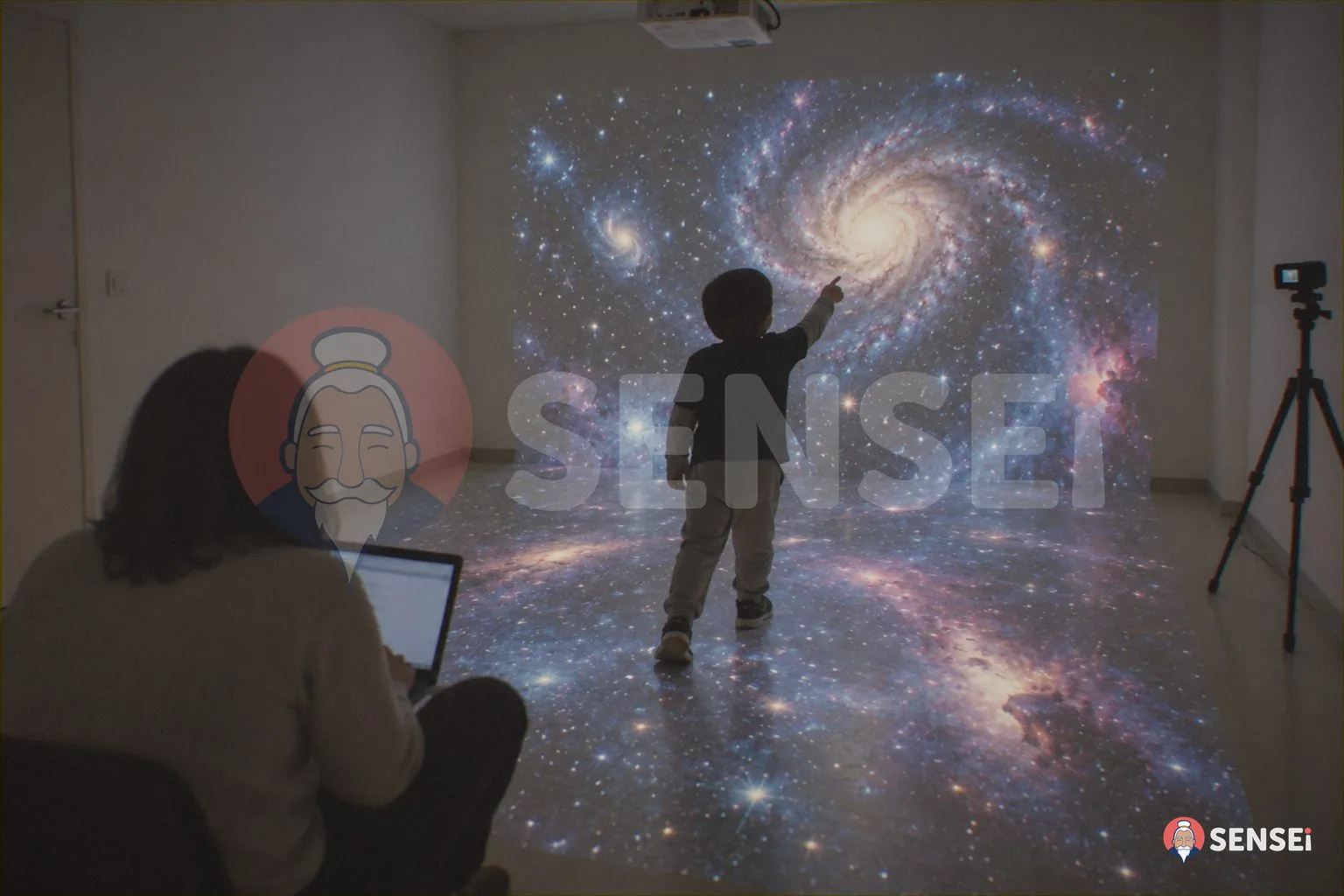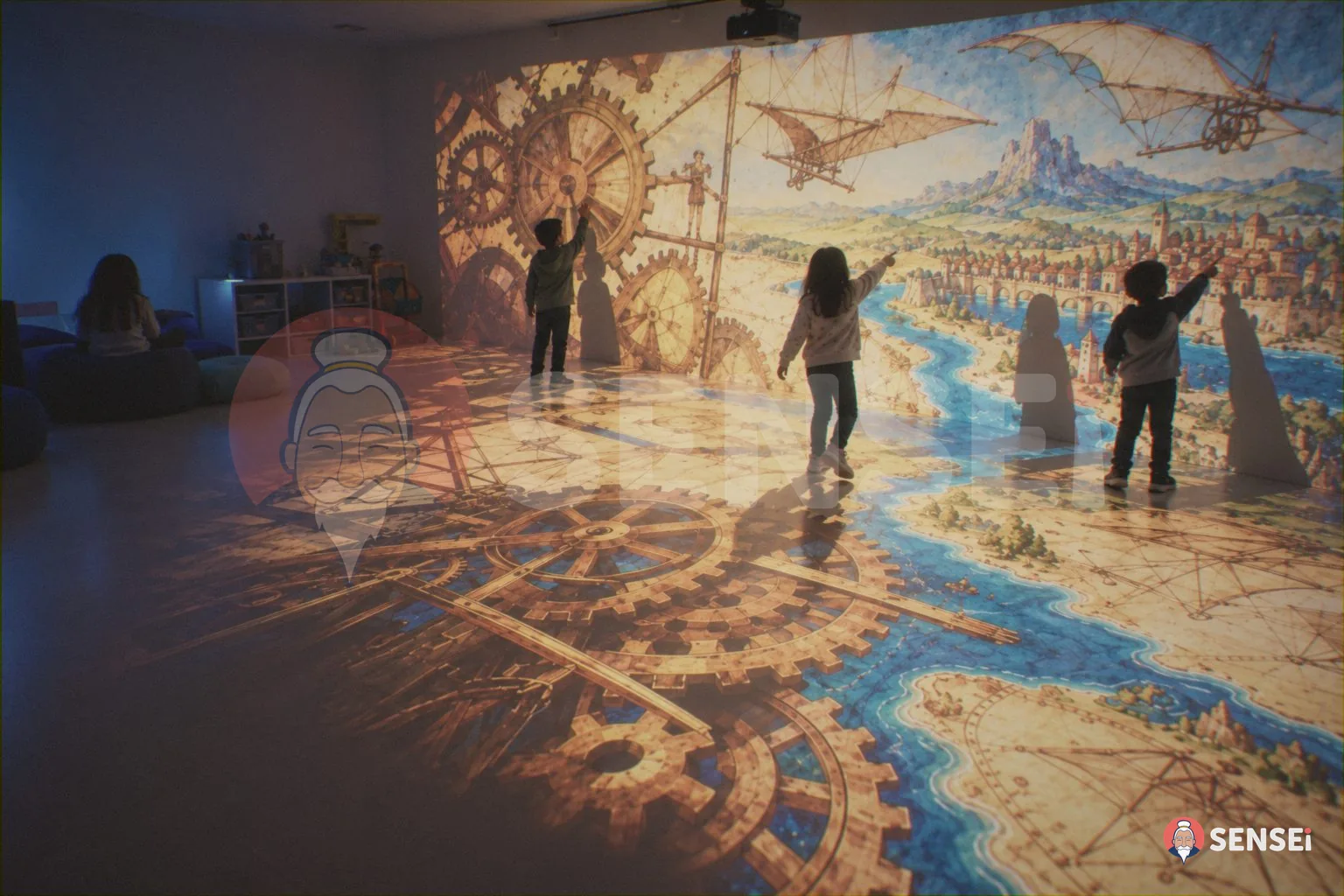

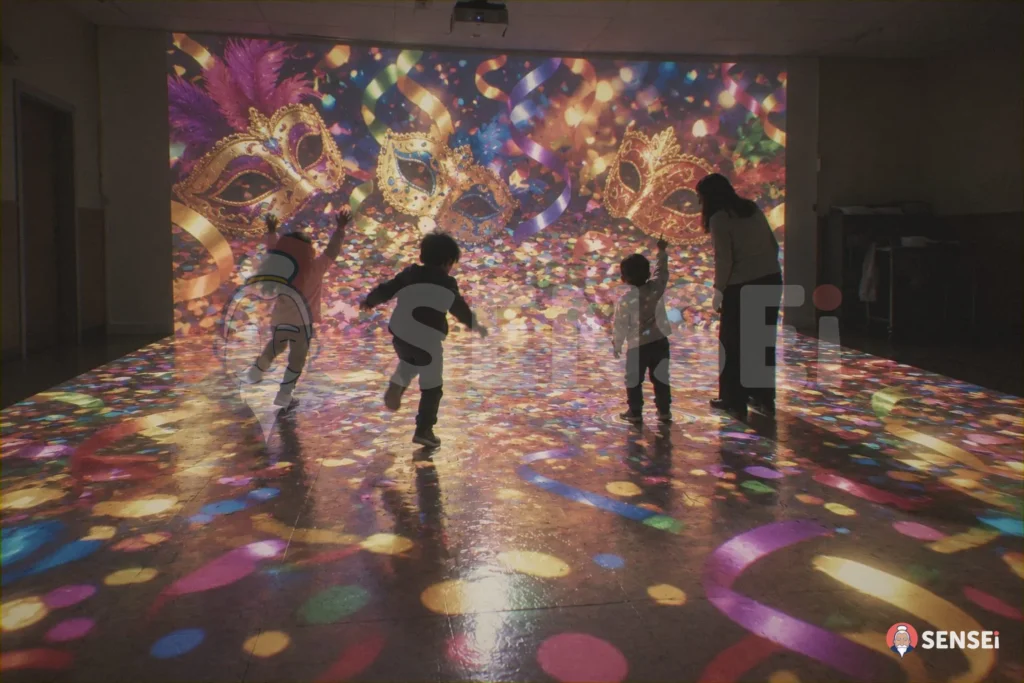
Carnival in the immersive room becomes an experience to live with the body: confetti that moves under your feet, masks that change expression, floats parading across the walls. Here you will find eight ready-to-adapt activities for preschool and primary school, with goals, timing and inclusive variations.
In 2027 Shrove Tuesday falls on 9 February; in areas that follow the Ambrosian rite, the celebrations continue until the following Saturday. The activities, however, work throughout the whole period and can be repeated at other times of the year.
Why celebrate Carnival in the immersive room?
Carnival is a festival of costumes, colours, music and movement. These are the very ingredients an immersive room works with.
The Italian National Curriculum Guidelines state it clearly: children “play with their bodies, communicate, express themselves through facial expressions, dress up, test themselves”. The field of experience “The body and movement” also points out that moving is the first factor in learning.
The immersive room adds one advantage: everything can be adjusted. Volume, light, animation speed and number of stimuli are set according to the group. This way the celebration stays enjoyable even for those who struggle with noise and confusion, and nobody is left watching from the outside.
How do you prepare the room for Carnival?
Before you start, three precautions.
- Digital confetti, not real confetti. Paper confetti on the floor makes the surface slippery, and the small pieces need to be kept away from the youngest children. Projected confetti has none of these problems.
- No rapid flashing. According to the Epilepsy Society, lights that flash between 3 and 30 times per second can cause problems for people with photosensitive epilepsy. Smooth animations and slow colour changes are better.
- Masks are optional. Some children do not like covering their face or touching new materials. Always have an alternative ready: a hat, a cape, a colour chosen on the wall.
The 8 Carnival activities
Each activity lists its goal, what is projected, sounds, materials and duration. Durations are indicative and should be adapted to the group.
1. The confetti shower
- Goal: free movement, colour recognition.
- What is projected: confetti falling on the floor and moving as the children pass.
- Sounds: cheerful music at a moderate volume.
- Materials: none.
- Duration: 10 minutes.
- Variation: the educator calls out a colour and the children look for confetti of that colour.
2. The masks of emotions
- Goal: recognising and naming emotions.
- What is projected: a large mask on the wall that changes expression: happy, sad, surprised, angry.
- Sounds: a short, different sound for each emotion.
- Materials: cards with emotion pictograms.
- Duration: 10-15 minutes.
- Variation: the children imitate the expression, then they choose one for the others.
3. Guess the mask
- Goal: memory, vocabulary, knowledge of traditions.
- What is projected: a traditional Italian mask that appears one piece at a time, such as Arlecchino, Pulcinella or Colombina.
- Sounds: a sound clue or a nursery rhyme.
- Materials: printed pictures of the masks.
- Duration: 15 minutes.
- Variation for primary school: match each mask to its city on a projected map.
4. Harlequin’s costume
- Goal: colours, geometric shapes, balance.
- What is projected: a floor of coloured diamonds.
- Sounds: a sound when you jump onto the right diamond.
- Materials: none.
- Duration: 10 minutes.
- Variation: at primary school, count the diamonds or build colour sequences.
5. Musical streamers
- Goal: rhythm, coordination, listening.
- What is projected: streamers that draw themselves on the wall following the movement of the arms.
- Sounds: alternating slow and fast tracks.
- Materials: fabric ribbons to hold, optional.
- Duration: 10 minutes.
- Variation: when the music stops, everyone stops.
6. The parade of floats
- Goal: taking turns, teamwork.
- What is projected: a street on the floor and colourful floats on the walls.
- Sounds: a band that comes closer and moves away.
- Materials: simple percussion instruments.
- Duration: 15 minutes.
- Variation: taking turns, one child leads the procession and the others follow.
7. Counting confetti
- Goal: numbers and quantities with the body, for primary school.
- What is projected: groups of confetti to gather into circles on the floor.
- Sounds: a confirmation sound for each answer.
- Materials: none.
- Duration: 15 minutes.
- Variation: addition and subtraction, with the children moving between the circles.
8. The quiet masked ball
- Goal: relaxation, closing the experience.
- What is projected: a town square in the evening with soft lights that slowly go out.
- Sounds: slow music, low volume.
- Materials: cushions or mats.
- Duration: 5-10 minutes.
- Variation: say goodbye to each mask before leaving.
How do you make the activities inclusive?
A celebration succeeds when everyone finds their own way to take part. Universal Design for Learning suggests offering multiple ways to engage, understand and express oneself: at Carnival this means more ways to move, communicate and choose.
- Movement. A child in a wheelchair can take part in “The confetti shower” if the projection also responds to arm movements or to the wheelchair.
- Communication. Pictograms help those who use augmentative communication to choose emotions, colours and masks.
- Sensitivity. Volume and brightness can be lowered for those who are sensitive to noise. A quiet corner is always available.
- Predictability. Explaining the sequence of activities beforehand, perhaps with a small visual schedule, reduces anxiety.
For very young groups, at nursery, choose one or two activities and shorten the times. You will find guidance in the guide to the immersive room at nursery.
What does research say about learning with the body?
The idea that movement helps learning is not just intuitive. The study Embodied Learning in Immersive Smart Spaces uses a controlled design to evaluate an immersive space in which 48 children aged 6-8 use their bodies to interact with content on walls and floor. The SENSEi research group highlights its educational potential compared with traditional methods.
The Magika project, on the other hand, shows how to combine projected worlds and physical objects, with an interface that allows the educator to adjust the intensity and progression of stimuli. This is exactly what is needed in a noisy celebration like Carnival. These are two milestones of a body of work that began at the Politecnico di Milano and today counts more than 40 scientific publications.
What changes for children and teachers?
In the preschools we work with, celebrations become opportunities for shared learning. With the Cooperativa ORSA, a mobile SENSEi kit brings immersive experiences to six municipal preschools in Milan: the schools choose themes and backgrounds linked to their own curriculum planning, and the same activity can host anything from a small group to an entire class.
At the ICS IV Novembre in Cornaredo, the preschool teachers use the magic room as part of their teaching, with the experience guided from a tablet. For children it means moving, choosing and playing together; for teachers, having ready-made activities to adapt to every celebration.
How do you create Carnival activities with Eureka?
With Eureka, the SENSEi platform for creating activities, you can build your own Carnival scenes starting from an idea: choose the background, the sounds, the rules of the game and the difficulty level. Artificial intelligence helps turn the idea into an activity, and the educator always stays in control.
Activities can be shared with colleagues and reused the following year. For other seasons, look at the ideas for winter and spring, or the 30 examples of multisensory activities. For preschool you will find more information on the page SENSEi for preschool.
Frequently asked questions
How long should a Carnival session last?
It depends on age. At preschool, two or three activities for a total of 20-30 minutes are enough. At primary school you can go up to a whole lesson, alternating movement and breaks.
Do the children have to wear masks?
No. Dressing up is optional. Those who do not like masks can choose an accessory or a colour to “wear” on the wall.
Are coloured lights safe for everyone?
Rapid flashing and strobe effects should be avoided. Slow colour changes and smooth animations are the most prudent choice.
Can real confetti be used?
Better not in the room: it makes the floor slippery and consists of small pieces. Projected confetti offers the same effect without the risks.
Do the activities also work with pupils with disabilities?
Yes, if adapted. Pictograms, adjustable volume, response to arm movements and a quiet corner make the activities accessible.
Want to create your own immersive Carnival? Discover Eureka and design the activities for your class.
Sources
- Indicazioni nazionali per il curricolo della scuola dell’infanzia e del primo ciclo d’istruzione (2012), Italian Ministry of Education.
- Epilepsy Society, Minimising risk from flashing lights.
- Gelsomini, Leonardi, Garzotto, Embodied Learning in Immersive Smart Spaces, CHI 2020.
- Gelsomini et al., Magika, a Multisensory Environment for Play, Education and Inclusion, CHI EA 2019.