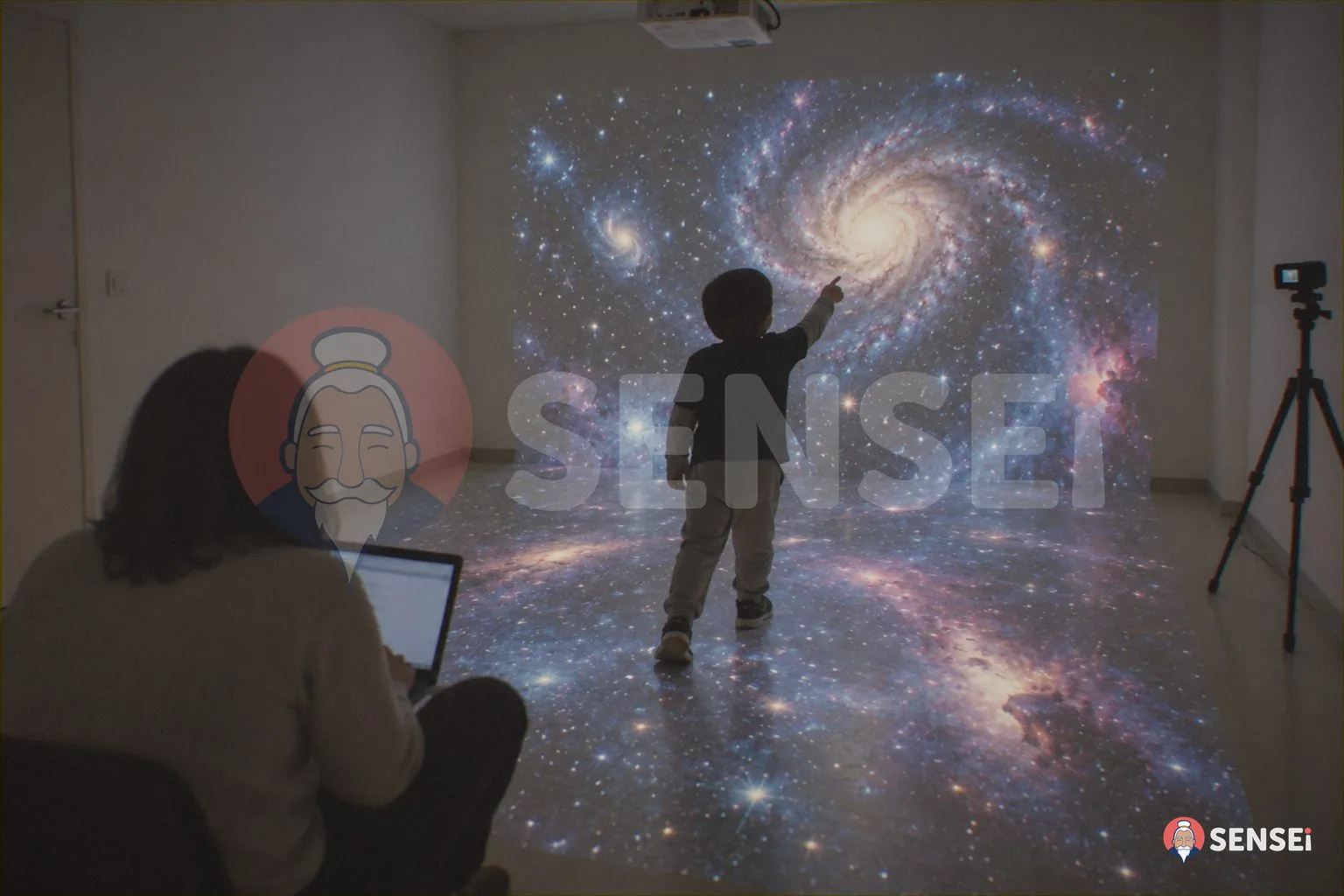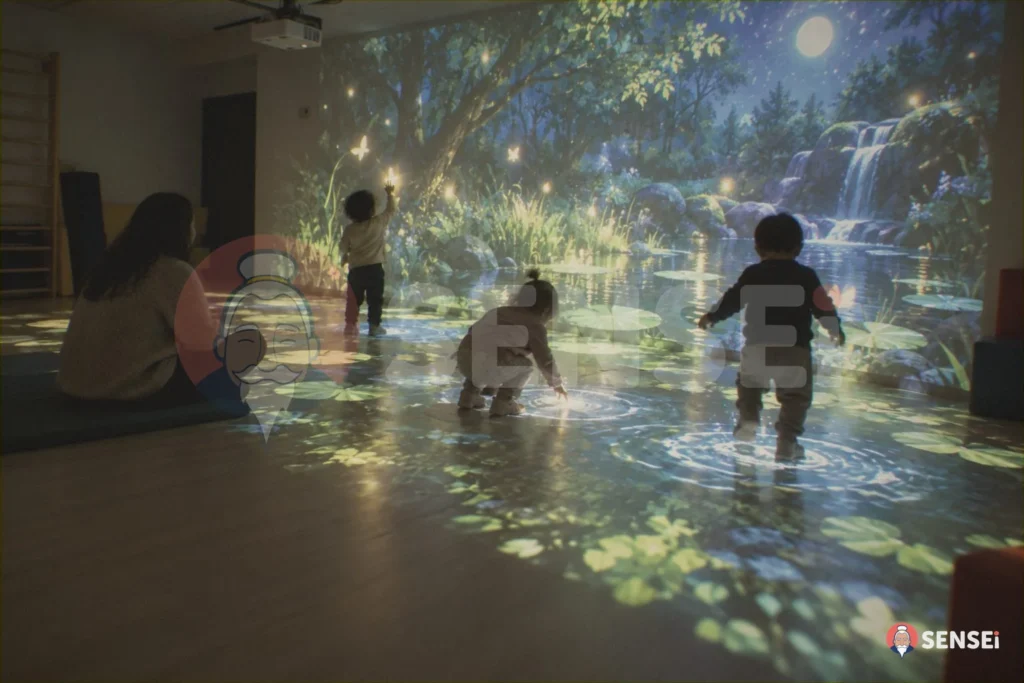
The immersive room at nursery is a space in which lights, wall and floor projections, sounds and soft materials respond to the movements of children aged 0 to 3. Used with short sessions, few stimuli at a time and an educator always close by, it can support exploration, shared attention, language and emotional regulation.
This guide is designed for educators, pedagogical coordinators and managers of 0-3 services. It explains what a child experiences in the room, which goals to set for infants, young toddlers and older toddlers, how to organise groups and timing, which stimuli to avoid and how to observe and document. At the end you will find a calendar of activities for the whole year.
What is an immersive room at nursery?
An immersive room is an environment in which the image is not confined to a screen: it covers walls and floor, changes with light and sound, and reacts to whoever moves. In the SENSEi magic room the technology stays discreet, on the ceiling, and the existing walls and floor come to life: no building work or dedicated room is needed. The room responds to the movements of several children at once, with nothing to wear, and the educator guides everything from a tablet while sitting next to them.
For those who work at nursery, the difference from a traditional sensory room is important. In a traditional room, the stimuli are mostly fixed (a bubble tube, fibre optics, a coloured light). In the immersive room, the environment responds: the child discovers that their step makes a fish move on the floor or that their voice turns on a light. It is a cause-and-effect experience lived with the whole body. For an overview, read the guide to the multisensory room.
What does a child aged 0 to 3 experience in the room?
Young children learn through their body, their senses and their relationship with the adult. In the immersive room this translates into a few recurring experiences:
- Cause and effect: a gesture produces a visible or audible change. It is one of the most powerful discoveries of the early years.
- Exploring space: crawling, rolling, walking towards a light, stopping, going back.
- Shared attention: looking at the same thing together with the educator or a peer and pointing to it.
- Listening: recognising a sound, looking for where it comes from, associating it with an image.
- Touch: touching different materials while the surrounding environment changes colour.
- Calm: with low lights and slow sounds, the room can become a place of quiet and containment.
Italy’s national guidelines for early childhood educational services (Orientamenti nazionali per i servizi educativi per l’infanzia) recommend flexible spaces, suitable for free play and organised into areas. The immersive room fits well with this idea: it does not replace the other spaces of the nursery, it is an extension of them that can be transformed in a few seconds.
Which goals for infants, young toddlers and older toddlers?
Goals change a great deal between a 6-month-old and a 30-month-old child. The table offers a starting reference, to be adapted to each individual child.
| Group | What to offer | Main goals | Indicative duration |
|---|---|---|---|
| Infants (about 3-12 months) | Slow lights, large high-contrast shapes on the floor, gentle sounds, materials to grasp | Visual tracking, orienting towards sound, tactile exploration, wellbeing in the relationship | 5-8 minutes |
| Young toddlers (about 12-24 months) | Projections that react to footsteps, animals that appear, bubbles, objects to push | Cause and effect, walking and balance, first words, imitation | 8-12 minutes |
| Older toddlers (about 24-36 months) | Short stories, turn-taking games, colours to choose, songs with gestures | Language, shared attention, waiting for one’s turn, play with peers, first rules | 10-15 minutes |
Infants: few stimuli, lots of relationship
With infants, the room is above all a place of relationship. The child is held or lies on a soft mat, with the educator just a few centimetres away. A slow projection on the floor (waves, circles of light, stars) and a gentle sound are enough. The goal is not to “do an activity”, but to offer a moment of calm sensory exploration and observe how the child reacts.
Young toddlers: the body in motion
Between 12 and 24 months, the child walks, falls, gets up again, pushes, pulls. The interactive floor takes centre stage: leaves that fly up when you walk over them, fish that dart away, puddles that go “splash”. It is the ideal time to work on cause and effect and to name together what is happening (“the fish is swimming away!”).
Older toddlers: first stories and first turns
After the age of 2, the child is ready for short narratives and games with simple rules: “now it’s your turn to light up the moon”. Songs with gestures, colours to choose and small paths can be introduced. The group becomes more important and the room helps build moments of shared attention among peers.
How many children and for how long?
At nursery, the rule is little and well. Practical guidance:
- Small groups: 3-4 children with infants, up to 5-6 with older toddlers, always with at least one dedicated educator.
- Short sessions: between 5 and 15 minutes of actual activity, plus a few minutes for entering and leaving.
- Fixed rituals: always entering in the same way (taking off shoes, sitting on the mat, a greeting song) helps children feel safe.
- Best time: mid-morning, away from meals and naps.
- Frequency: short, regular sessions, for example two or three times a week, are better than one long, occasional session.
The World Health Organization advises against sedentary screen time for children under 2 and recommends limiting it to no more than one hour for 2-year-olds. The immersive room is a different experience, because it is explored through movement and with an adult, but the message remains useful: the child must be active, not a spectator. If the children stay still watching the wall as if in front of a television, it is time to change activity.
Which stimuli should be avoided at nursery?
The immersive room can do a lot, and that is exactly why it needs to be dosed. Here is what to avoid:
- Flashing and strobing: no stroboscopic lights or rapid colour changes.
- Loud volume: sounds must be soft; a peer crying must remain audible.
- Too many stimuli at once: one projection, one sound and one material are enough. Adding scent, bubbles and music all together is confusing.
- Complete darkness: a low, warm light that lets faces be seen is better.
- Frightening images: animals with wide-open mouths, sudden noises, monsters, even “friendly” ones.
- Strong scents: if used, they must be light, brief and checked with families for allergies.
- Slippery floor: be careful with soap bubbles, which wet the floor.
Some children are more sensitive than others to light, sound or touch. Watch for signs of discomfort (turning the head away, covering the ears, crying, stiffening) and lower the intensity immediately. Always provide a calm corner inside or next to the room.
What is the educator’s role?
In the immersive room, the educator is not a technician pressing buttons. They are the person who mediates the experience: choosing what to offer, adjusting the stimuli, putting into words what happens, welcoming emotions.
In practice, the educator:
- Prepares the room before the children come in (light, volume, materials, clear floor).
- Stays at the children’s level, sitting on the floor, not standing and watching from outside.
- Names what happens: colours, animals, actions, emotions.
- Adjusts in real time the intensity of the stimuli from the tablet, slowing down or stopping the activity when needed.
- Respects each child’s pace: those who want to watch from a distance can do so.
- Observes and takes notes on reactions to build the following sessions.
This approach is at the heart of the research from which SENSEi was born, collected in more than 40 scientific publications. The Magika project, developed with more than 30 specialists from care centres and schools, puts the level of stimuli and their progression in the hands of educators, so they can be adapted to the needs of each child. The P3S model (Playful Supervised Smart Spaces) also puts adult supervision at the centre of multisensory experiences. The message for nurseries is clear: technology is useful if it strengthens the relationship, not if it replaces it. To learn to use the room mindfully, SENSEi offers training for educators.
What changes for children, educators and families?
When the room becomes part of the routine, the changes show in the small things. A shy child who, after a few weeks, is the first to go in. A group that learns to wait its turn to light up the moon. An older toddler who names the animals appearing on the floor and talks about them at home.
For the team, the room is an additional observatory that enriches educational planning and dialogue with families. This is what happens in the preschools that use SENSEi: with Cooperativa ORSA, a mobile kit brings the programme “All’avventura tra i sensi” to six municipal schools in Milan, while at ICS IV Novembre in Cornaredo the magic room has been growing for years together with a community of teachers.
Calendar of activities for the nursery
Having a seasonal thread helps children find familiar themes again and helps the team plan. Here is a basic calendar, with the dedicated guides:
| Period | Theme | Guide |
|---|---|---|
| September-November | Autumn: leaves, chestnuts, rain, animals getting ready for winter | Autumn in the immersive room |
| December | Christmas and the festival of lights, with a secular version | Christmas in the immersive room |
| January-February | Winter: snow, ice, cold-weather animals | Winter in the immersive room |
| February | Carnival: colours, masks, music | Carnival in the immersive room |
| March-May | Spring: flowers, insects, growing seeds | Spring in the immersive room |
| June-July | Summer and the sea: waves, fish, sand | Summer and the sea in the immersive room |
Each theme can be revisited for several weeks, changing a little at a time: first only the sound of the wind, then the falling leaves, then the leaves to gather with the feet. Repetition is a resource, not a limitation: young children love finding what they already know.
How to observe and document?
Observation is what turns a pleasant moment into an educational experience. The national guidelines remind us that at nursery children are observed in their developmental process, involving families. In the immersive room this is even more true, because the environment changes and the child’s reactions change with it.
What to observe
- Entering: does the child come in willingly, hesitate, look for the adult?
- Attention: how long do they follow a stimulus? Do they point to it? Do they look for it when it disappears?
- Movement: do they move around the room, try to touch the projections, stay still?
- Communication: vocalisations, words, gestures, looks towards the adult or peers.
- Regulation: signs of wellbeing or discomfort, how they react to changes.
- Relationship: do they play alongside peers, imitate them, seek them out?
How to document
A simple grid, filled in right after the session, is worth more than long reports written at the end of the month. Note the date, group, activity offered, intensity of the stimuli and two or three observations per child. Over time, preferences and progress emerge.
SENSEi makes it possible to record and document sessions and produces interpretable reports on progress. These data do not replace the educator’s eye, but they support it: it becomes easier to notice that a child, week after week, stays longer on an activity.
Privacy and families
Photos and videos are valuable for showing families the work being done, but they must be handled with care. Collect parents’ consent, use images only for the stated purposes and store them securely, in compliance with the European General Data Protection Regulation (GDPR) and the service’s rules. Sharing with families what the child experiences in the room strengthens the educational partnership.
Frequently asked questions
From what age can the immersive room be used at nursery?
Even with infants, provided sessions are very short, with slow lights, gentle sounds and the child held by or close to the educator. As children grow, duration and interactivity increase.
Is the immersive room “screen time”?
Not in the classic sense: the child does not sit and watch, they move, touch and interact with an adult. For exactly this reason, sessions must remain short and active.
How many children can go in together?
As a guide, 3-4 infants or 5-6 older toddlers with at least one dedicated educator. Small groups make it possible to observe and adjust the stimuli.
Is a dedicated room needed?
No. SENSEi transforms an existing room with discreet ceiling-mounted technology and uses the walls and floor, so the space remains usable for other activities too.
How can families be involved?
Invite them to an open session, share short pieces of documentation (with consent) and ask for sounds, songs and words from home to include in the activities.
Do educators need training?
Yes, it is recommended: it helps them choose the right stimuli, read children’s signals and use the software with confidence.
Book a demo
Want to understand how an immersive room can become part of your nursery’s day? Book a demo: we show you the room in action and design the first activities together.
Sources
- Eurydice, Italy: Educational guidelines (Linee pedagogiche per il sistema integrato zerosei and Orientamenti nazionali per i servizi educativi per l’infanzia)
- WHO (2019). To grow up healthy, children need to sit less and play more
- Gelsomini et al. (2019). Magika, a Multisensory Environment for Play, Education and Inclusion. CHI EA 2019. doi:10.1145/3290607.3312753
- Agosta et al. (2015). Playful Supervised Smart Spaces (P3S). Euromicro DSD 2015. doi:10.1109/DSD.2015.61