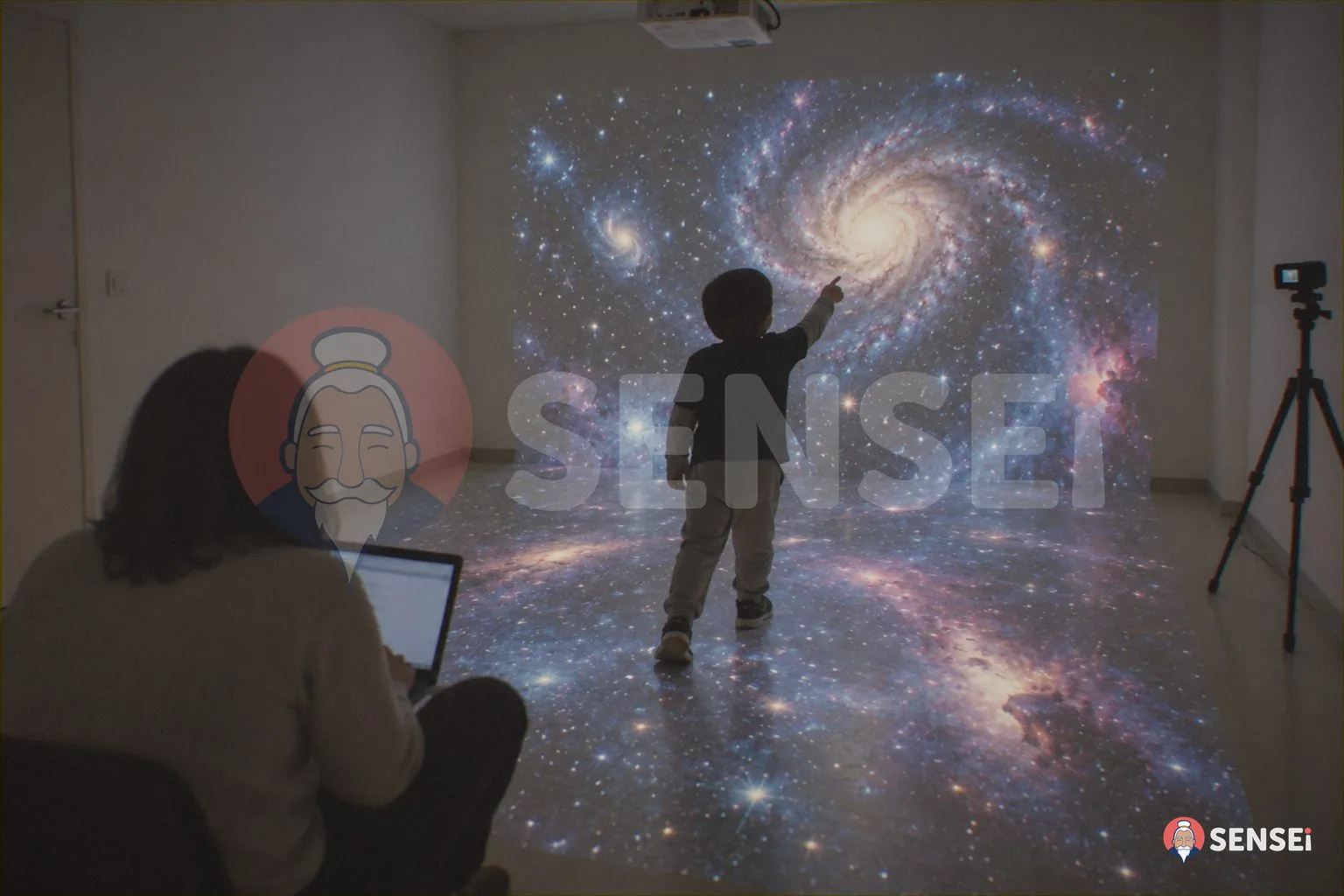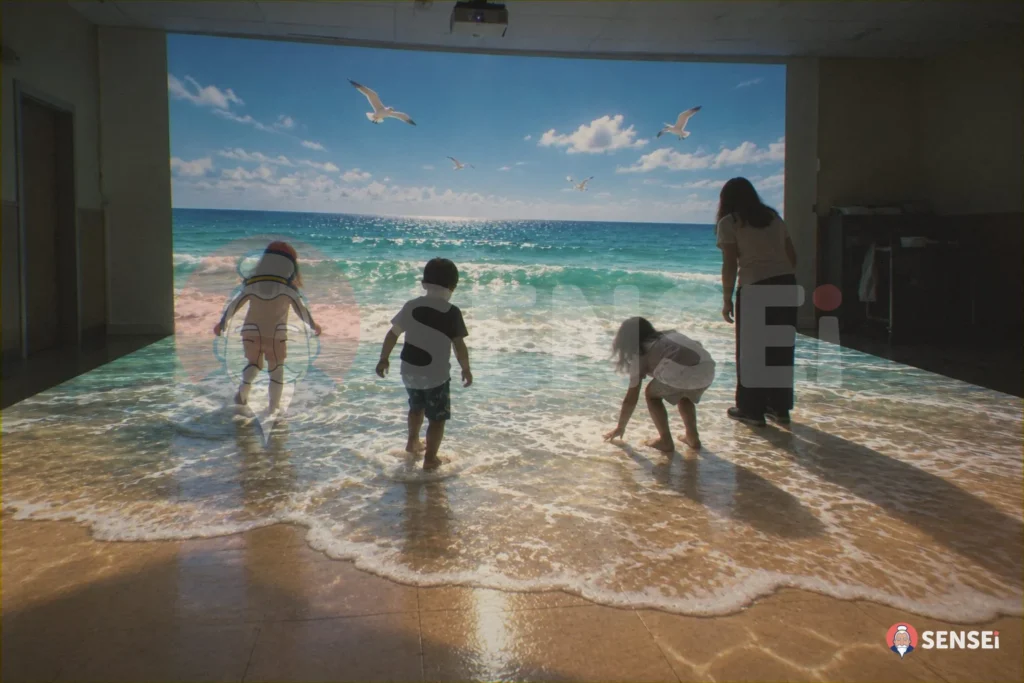
In the immersive room, the sea can be experienced even far from the beach: waves on the floor that retreat as the children pass, fish that come closer if you move slowly, the sound of the surf and materials to touch such as kinetic sand and shells. Here you will find 10 ready-made activities for summer camps, each with its goal, what is projected, sounds, materials and duration.
The activity sheets are designed for preschool and primary school, with adaptations for nursery, to be carried out in a SENSEi magic room or, in a simplified form, with images and everyday materials. They are a way of making summer a time of discovery, movement and connection, not just supervision.
Why bring the sea into the immersive room in summer?
Summer camps have mixed-age groups and long, hot days. The immersive room offers a cosy, cool place in which to alternate movement and calm, and where older children can guide younger ones.
The sea is a perfect theme for multisensory work: it has colours, sounds, textures and scents that everyone recognises. According to research on multisensory learning, activities that combine several senses consistently come closer to the natural conditions in which we learn (Shams and Seitz, Trends in Cognitive Sciences). Many activities also involve the body: in the study on the IMAGINE immersive space, carried out by the SENSEi research group with 48 primary school children, learning by moving inside content on the wall and floor showed interesting educational potential (CHI). It is one of the studies in a body of work that counts more than 40 scientific publications.
How to use the activity sheets
- Each activity follows the same structure: calm entry, active phase, calm close.
- Durations are indicative and should be adapted to the group.
- If a child moves away or covers their ears, lower the lights and sounds and offer them a quiet corner.
10 activities on summer and the sea
1. Waves on the shore
- Goal: eye-foot coordination, cause and effect, waiting for one’s turn.
- What is projected: on the floor, the shoreline seen from above; when a child enters the water area, the waves retreat, leaving footprints in the sand.
- Sounds: slow surf, a few seagulls in the distance.
- Materials to touch: a sand-coloured sheet around the edges, a tray of kinetic sand on a separate small table.
- Duration: 10 minutes (nursery 5 minutes, held in arms or crawling).
2. Collect the shells
- Goal: counting, recognising shapes and colours, collaborating.
- What is projected: shells and starfish scattered across the floor; standing still on a shell sends it into the bucket drawn on the wall.
- Sounds: a different gentle sound for each type of shell, a melody when the bucket is full.
- Materials to touch: large real shells (not small ones for the youngest children) and a bucket to touch after the game.
- Duration: 15 minutes.
3. The seabed
- Goal: vocabulary of sea creatures, shared attention, controlled movement.
- What is projected: walls and floor become a seabed with fish, octopuses and turtles; slowly raising an arm makes the fish come closer, sudden movements make them swim away.
- Sounds: water bubbles, slow underwater music; the animal’s name is spoken when a child points to it.
- Materials to touch: sensory bags with blue gel and small fish figures sealed inside, a natural sponge.
- Duration: 15-20 minutes.
4. Sandcastles
- Goal: fine motor skills, creativity, describing what you are doing.
- What is projected: a beach at sunset on one wall; for each castle completed at the table, the educator makes a coloured flag appear on the projected beach.
- Sounds: cheerful music at low volume, waves in the background.
- Materials to touch: kinetic sand in high-sided trays, moulds, small spades; a mat under each tray.
- Duration: 20 minutes.
5. The turtle returns to the sea
- Goal: cooperation, problem solving, first environmental education themes.
- What is projected: on the floor, a path from the beach to the sea with baby turtles; the children have to clear the way of obstacles (seaweed, sticks) by touching them with their feet, then accompany the turtles to the water.
- Sounds: footsteps on the sand, a celebratory sound when each turtle reaches the sea.
- Materials to touch: a padded fabric turtle shell to pass around the circle at the end.
- Duration: 15 minutes.
6. Let’s clean the beach
- Goal: sorting, recycling, respect for the environment.
- What is projected: a beach with scattered litter (bottles, paper, cans); on the wall, three coloured bins; the children drag each item into the right bin with a gesture.
- Sounds: a positive sound for each correct choice, a neutral sound (never a punishing one) for a mistake.
- Materials to touch: real clean items to sort into three baskets: a plastic bottle, a piece of card, a jar with no sharp edges.
- Duration: 15-20 minutes (suitable above all for preschool and primary school).
7. The lighthouse at night
- Goal: relaxation, breathing, a calm end to the day.
- What is projected: a night sea with stars; the lighthouse beam rotates very slowly across the walls; the sea calms down when the group stays still.
- Sounds: slow waves, a music box.
- Materials to touch: cushions and light blankets, a smooth stone to hold.
- Duration: 10 minutes.
The lighthouse beam must move slowly, without flashing: rapid intermittent lights should be avoided for anyone with photosensitivity.
8. The summer storm
- Goal: anticipating an event, recognising and expressing emotions (surprise, fear, relief).
- What is projected: a blue sky that clouds over, rain on the floor, then sunshine again and a rainbow.
- Sounds: wind, rain; the thunder is soft and always announced by the educator with an agreed gesture.
- Materials to touch: a rain stick, a fabric sheet to shake together to make wind, a mister to feel a few drops.
- Duration: 10-15 minutes.
With children who are sensitive to noise, the thunder can be removed entirely, leaving only rain and wind.
9. The colour ice-cream parlour
- Goal: recognising and mixing colours, making choices, first elements of a foreign language with older children.
- What is projected: a large empty ice-cream cup on the wall; coloured circles on the floor as flavours; two children on two different colours make a scoop of the mixed colour appear.
- Sounds: a different sound for each flavour, the name of the colour in Italian and, for older children, in English.
- Materials to touch: wooden spoons, soft coloured balls, a fruit scent (strawberry or lemon) to smell in turn.
- Duration: 15 minutes.
10. The regatta
- Goal: group coordination, rhythm, collaboration between teams.
- What is projected: an open sea with two sailing boats; the more the group waves their arms, the more the wind blows and the boat moves towards the buoy.
- Sounds: wind, flapping sails, a drum keeping the rhythm.
- Materials to touch: light scarves to wave like sails, a fan to feel the air on your face.
- Duration: 15 minutes.
In the cooperative version the two teams have to arrive together: a simple way to work on waiting and agreement.
How to adapt the activities to different ages
| Age | What changes | Recommended examples |
|---|---|---|
| Nursery (1-3 years) | Groups of 3-5 children, 5-10 minutes, slow stimuli, adult close by | Waves on the shore, The seabed, The lighthouse at night |
| Preschool (3-6 years) | Simple rules, group play, 15-20 minutes | Collect the shells, The turtle returns to the sea, The colour ice-cream parlour |
| Primary (6-11 years) | Subject content, teams, final reflection | Let’s clean the beach, The regatta, The summer storm |
For the youngest children you will find detailed guidance in the guide to the immersive room at nursery. The group activities with cooperative and competitive teams draw on an idea studied with Ahù, a mobile multisensory solution designed for classroom games, which in an exploratory study showed potential for engagement, collaboration and socialisation (ISS).
What changes for children and educators?
In the summer months groups change often and educators do not always know the children. A well-structured immersive activity helps break the ice: everyone takes part, including those who do not yet speak Italian well or have particular needs, because the play happens through the body and the senses. For educators it is a simple way to observe the group, propose shared rules and end the day calmly.
The experience does not stay shut in a room. With the Cooperativa ORSA, a mobile SENSEi kit brings a journey through the senses to six municipal preschools in Milan. At the IC Silvio Pellico in Arluno, alongside the environments in the school sites, there is also an outdoor classroom.
Safety in the immersive room in summer
- Sand and water away from electronics. Use kinetic sand in high-sided trays and keep misters away from sockets and devices.
- Dry floor. If you use soap bubbles or water sprays, dry the floor immediately: it becomes slippery.
- No rapid flashing. Lightning, lighthouses and party lights must change slowly. International guidelines on photosensitive epilepsy recommend not exceeding 3 flashes per second (International Guidelines for Photosensitive Epilepsy).
- Scents with caution. Ask families about allergies and sensitivities before using scents.
- Small objects. At nursery, no small shells or objects that could be put in the mouth.
- Heat and hydration. Air the room between groups and plan a break for drinking.
How to create the activities with Eureka
With the Eureka platform you can build these activities starting from the goal: choose the scenario (beach, seabed, open sea), the interactions (steps, gestures, voice), the sounds and the lights, and adapt intensity and duration to your group, including with the help of artificial intelligence. During the activity the educator adjusts everything from the tablet. For more ideas, read the 30 examples of multisensory activities and, when September comes, the ideas for autumn in the immersive room.
Frequently asked questions
Are the activities suitable for mixed-age groups?
Yes. Choose activities with several levels of participation, such as The seabed or The regatta, and give older children helper roles.
How many children can take part at once?
It depends on the space. At nursery, 3-5 children; with preschool and primary school you can go up to a small class group, alternating between those who act and those who observe.
Can real sand be used?
Kinetic sand in trays is better, as it is easier to contain. Real sand spreads and can damage the devices.
Are the activities suitable for autistic children?
Yes, with a few precautions: explain in advance what will happen, reduce sudden sounds, leave the option to leave and, where possible, let the child control the stimulus.
Want to create your own summer activities in a few minutes? Discover Eureka.
Sources
- Shams L., Seitz A. R. (2008). Benefits of multisensory learning. Trends in Cognitive Sciences
- Gelsomini M., Leonardi G., Garzotto F. (2020). Embodied Learning in Immersive Smart Spaces. CHI 2020
- Gelsomini M. et al. (2018). On the Effects of a Nomadic Multisensory Solution for Children’s Playful Learning. ISS 2018
- International Guidelines for Photosensitive Epilepsy: Gap Analysis and Recommendations (2024). ACM Transactions on Accessible Computing