
Christmas in the immersive room is a set of short activities in which lights, projections, sounds and materials to touch transform the room into a winter landscape to explore with the body. Here you will find 10 ready-to-use activities for nursery and preschool, each with a secular version (festival of lights, winter, snow) suited to multicultural classes.
The activity cards follow the same structure: goal, what is projected, sounds, materials to touch and duration. They are designed for a SENSEi magic room, but many ideas also work with a simple projector and a little music.
Why bring Christmas into the immersive room?
December is a month full of stimuli, sometimes too many. The immersive room makes it possible to experience the festive atmosphere in a controlled and predictable way: the educator decides light intensity, volume and pace, and can turn everything down in an instant if a child becomes agitated.
Multisensory experiences involve the body. A controlled study with 48 children aged 6 to 8 in a primary school suggests that learning with the body in an immersive space has educational value, including compared with traditional teaching (see Embodied Learning in Immersive Smart Spaces). At nursery and preschool the same principle applies: children explore by moving. The Magika project, designed with more than 30 specialists from care centres and primary schools, shows how images, lights and real objects can become a single experience of play, education and inclusion. These are two milestones in a research journey that today counts more than 40 scientific publications and shapes every SENSEi activity.
Christmas or festival of lights: how to include every family?
Many classes bring together families with different traditions. This is why each activity has two variants:
- Christmas version: tree, star, presents, sleigh.
- Secular version: winter lights, snow, stars, woodland animals, the return of light after the longest night.
The secular version takes nothing away from the sensory experience and lets every child recognise themselves in the celebration. Talk about it with families at the beginning of December: it is a good way to collect songs, words and sounds from different cultures to include in the activities.
The 10 activities for nursery and preschool
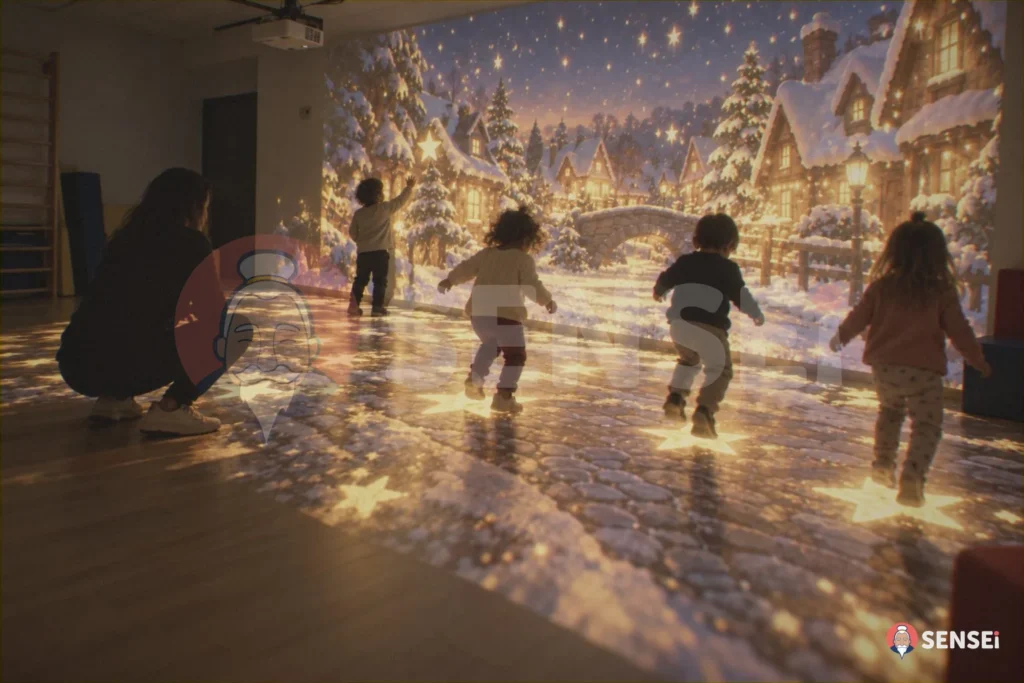
1. Snow falling on the floor
- Goal: explore free movement and cause and effect.
- What is projected: snowflakes that move when a child walks over them.
- Sounds: gentle rustling, distant little bells.
- Materials to touch: cotton wool, pieces of white fleece, soft cushions.
- Duration: 8-10 minutes at nursery, 15 minutes at preschool.
- Secular version: identical, it is already a winter celebration.
2. The tree that lights up
- Goal: shared attention and waiting for one’s turn.
- What is projected: a large bare tree on the wall; each gesture switches on a coloured light.
- Sounds: a different note for each light.
- Materials: soft fabric baubles to “hang” on a felt panel.
- Duration: 10 minutes.
- Secular version: the forest tree that fills up with fireflies.
3. The star that leads the way
- Goal: motor coordination and spatial orientation.
- What is projected: a star that moves slowly across the floor and leaves a glowing trail to follow.
- Sounds: slow, steady music.
- Materials: a soft ribbon for everyone to hold together, like a little train.
- Duration: 5-8 minutes.
- Secular version: the North Star guiding the animals back to their den.
4. Surprise parcels
- Goal: tactile exploration and language (naming shapes and textures).
- What is projected: colourful parcels that open with a touch and reveal an animal or an object.
- Sounds: the animal’s call, the object’s name spoken in a calm voice.
- Materials: real boxes wrapped in paper of different textures (smooth, rough, crêpe).
- Duration: 10-15 minutes.
- Secular version: boxes of gifts from the woods (pine cones, dry leaves, chestnuts).
5. The sleigh and the reindeer
- Goal: motor imitation and rhythm.
- What is projected: a snowy landscape scrolling across the walls, as if the room were travelling.
- Sounds: sleigh bells and footsteps in the snow at varying rhythms.
- Materials: fabric bells to shake.
- Duration: 8 minutes.
- Secular version: the journey of the winter animals (reindeer, foxes, hares).
6. The village at night
- Goal: relaxation and regulation.
- What is projected: a village with windows lighting up one by one, a starry sky.
- Sounds: music box, light wind.
- Lights: warm, very dim ambient light.
- Materials: soft blankets and cushions.
- Duration: 10 minutes, ideal as a closing activity.
- Secular version: it already suits everyone.
7. The scent of the holidays
- Goal: olfactory discovery and memory.
- What is projected: a cosy kitchen or a winter forest.
- Scents: orange, cinnamon or pine, diffused very sparingly.
- Materials: dried orange peel and cinnamon sticks in closed cloth bags.
- Duration: 5-8 minutes.
- Caution: always check allergies and sensitivities before using scents.
8. The snowflake dance
- Goal: body expression and listening.
- What is projected: snowflakes that change colour and speed following the music.
- Sounds: alternating slow and fast pieces, to practise stop and go.
- Materials: light scarves to send flying.
- Duration: 10 minutes.
- Secular version: the snow dance.
9. Ice bubbles
- Goal: visual tracking and fine motor skills.
- What is projected: a frozen lake on the floor.
- Effects: a few light bubbles rising slowly, with a cold blue light.
- Materials: non-slip mats.
- Duration: 5 minutes.
- Caution: bubbles make the floor slippery, so work with small groups and dry it immediately.
10. The festival of lights
- Goal: group participation and sharing.
- What is projected: the dark room lighting up in a new colour every time a child raises their arms.
- Sounds: a song chosen with the families, even in several languages.
- Materials: cool LED lanterns, never real candles.
- Duration: 10-15 minutes, perfect for the end-of-year party.
- Christmas version: the final lighting of the tree.
How to adapt the activities for nursery and preschool?
At nursery, sessions should be short, slow and with few stimuli at a time. Better a single projection and a single sound, with the educator sitting on the floor near the children. To find out more, see the dedicated guide to the immersive room at nursery and the winter activities for nursery.
At preschool you can introduce simple game rules, turn-taking and longer stories. Five-year-olds can also suggest variations: choosing the colours, inventing a name for the star, recording their own voice. More ideas for this age group are on the page SENSEi for preschool.
A useful reference is the World Health Organization: for children under 2 it advises against sedentary screen time. In the immersive room the projection is not watched sitting down, it is explored by moving. This is precisely why it is best to alternate active moments and calm moments, and not turn the session into “watching a video”.
What do the children and the class take away?
A well-led activity leaves more than a nice memory. Children wait their turn, share a discovery, find in the room the words and songs learned in class. Those who struggle to be part of the group find a way to take part, perhaps by lighting the star for everyone. Educators, by observing, discover preferences and skills that remain hidden at other times.
This is what the schools that use SENSEi every day tell us. At IC Perlasca in Bareggio the magic room accompanies children from 3 to 14 years old; at IC Silvio Pellico in Arluno there is an environment in every school building, designed with the teachers, plus an outdoor classroom.
Safety: what to check before starting
- Light: avoid rapid flashing and sudden colour changes.
- Volume: keep it low, especially with children with auditory hypersensitivity.
- Scents and bubbles: check allergies, use minimal intensity, air the room.
- Floor: free of small objects and liquids.
- Way out: every child must be able to leave the activity and find a quiet corner.
- No flames: LED lights only.
Frequently asked questions
From what age can Christmas activities be offered in the immersive room?
From nursery onwards. For the youngest, sessions of 5-10 minutes with few stimuli are enough; at preschool you can go up to 15-20 minutes with simple game rules.
How can the activities be made inclusive for multicultural classes?
Use the secular version (winter, snow, festival of lights) and involve families in choosing songs and words in several languages.
Do you need a special room?
No. SENSEi transforms an existing room with discreet ceiling-mounted technology, using walls and floor with no building work.
Can I create a personalised Christmas activity?
Yes. With Eureka you can create and share multisensory activities, choosing images, sounds and interactions.
Are the activities also suitable for autistic children?
They can be adapted by reducing the intensity and number of stimuli and announcing every change in advance. Always provide a calm corner and observe each child’s reactions.
Discover Eureka
Would you like to prepare your immersive Christmas with images, sounds and stories from your class? Discover Eureka, the platform for creating and sharing multisensory activities.
Sources
- Gelsomini, Leonardi, Garzotto (2020). Embodied Learning in Immersive Smart Spaces. CHI 2020. doi:10.1145/3313831.3376667
- Gelsomini et al. (2019). Magika, a Multisensory Environment for Play, Education and Inclusion. CHI EA 2019. doi:10.1145/3290607.3312753
- WHO (2019). To grow up healthy, children need to sit less and play more