
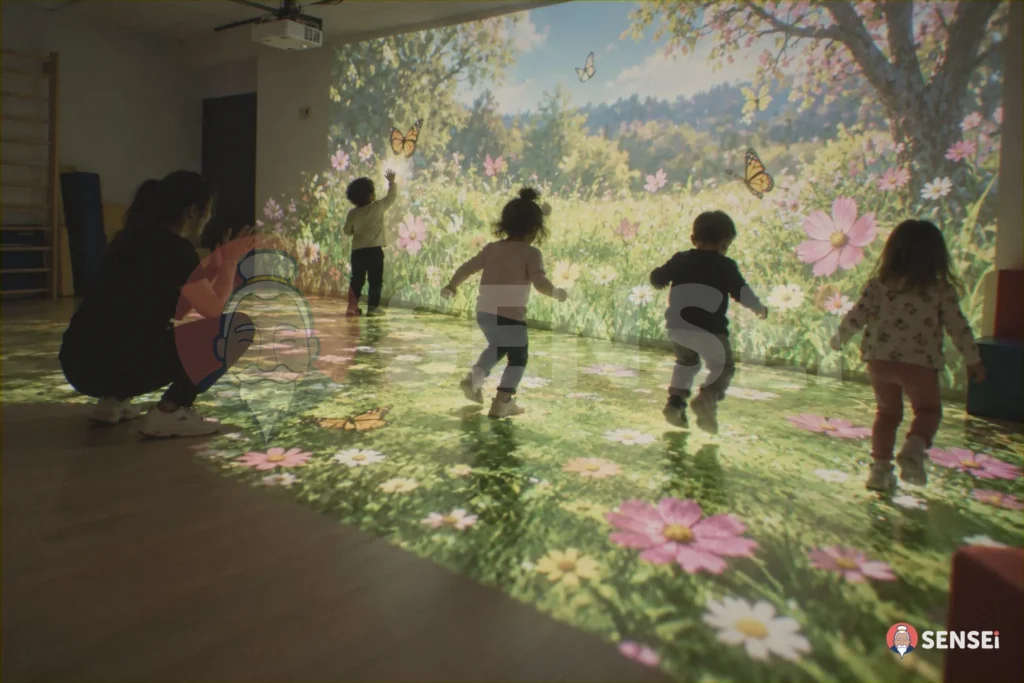
Spring comes into the immersive room with flowering meadows, butterflies to chase, light rain and growing seeds, together with real materials to touch and smell. The activities work at nursery and preschool if they are short, slow and give children time to explore.
Here you will find ten ready-to-use activity sheets, with goal, content, sounds, materials and duration, plus guidance on safety, adapting to age and documentation.
Why bring spring into the immersive room?
Spring is made of visible changes: the light, the colours, the sounds of animals, brief showers. In an immersive room these changes can be slowed down, repeated and linked to the children’s movement. A step makes a flower bloom, a raised arm makes a butterfly fly. This is the relationship between cause and effect, which is very important in the early years.
It is also the heart of the research from which SENSEi was born. With Magika, at Politecnico di Milano, the group designs environments in which images, sounds, scents and real objects work together, with activities that the educator adapts to each child. A study on a mobile multisensory solution suggests that these experiences can support engagement, collaboration and socialisation. They are pieces of a body of work that today counts more than 40 scientific publications, collected on the Research page.
Ten spring activities
1. The meadow wakes up
- Goal: observe a slow change and name the colours.
- What is projected: a grey meadow that fills with grass and flowers as the children walk across it.
- Sounds: birdsong and a light breeze.
- To touch: an artificial grass mat, fabric flowers.
- Duration: 10 minutes.
- How it works: the children come in quietly, the educator explains that the meadow is asleep; every step wakes it up a little.
2. The butterflies
- Goal: hand-eye coordination, movement in space.
- What is projected: colourful butterflies flying across walls and floor and landing wherever a hand reaches.
- Sounds: light music with strings.
- To touch: light scarves to make fly.
- Duration: 10-15 minutes.
- How it works: the children chase the butterflies, then become butterflies with the scarves.
3. Spring rain
- Goal: listening, anticipation, an inside-and-outside game.
- What is projected: a sky clouding over, drops falling on the floor.
- Sounds: light rain, distant thunder at low volume.
- To touch: small umbrellas, rain sticks, damp cloths.
- Duration: 10 minutes.
- How it works: when the rain comes, everyone shelters under the umbrellas; when the sun returns, they come out to jump.
4. The growing seed
- Goal: body awareness, time sequences.
- What is projected: a seed in the soil that sprouts and becomes a plant.
- Sounds: music that slowly builds.
- To touch: soil in a tray, large seeds, small pots.
- Duration: 10 minutes plus real sowing.
- How it works: the children curl up like seeds and slowly rise; at the end they sow a small pot to look after in the classroom.
5. The birds’ nest
- Goal: recognising bird calls, symbolic play.
- What is projected: a tree with a nest, little birds arriving and flying off.
- Sounds: calls of different birds.
- To touch: feathers, twigs, a straw nest.
- Duration: 10 minutes.
- How it works: at each call, the children look for the bird on the wall; with the youngest, they stroke the feathers.
6. The colours of the flowers
- Goal: sorting by colour, first words.
- What is projected: flowers appearing on the floor in four colours.
- Sounds: a different sound for each colour.
- To touch: coloured hoops, cardboard flowers.
- Duration: 10-15 minutes.
- How it works: the children gather the flowers of one colour and carry them to the right hoop.
7. Bees in flight
- Goal: following a path, rhythm.
- What is projected: bees flying from one flower to another, leaving a trail.
- Sounds: a light buzzing and rhythmic music.
- To touch: yellow and black pompoms, fabric flowers.
- Duration: 10 minutes.
- How it works: the children follow the trail like bees; when the music changes, they stop on a flower.
8. The frog pond
- Goal: jumping, balance, counting.
- What is projected: a pond with water lilies to jump on; a frog appears with each jump.
- Sounds: water, croaking.
- To touch: flat cushions as water lilies.
- Duration: 10 minutes.
- How it works: one jump at a time from one lily to the next; the older children count the frogs.
9. The wind in the trees
- Goal: perceiving air movement, relaxation.
- What is projected: treetops swaying, petals flying.
- Sounds: wind, leaves.
- To touch: a hand fan, ribbons, a large sheet.
- Duration: 10 minutes.
- How it works: the educator makes wind with the sheet; the children move their arms like branches, then lie down to watch the petals.
10. The spring party
- Goal: being together, sharing.
- What is projected: a garden in bloom with warm lights and bubbles.
- Sounds: cheerful music.
- To touch: flowers, maracas, scarves.
- Duration: 15 minutes.
- How it works: a ring-a-roses in the garden, then a goodbye moment as the light dims.
Scents and safety
Spring is also made of smells. If the room also uses scents, it is best to choose light fragrances and to check beforehand for children’s allergies and sensitivities. The same goes for real pollen, fresh flowers and soil: clean, checked materials are better.
- Floor clear of objects that children could trip over while running.
- Low volume and lights without rapid flashing.
- Small materials only with children who no longer put everything in their mouths.
- A quiet corner for those who need a break.
How to adapt the activities to age?
| Age | What to focus on | Duration |
|---|---|---|
| Infants | slowly changing light, gentle sounds, soft materials to touch while being held | 5 minutes |
| Young toddlers | cause and effect with steps and hands, crawling and walking on the projected meadow | 5-10 minutes |
| Older toddlers | chasing, jumping, gathering, first words | 10 minutes |
| 3-6 years | simple rules, counting, sorting, short stories | 10-20 minutes |
For a complete guide to nursery, read The immersive room at nursery: a guide for educators. For preschool, see SENSEi for preschool.
Observing and documenting
The guidelines for Italy’s integrated 0-6 system describe documentation as a tool for pedagogical reflection, also useful for sharing pathways with families. After each activity a few notes are enough: who came closer, what caught their attention, which words emerged, what to repeat. Photos and videos must be collected with the families’ consent.
What changes for children and educators?
For children, the season becomes an experience lived with the body: the rain is listened to and waited for, the seed is something you become. For educators, the room is an ally that adapts to the group of the day: slower for the little ones, richer in rules for the older ones, always guided from a tablet. And families find at home words and emotions born in the classroom.
With Cooperativa ORSA, a mobile SENSEi kit brings the programme “All’avventura tra i sensi” to six municipal preschools in Milan. At ICS IV Novembre in Cornaredo, the magic room has been growing for years together with the preschools.
The calendar of the seasons
Spring concludes a journey that runs through the whole year. You can find the other proposals in Winter in the immersive room, Carnival in the immersive room and Summer and the sea in the immersive room.
Frequently asked questions
From what age can the immersive room be used?
From nursery onwards, with slow stimuli, low volume and the constant presence of the educator.
How many activities should be done in one session?
One or two, with an opening and a closing moment. It is better to repeat the same activity several times than to change it often.
Are real materials needed if there is a projection?
Yes. Touching a petal or a feather completes what is seen and heard: this is what makes the experience multisensory.
Can custom spring scenes be created?
Yes, with Eureka the educator can create tailor-made activities and share them with colleagues.
Create your own immersive spring
With Eureka you can create scenes, sounds and activities for your class. Discover Eureka.
Sources
- Gelsomini et al. (2019), Magika, a Multisensory Environment for Play, Education and Inclusion, ACM CHI Extended Abstracts
- Garzotto, Gelsomini, Gianotti, Riccardi (2019), Engaging Children with Neurodevelopmental Disorder Through Multisensory Interactive Experiences in a Smart Space, Social Internet of Things
- Gelsomini et al. (2018), On the Effects of a Nomadic Multisensory Solution for Children’s Playful Learning, ACM ISS
- USR Lazio, Guidelines for the integrated 0-6 system (Linee guida di indirizzo del sistema integrato 0-6 anni)