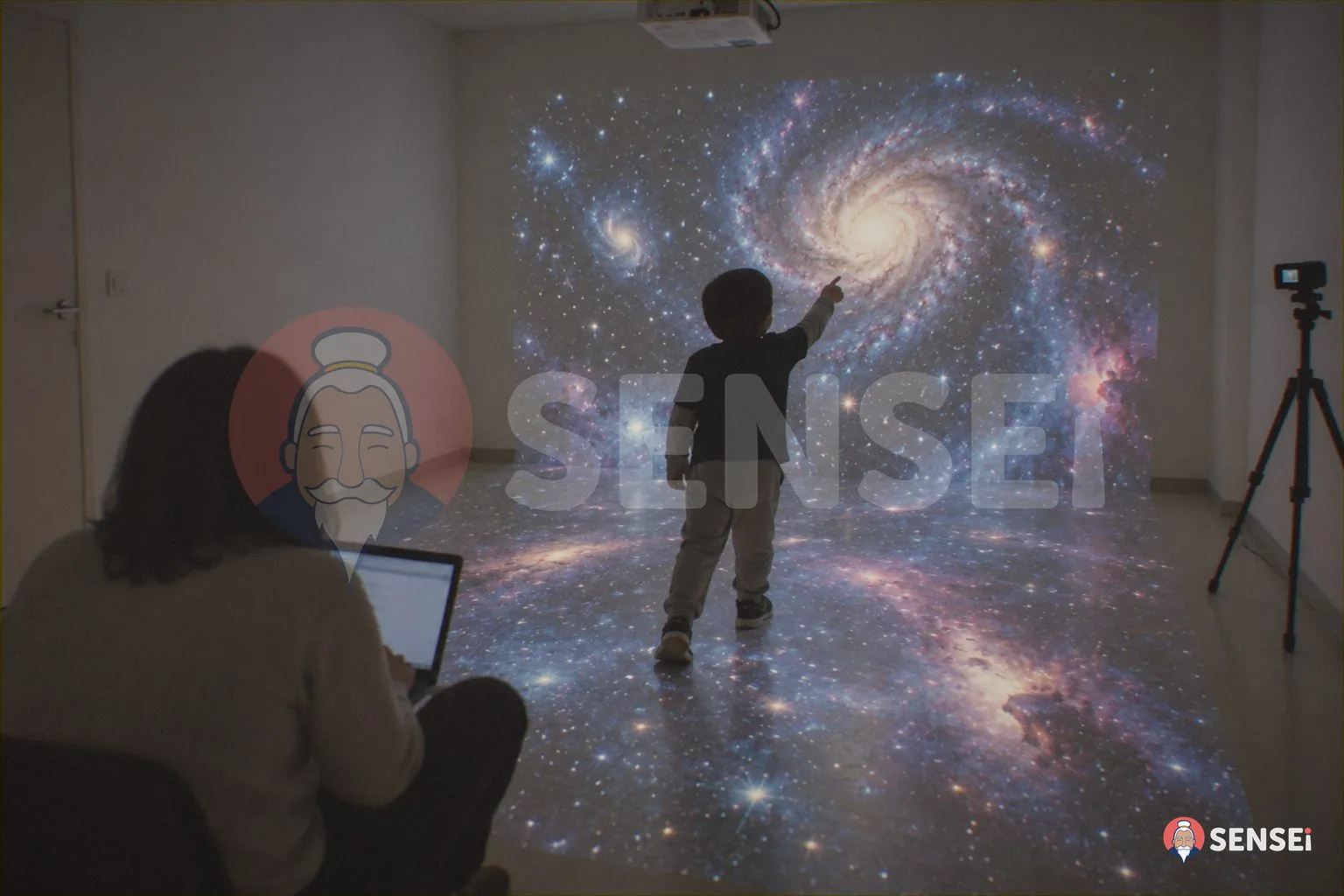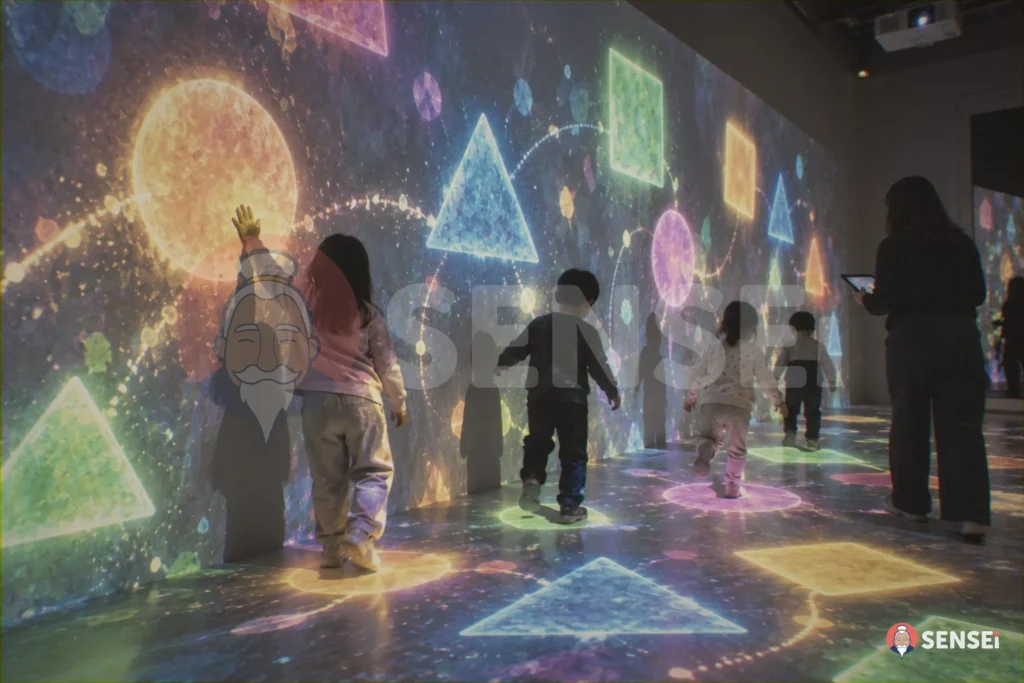
Not just therapy: play, education and inclusion in the same space. Magika, an interactive multisensory environment presented at the ACM CHI conference, is the research project closest to what is today the SENSEi room.
It was born from co-design with more than 30 specialists from schools and care settings, and it puts the educator at the centre of the experience. Two choices that SENSEi never abandons.
What is the research question?
Magika continues the work of the Magic Room, the smart room trialled in two Italian therapy centres. The step forward is in the title: play, education and inclusion in a single environment.
The question is therefore broader: can a single space welcome children, in particular those with special educational needs, both in care settings and in primary school? The team behind it numbers twenty people, a sign of the broad teamwork typical of applied research.
The study in brief
The group designs Magika with more than 30 specialists from local care centres and primary schools. Co-design with those who work with children every day is part of the method from the start.
The environment brings together two worlds: digital worlds that come to life on wall and floor, and “smart” physical objects such as toys, ambient lights and materials. Together they generate tactile, auditory, visual and olfactory stimuli. The child does not just watch: they touch, move, listen, smell.
The heart of the project is an interface for educators, which makes it possible to:
- control the level of stimuli and their progression;
- create and share play-based learning activities;
- personalise activities according to each child’s needs, which change over time.
The educator remains the director of the experience. Technology provides tools to dose, create and adapt.
What emerges?
The group presents Magika in an extended abstract: it describes the environment and discusses its potential benefits for play, education and inclusion. It does not present an effectiveness study with quantitative measures.
Its value lies in the model it proposes: a single environment, co-designed with school and care specialists, that puts the adult at the centre of control. The same group then evaluates specific aspects in later studies, such as the one on embodied learning.
Why does it matter today?
SENSEi starts here: after Magic Room, Magika is the second Politecnico di Milano project from which it takes shape, within a journey documented in more than forty scientific articles. Many elements of Magika can be found almost unchanged in the SENSEi magic room:
- interactive walls and floor, which respond to gestures and movements;
- lights, sounds, scents, bubbles and tactile objects that switch on with the activity;
- control from the tablet for the educator or therapist, in real time;
- creating and sharing activities, today with the Eureka platform.
The underlying principle remains too. SENSEi calls it reverse inclusion, and it is already written into Magika’s title: if an environment is designed for children with special educational needs, play and education open up to the whole group. And co-design with teachers and care teams remains the starting point of every new environment. Discover the areas of use on the Education page.
The original publication is in the Research section: Magika, a Multisensory Environment for Play, Education and Inclusion. The earlier work is the article on the Magic Room published in IEEE Pervasive Computing.
Frequently asked questions
What is Magika?
It is an interactive multisensory environment for play, education and inclusion, designed for children, in particular those with special educational needs. It combines digital worlds on wall and floor with connected physical objects.
Who takes part in the design?
The group co-designs it with more than 30 specialists from local care centres and primary schools.
What is the difference between Magika and SENSEi?
Magika is a research project. SENSEi is its evolution: a platform that transforms an existing room, with activities created and shared through Eureka.
How much does an environment like this cost?
It depends on the configuration: space, experiences, training and services. Contact us for an assessment.
Do you work in a school, a centre or a museum and want an environment like this? Tell us about your project: we start from the needs of the people who will use it.
Sources
- Gelsomini M., Cosentino G., Spitale M., Gianotti M., Fisicaro D., Leonardi G., Riccardi F., Piselli A., Beccaluva E., Bonadies B., Di Terlizzi L., Zinzone M., Alberti S., Rebourg C., Carulli M., Garzotto F., Arquilla V., Bisson M., Del Curto B., Bordegoni M. (2019). Magika, a Multisensory Environment for Play, Education and Inclusion. CHI EA 2019, ACM
- Garzotto F., Gelsomini M. (2018). Magic Room: A Smart Space for Children with Neurodevelopmental Disorder. IEEE Pervasive Computing