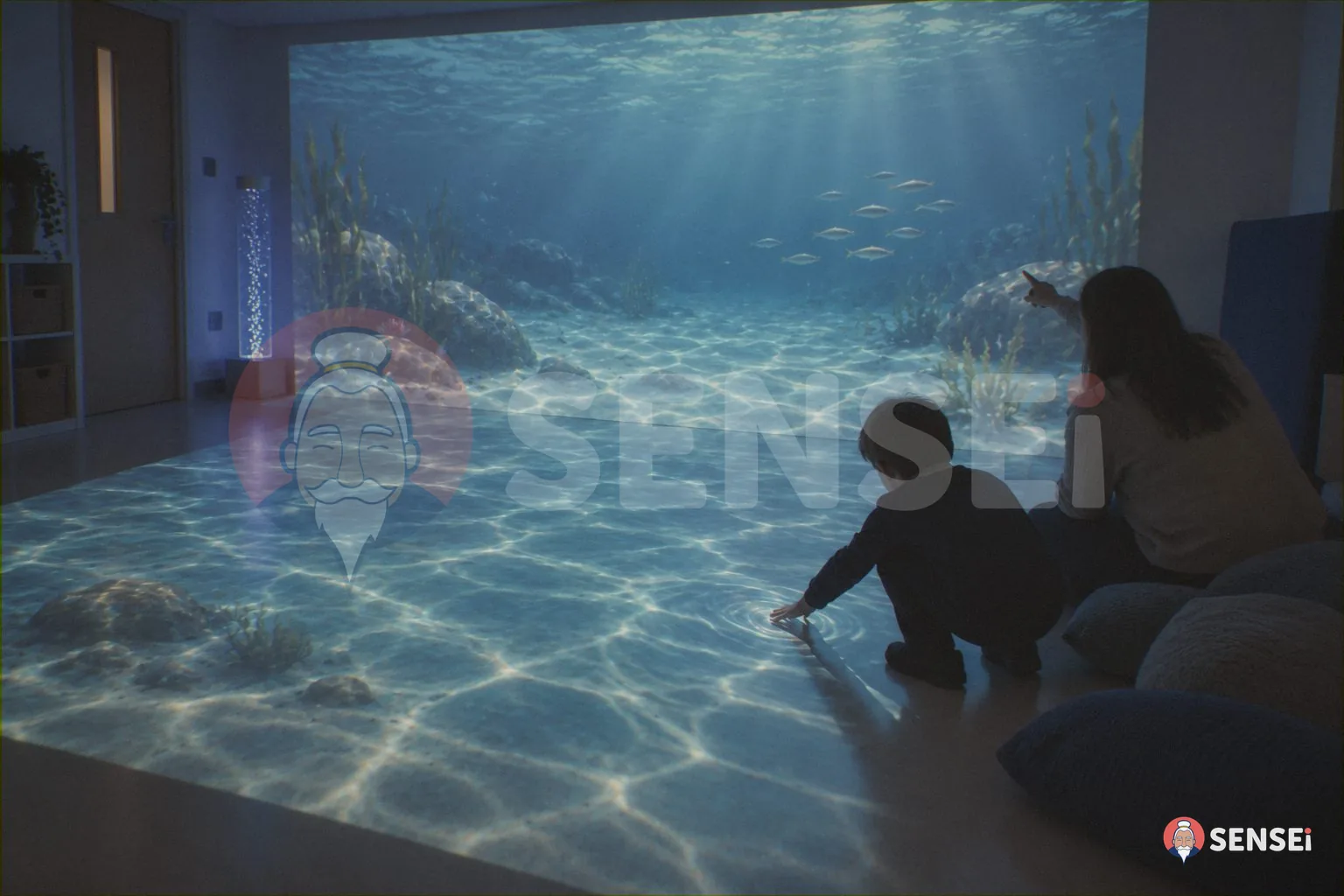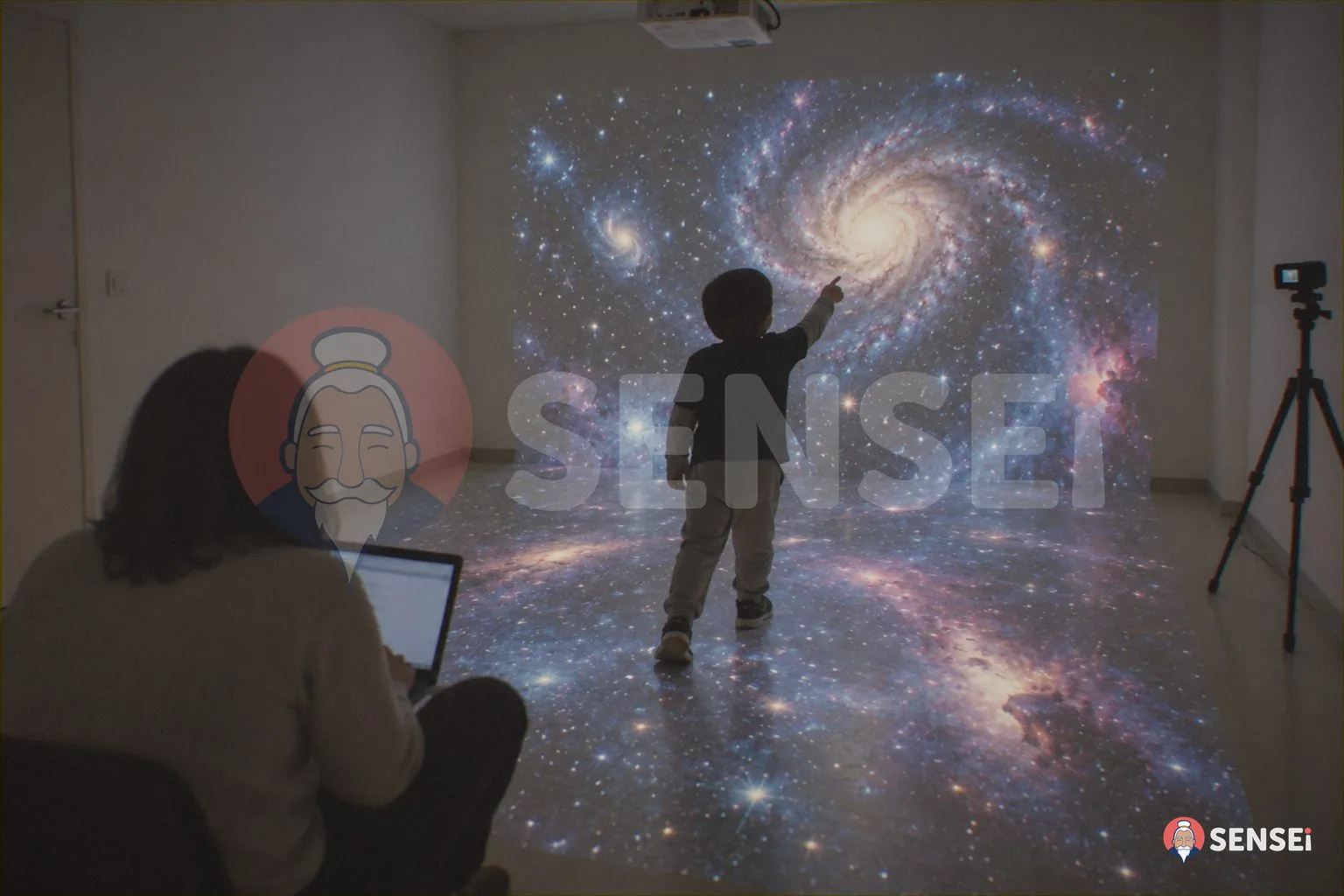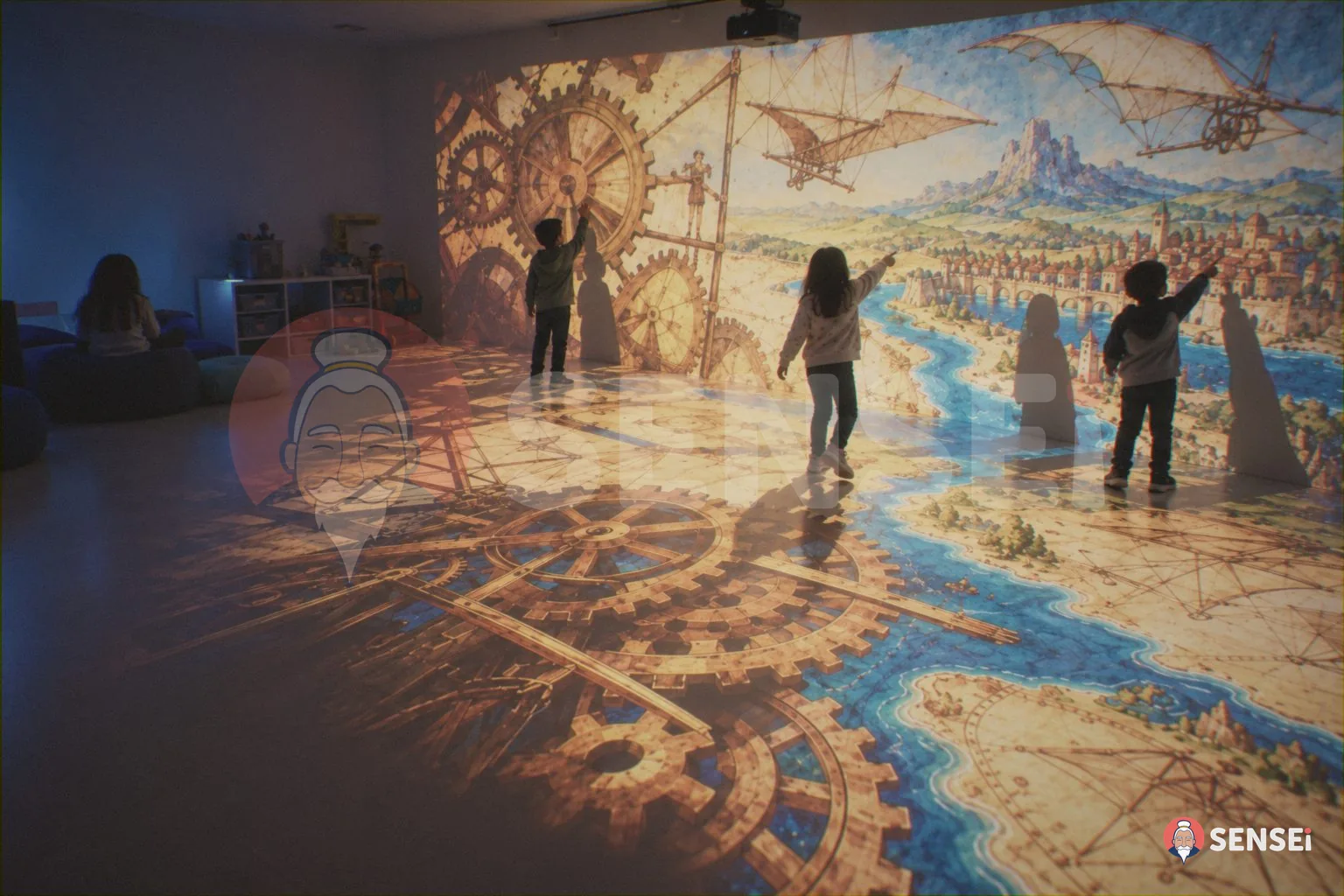

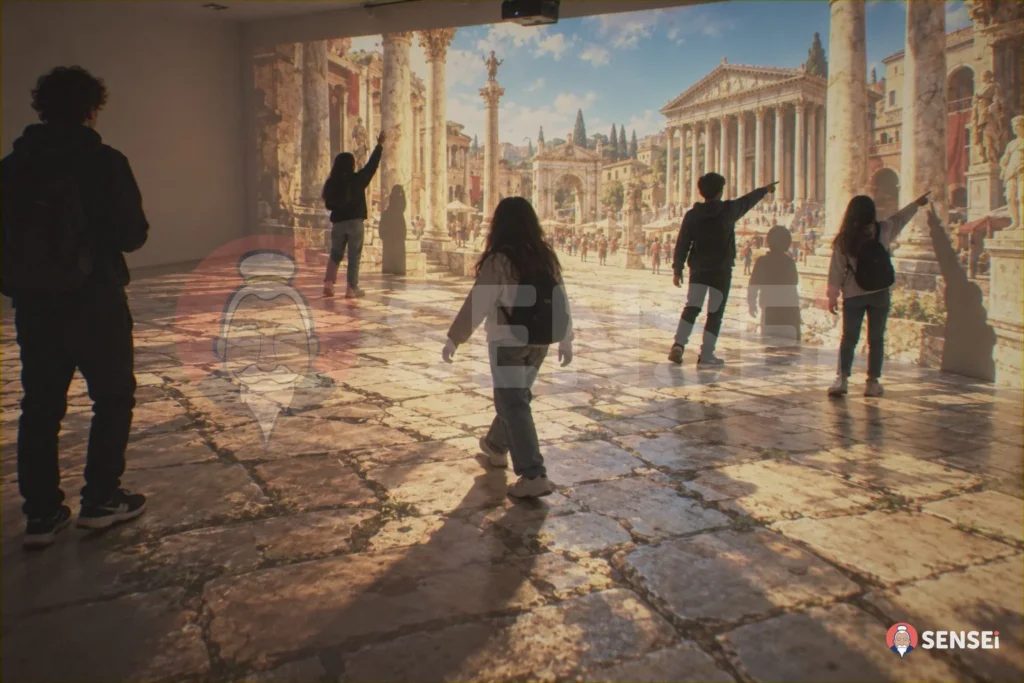
In lower and upper secondary school, the immersive classroom makes abstract concepts visible and hands-on: graphs, scientific models, historical places, situations in a foreign language. Students do not watch content, they step into it and act, alone or in groups, with the teacher guiding and asking questions.
This guide suggests activities for STEM, history and languages, describes a recent study on mathematics with the body and gives practical advice on timetable, groups and inclusion.
Why an immersive classroom in secondary school?
As students get older, abstraction carries more weight. Negative numbers, functions, forces, chemical reactions, timelines: many students only encounter them on the page. An environment in which the concept takes shape in space, and in which their own movement produces an effect, offers another way in. It does not replace the textbook or the exercise, it prepares for them and completes them.
In the SENSEi offer for secondary school the motto is “Engage. Think. Connect.”: experiences that develop critical thinking, collaboration and personalised learning.
What research says: mathematics with the body and artificial intelligence
In the article published in the British Journal of Educational Technology, the SENSEi research group, with the Graduate School of Education at the University of California, Berkeley, and the Norwegian University of Science and Technology (NTNU), describes a study with 29 students across the three years of lower secondary school, each for about an hour with the support of a facilitator. The students solve integer arithmetic problems by walking along a number line, with feedback from an artificial intelligence system, multisensory cues and the teacher’s questions. The system is based on the SENSEi platform.
The study shows that AI feedback and teacher feedback are mostly complementary. Engagement is highest when the two are aligned. An avatar that mirrors the students’ movements supports spatial awareness and reflection. The hybrid approach also helps teachers identify misconceptions in real time. The practical account, written for teachers, is in the case Mathematics with the body and AI; the in-depth analysis is in Hybrid teaching intelligence and embodied mathematics.
The key point for a teacher is this: technology does not take the teacher’s place. It works best when teacher and system work together. This thread runs through the whole of SENSEi research, born at Politecnico di Milano and today documented by more than 40 scientific publications.
STEM activities
- Mathematics: the number line. Students move across the floor to add and subtract positive and negative numbers, then explain their strategy to the group.
- Mathematics: functions with the body. A projected graph reacts to the position of their hands; the group tries to reproduce a straight line, a parabola, exponential growth.
- Physics: motion and speed. Walking faster or slower in front of the wall and watching the distance-time graph take shape.
- Science: inside the cell. A wall-sized cell model; each group explores an organelle and presents it.
- Earth sciences: volcanoes and earthquakes. Scenes and sounds to connect phenomena with the planet’s internal structure. Popular science resources such as Geopop are integrated into SENSEi.
- Technology: the smart home. The room itself becomes a concrete example of input and output: the student’s gesture, the environment’s response.
History, art history and geography
- Visit to a Roman forum: the group enters the reconstruction, identifies buildings and their functions, and forms hypotheses about daily life.
- Inside a work of art: a painting projected across the whole wall to analyse composition, light and details, with resources such as Google Arts & Culture.
- The walkable timeline: events to place in space, with discussion of causes and consequences.
- Geography of landscapes: deserts, forests, cities, with data and images to compare.
Foreign languages and Italian
- Role play in context: an airport, a market, a museum projected around the students for realistic dialogues.
- Immersive listening: sounds and images of a foreign city, with comprehension questions.
- Live writing: an environment as a prompt for a descriptive or narrative text, then reread in class.
Civic education and guidance
The immersive space lends itself to decision-making simulations: designing a sustainable neighbourhood, discussing a dilemma, exploring workplaces. In upper secondary school, students can also become designers: with Eureka they can create activities for younger classes, a valuable experience of peer tutoring and digital skills.
How to organise the timetable and groups?
- Short modules: 20-30 minutes in the immersive classroom within a one-hour lesson, the rest for preparation and follow-up.
- Groups of 6-10 students: some act, some record data, some observe and comment, in rotation.
- Shared calendar: one booking per department keeps the space from going unused.
- The teacher in charge: from a tablet, the teacher starts the activity, adjusts the stimuli and pauses to discuss.
Inclusion in secondary school
In secondary school it is important that content does not feel childish. An immersive classroom makes it possible to work on the same topic at different levels: the same graph can be explored intuitively or formally. Students with special educational needs can play an active role without being separated from the group. Designing from the most complex needs makes the activity clearer and more accessible for the whole class.
A study by the SENSEi group with 175 primary school pupils shows that different ways of interacting (moving, touching, using objects, speaking) have different advantages and limitations: we describe it in Touching, moving, speaking. In secondary school too, it is worth offering several ways to take part.
What changes for students and teachers?
For students, an abstract concept becomes a shared experience, to discuss with classmates. Those who struggle with the written page find another way in, those who are already strong can push further. For teachers, the immersive classroom becomes a place to observe reasoning as it happens, not just the final result.
At IC Perlasca in Bareggio, the De Amicis lower secondary school has an immersive art classroom and an immersive lab, within a project that spans the institute from preschool to lower secondary. At IC Silvio Pellico in Arluno, the lower secondary school also has its own environment, designed with teachers starting from a focus group.
Immersive classroom or virtual reality?
A headset isolates the individual, while the immersive classroom keeps the group and the teacher together in the same space. They are different tools, with different uses. We discuss this in Virtual and augmented reality compared with immersive environments.
How is it funded?
Some regions have funded immersive classrooms for primary and lower secondary schools. In Sicily, for example, the 2024 call on immersive teaching includes among its goals the strengthening of STEM teaching and transversal skills. Upper secondary schools need other funding lines. An overview is available in How to fund a multisensory classroom.
Frequently asked questions
Is an immersive classroom suitable for teenagers?
Yes, if the content is age-appropriate and the activity requires reasoning, not just wonder. Simulations and STEM models work well.
Does the student need to wear anything?
With SENSEi, no: the system recognises the gestures and movements of several people without wearable sensors.
Can it be used in an ordinary classroom?
Yes. SENSEi uses the walls and floor of the existing classroom, without building work.
How many subjects can use it?
All those in which a space, a model or a situation helps understanding: STEM, history, art, languages, civic education.
How much does it cost?
It depends on the configuration and the space available. Contact us for an assessment.
Want to try it with your class?
We show you STEM, history and language activities in a SENSEi room. Book a demo.
Sources
- Hybrid Teaching Intelligence in Embodied Mathematics Learning, British Journal of Educational Technology (DOI 10.1111/bjet.13525)
- SENSEi, Hybrid teaching intelligence in mathematics learning (summary of the study)
- Gelsomini, Leonardi, Garzotto (2020), Embodied Learning in Immersive Smart Spaces, ACM CHI
- Cosentino, Gelsomini, Sharma, Giannakos (2023), Interaction Modalities and Children’s Learning in Multisensory Environments, ACM IDC
- Regione Siciliana, School: 5 million for immersive teaching