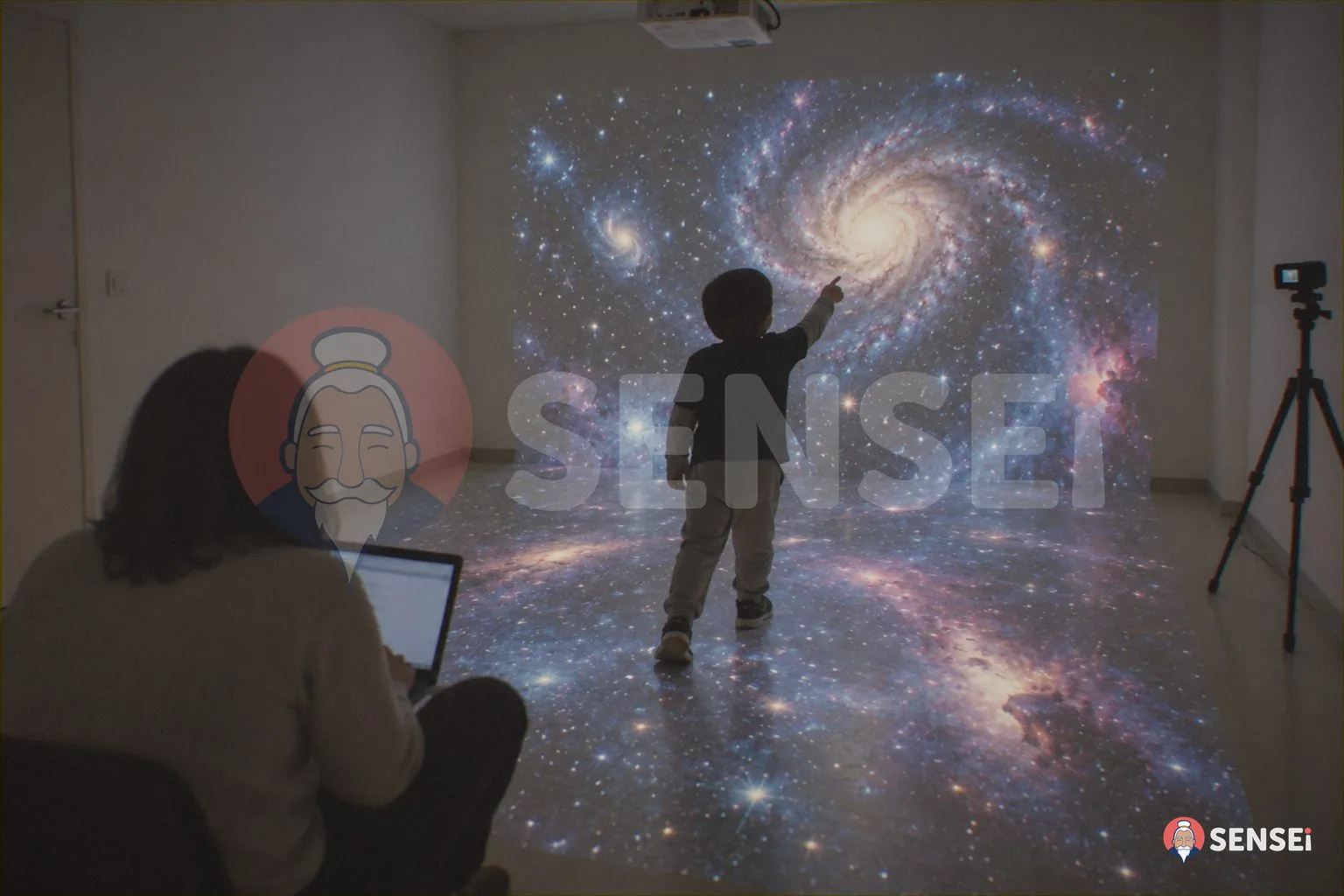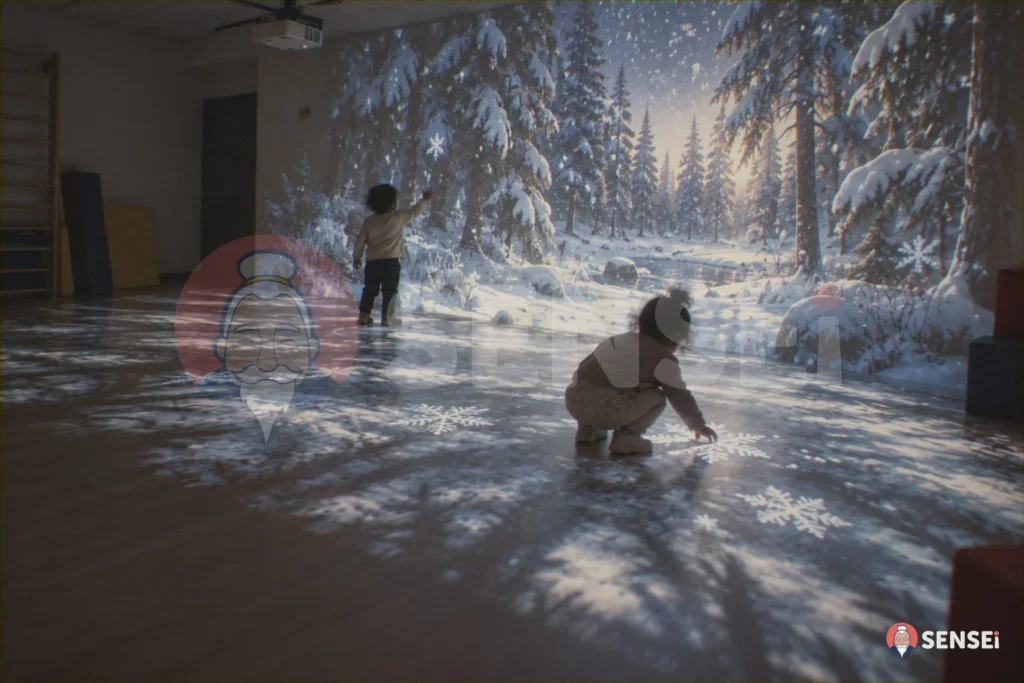
Winter in the immersive room at nursery is told through slowly falling snow, footprints appearing on the floor, cold lights and muffled sounds, to be explored with the body and the hands. Here you will find 10 ready-to-use activity sheets, with a goal, content to project, sounds, materials to touch and an indicative duration.
Each activity is designed for children aged 0 to 3 and can be adapted for babies, young toddlers and older toddlers. At the end you will find guidance on safety and on how to document. For a general overview, read the guide to the immersive room at nursery.
How to use these sheets at nursery
At nursery, the immersive room is not time spent in front of a screen. The World Health Organization advises against sedentary screen time for children under two and recommends active play, including floor-based play, several times a day. That is why every sheet asks the children to move, touch, listen and interact with the educator, and the projection is just one of the stimuli.
- Offer one sheet at a time, repeating it over several days: repetition builds a sense of security.
- Work in small groups, with an educator always close to the children.
- Use a ritual for entering and leaving, always the same.
- The durations are indicative: stop before tiredness sets in.
10 winter activities for the nursery’s immersive room
1. Falling snowflakes
- Goal: follow a slow movement with the eyes and discover that one’s own gesture changes it.
- What is projected: white flakes falling gently on the wall and floor; when a child moves, the nearby flakes slow down or swirl.
- Sounds: a light soundscape, like a music box at low volume.
- Materials to touch: cotton wool balls, soft white fabrics.
- Indicative duration: 5-10 minutes.
2. Footprints in the snow
- Goal: discover the relationship between one’s own movement and what appears on the floor.
- What is projected: a snowy meadow on the floor; with every step or crawl a footprint appears.
- Sounds: a light crunch with every footprint.
- Materials to touch: a soft white mat, tissue paper to scrunch up.
- Indicative duration: 5-10 minutes.
3. The winter forest falls asleep
- Goal: experience a moment of calm and slow down together with the adult.
- What is projected: a snowy forest that slowly grows dark, with a few stars.
- Sounds: a lullaby sung by the educator or a background of light wind.
- Materials to touch: cushions, a soft blanket to lie on.
- Indicative duration: 5 minutes, at the end of the day or after a lively activity.
4. Animals of the cold
- Goal: recognise and name some animals, imitate their movements.
- What is projected: a penguin, a polar bear, an arctic fox appearing one at a time on the wall.
- Sounds: the call or a sound associated with each animal, with a moment of silence before the next one.
- Materials to touch: soft toys of the same animals, large and with no detachable parts.
- Indicative duration: 10 minutes.
5. The snowman
- Goal: build an image part by part and recognise the parts of the face.
- What is projected: a snowman that is completed one piece at a time (body, head, eyes, nose, scarf) when the children touch the wall.
- Sounds: a small festive sound with each piece added.
- Materials to touch: soft white balls, a real scarf to touch and wear.
- Indicative duration: 10 minutes.
6. Ice bubbles
- Goal: practise hand-eye coordination and joint attention.
- What is projected: light blue, transparent bubbles that rise up the wall and pop when touched.
- Sounds: a gentle sound with each bubble that pops.
- Materials to touch: if the room allows it, real soap bubbles blown by the educator; alternatively, soft transparent balls.
- Indicative duration: 5-10 minutes.
7. Hot and cold
- Goal: discover with the hands the difference between hot and cold and associate it with colours.
- What is projected: the room alternates blue lights and snow scenes with orange lights and a lit fireplace.
- Sounds: the winter wind and the crackling of the fire, at low volume.
- Materials to touch: an ice pack wrapped in a cloth and a lukewarm pack, always supervised by the adult; woollen fabrics.
- Indicative duration: 5-10 minutes, with older toddlers.
8. The sledge in the forest
- Goal: move following a direction and play together.
- What is projected: a snowy path scrolling across the floor as if travelling on a sledge.
- Sounds: little bells and a simple rhythmic song.
- Materials to touch: a large box or a sheet to sit on and be pulled gently by the educator.
- Indicative duration: 10 minutes.
9. The lights of the winter night
- Goal: observe slowly changing colours and point them out to the adult.
- What is projected: a night sky with coloured lights swaying slowly, without flashing.
- Sounds: a continuous, soft ambient sound.
- Materials to touch: light coloured cloths to lift and wave.
- Indicative duration: 5 minutes.
10. Animals in hibernation
- Goal: understand a simple sequence: we play, we go to sleep, we wake up.
- What is projected: a den in the forest; the animals go in to sleep, the scene grows dark, then the light returns and the animals come out.
- Sounds: a slow melody for sleep and a livelier one for waking up.
- Materials to touch: a soft tunnel or a tent the children can go in and out of.
- Indicative duration: 10 minutes, with young and older toddlers.
How to adapt the activities for babies, young toddlers and older toddlers
| Group | What to prioritise | Examples from the sheets |
|---|---|---|
| Babies | A few slow images, soft light, contact with the adult, floor play and tummy time | 1, 3, 9 |
| Young toddlers | Crawling and walking to see what happens, touching the wall, repeating | 2, 6, 10 |
| Older toddlers | Short sequences, names of animals and objects, small games together | 4, 5, 7, 8 |
With the youngest children, reduce the number of stimuli: a single slow image and the educator’s voice are better than a rich scene. With older toddlers you can introduce simple rules and turn-taking.
Safety in the nursery’s immersive room
- No flashing lights: flickering lights between 3 and 30 flashes per second are the most common range that can trigger seizures in people with photosensitive epilepsy. Prefer slow transitions.
- Low volume and no sudden loud sounds.
- Technology out of reach and no cables on the floor.
- Materials suitable for ages 0-3: large, washable, with no small parts that could be swallowed.
- A dry floor if soap bubbles are used.
- Scents: with the youngest children it is best to avoid them or use them with great caution, after consulting the families.
- A quiet corner always available for anyone who needs a break.
Observing and documenting
After each activity a few lines are enough: who came closer, who touched the wall, who sought the adult’s gaze, who preferred to watch from a distance. Over time these notes tell the story of each child’s progress and help choose the next activities. They are also valuable material to share with families.
Observing is also what makes the room truly useful. For the educator it becomes a way to get to know each child better: who loves movement, who seeks calm, who opens up to the group only after a few days. For families it is a window onto experiences they do not see at home.
Why explore winter with the body: the link with research
The sheets follow a simple idea: young children learn by doing, and a stimulus works when it is linked to their gesture and to an adult’s voice. It is the same principle the research group from which SENSEi originates has been working on for more than ten years, with more than 40 scientific publications on adult-regulated multisensory environments in which every action of the child produces a visible effect. One example is the Magic Room, co-designed with specialists from two therapy centres.
In everyday practice this approach is alive in many schools. With Cooperativa ORSA, a mobile SENSEi kit brings the programme “All’avventura tra i sensi” (An adventure through the senses) to six municipal preschools in Milan; at ICS IV Novembre in Cornaredo the magic room has been growing for years together with the preschool community. You will find more ideas for the preschool years on the page about preschool and in the article on immersive environments in preschool.
After winter: the next seasons
These sheets connect to other programmes throughout the year. In December you can offer the activities for Christmas in the immersive room, with a secular version dedicated to the festival of lights. Then come Carnival and spring.
Frequently asked questions
Is the immersive room suitable for children under two?
Yes, if the activity is short and based on movement and the relationship with the educator. The projection must not become passive viewing.
How long should an activity last at nursery?
Not long: often a few minutes are enough. The durations in the sheets are indicative. Stop at the first signs of tiredness or agitation.
How many children can go in together?
Small groups are best, so the educator can follow each child. The number depends on the space and the age.
Is special material needed for these activities?
No. Soft materials, fabrics and safe objects already available at the nursery are enough, together with the room’s content.
Can I create customised winter activities?
Yes. With the Eureka platform you can create scenes, sounds and games suited to your group and share them with other educators.
Create your own winter activities
With Eureka you can prepare snow scenes, forest animals and light games tailored to your children. Discover Eureka.
Sources
- World Health Organization. To grow up healthy, children need to sit less and play more (2019)
- World Health Organization. Guidelines on physical activity, sedentary behaviour and sleep for children under 5 years of age (2019)
- Epilepsy Society. Photosensitive epilepsy
- Garzotto F., Gelsomini M. Magic Room: A Smart Space for Children with Neurodevelopmental Disorder. IEEE Pervasive Computing, 2018