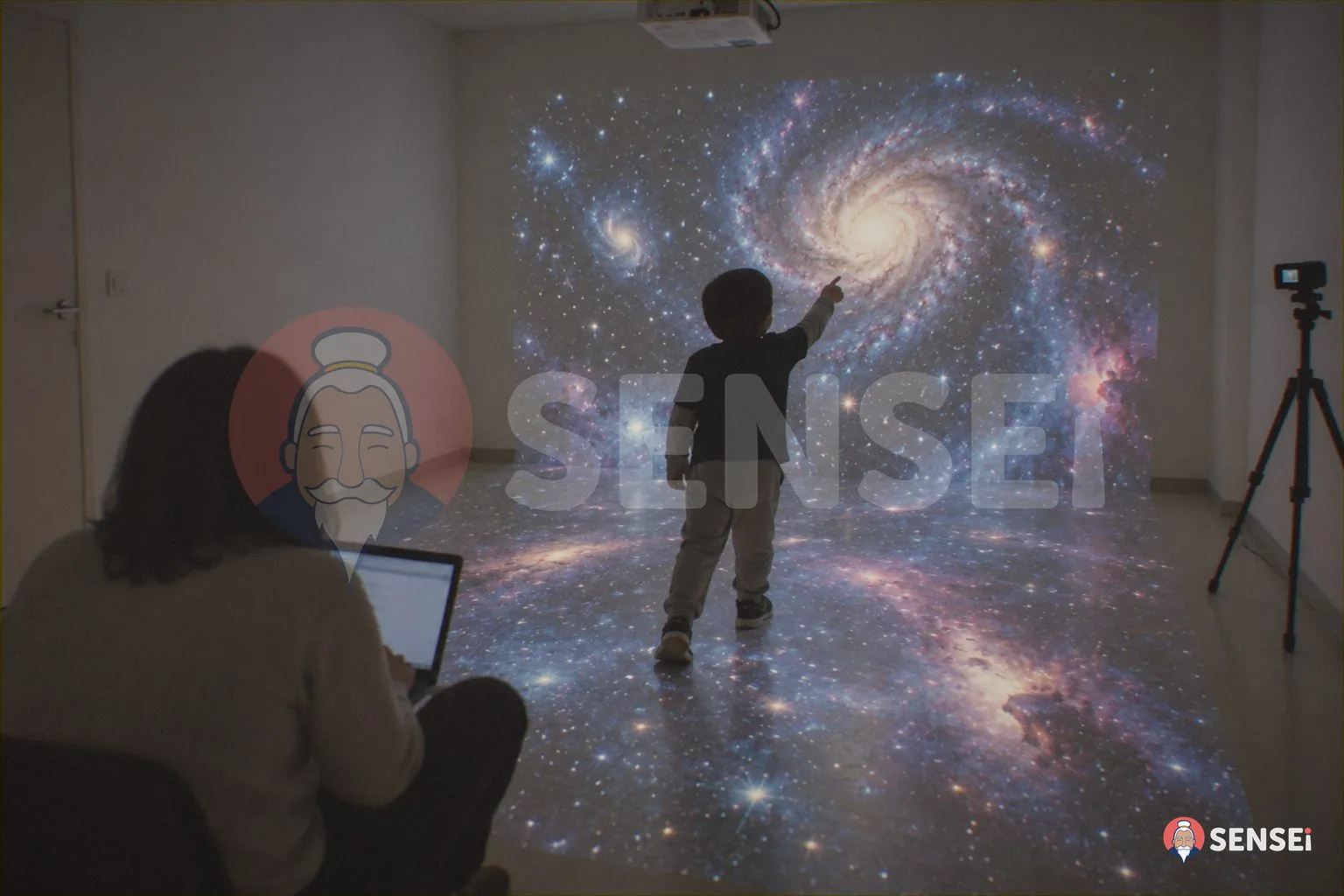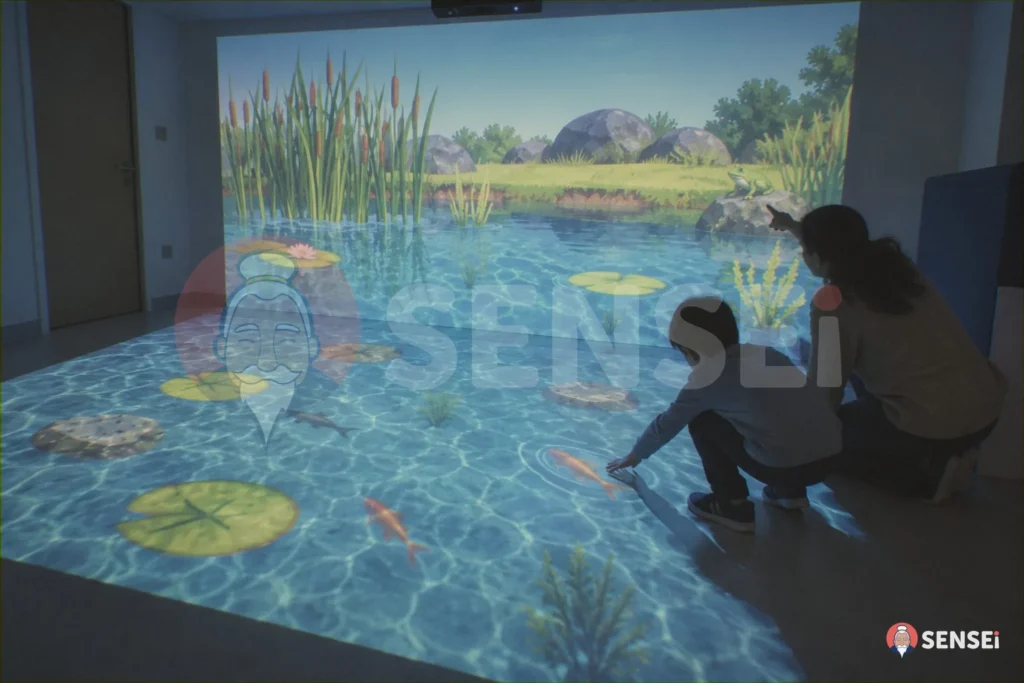
At the Autism Centre of the San Paolo Hospital in Milan there is a room where the wall and floor respond to children’s gestures. It is the SENSEi room dedicated to children and young people with autism followed by the Child and Adolescent Neuropsychiatry service (NPIA). It matters because it is not a fixed object: it grows together with the team, which co-designs about 50 activities with SENSEi.
An autism centre inside the hospital
The centre is located at the via Ovada site and is part of ASST Santi Paolo e Carlo, the public health and social care authority that runs the San Paolo and San Carlo hospitals in Milan. Here children and young people with autism follow rehabilitation programmes during the day.
The challenge is to bring an engaging yet predictable space into a clinical setting: one able to motivate without overloading. The room is made possible by a donation and, after building work and checks on the premises, becomes part of the centre’s routine.
How does the project begin?
The project starts from people, not from technology. The centre’s educators define goals, rules and activities with the SENSEi team. The activities are then tested with the children and refined together.
The room can be described in a few words: the wall and floor become interactive and respond to hands and movements, with no wearable sensors. The educator leads the session from a tablet. In one corner there is a “safe place”, a quiet refuge the children can return to whenever they need it.
Meetings with the team give rise to four shared principles, which today apply to every activity:
- a clear beginning and end, so that the child always knows what is happening;
- a wow effect that encourages engagement;
- simple, clean graphics;
- clear, predictable interaction.
The work does not stop at the opening. In regular review meetings the team assesses which activities to keep, which to modify and which to add.
What experiences do the children have?
The activities are organised by goal area: cognitive and semantic stimulation, sound discrimination, coordination between gesture and sound, visual memory, body schema, spatial concepts, communication and emotional expression. Some examples created at the team’s request:
- SENSEi’s Ark and Animals and habitats: farm, sea, mountain and savannah animals that move and make their call when touched;
- Where is it?: above and below, right and left, near and far, with animals and fruit;
- Musical instruments: drum, maracas, triangle, xylophone, to link a gesture to a sound;
- Body schema: face and body, part by part;
- Which emotion is it? and Dressing for the weather, to bring everyday life situations into the room.
The activities are grouped into thematic folders, for example the seasons and holidays, so the educators can find the right one straight away.
The link with research
The San Paolo method has a precise origin: the Magic Room, the first smart space designed by the SENSEi research group at Politecnico di Milano to engage children with complex needs. That work established the habit of designing with the people who know the children, observing and refining.
In the hospital, that method faces a demanding test. The four principles shared with the team echo what the group has been studying for years: engaging yet predictable environments, in which every child understands what is happening. The full journey, documented in more than forty scientific papers, is on the Research page.
What changes
- About 50 activities co-designed with the educators, organised by goals and themes.
- A common language between the team and the designers, set out in the four shared principles.
- A space for regulation: staff use some relaxing activities as a break and observe that the children often return to the safe place when they need it.
- Concrete improvements arising from everyday use: more positive reinforcement, fewer activities to choose from, elements at child height.
The NPIA medical management appreciates the latest update, describing it as “in line with the ideas shared at the time”.
Why is this a significant case?
San Paolo shows that a multisensory room in a hospital works when it becomes a tool of the care team, not a piece of furniture. The activities change with the children and with those who support them. This is the heart of SENSEi CARE. To learn more, read the guide to sensory rooms and autism and the article on the multisensory room in hospital.
Frequently asked questions
What does co-designing the activities mean?
Educators and therapists define goals and rules, SENSEi translates them into interactive experiences, then the activities are tested and refined together.
What is the safe place?
It is a quiet corner of the room the children can return to when they need to regulate themselves. Staff observe that they use it often.
Who leads the activities?
The educator or therapist, from a tablet: they choose the activity, change the stimuli and adapt the pace in real time.
How much does an environment like this cost?
It depends on the configuration: space, experiences, training and services. Contact us for an assessment.
Do you work in a school, a centre or a museum and want an environment like this? Tell us about your project: we start from the needs of the people who will use it.
Sources
- ASST Santi Paolo e Carlo, video “Stanza Multisensoriale SENSEi, Centro Autismo”
- ASST Santi Paolo e Carlo, official website
- Magic Room, IEEE Pervasive Computing
- SENSEi, Research and scientific publications
In the press
- SENSEi. Al Centro Autismo dell'ASST Santi Paolo e Carlo realtà virtuale e applicazioni motion-based per i piccoli pazienti, Mi-Lorenteggio
- Autismo: Sensei, uno spazio dove i bambini sono parte attiva di un'esperienza multisensoriale, Panorama della Sanità
- SENSEi: l'esperienza multisensoriale per i bambini autistici, Prima di tutto Milano
- SENSEi, la stanza multisensoriale per l'autismo, Associazione KOALA