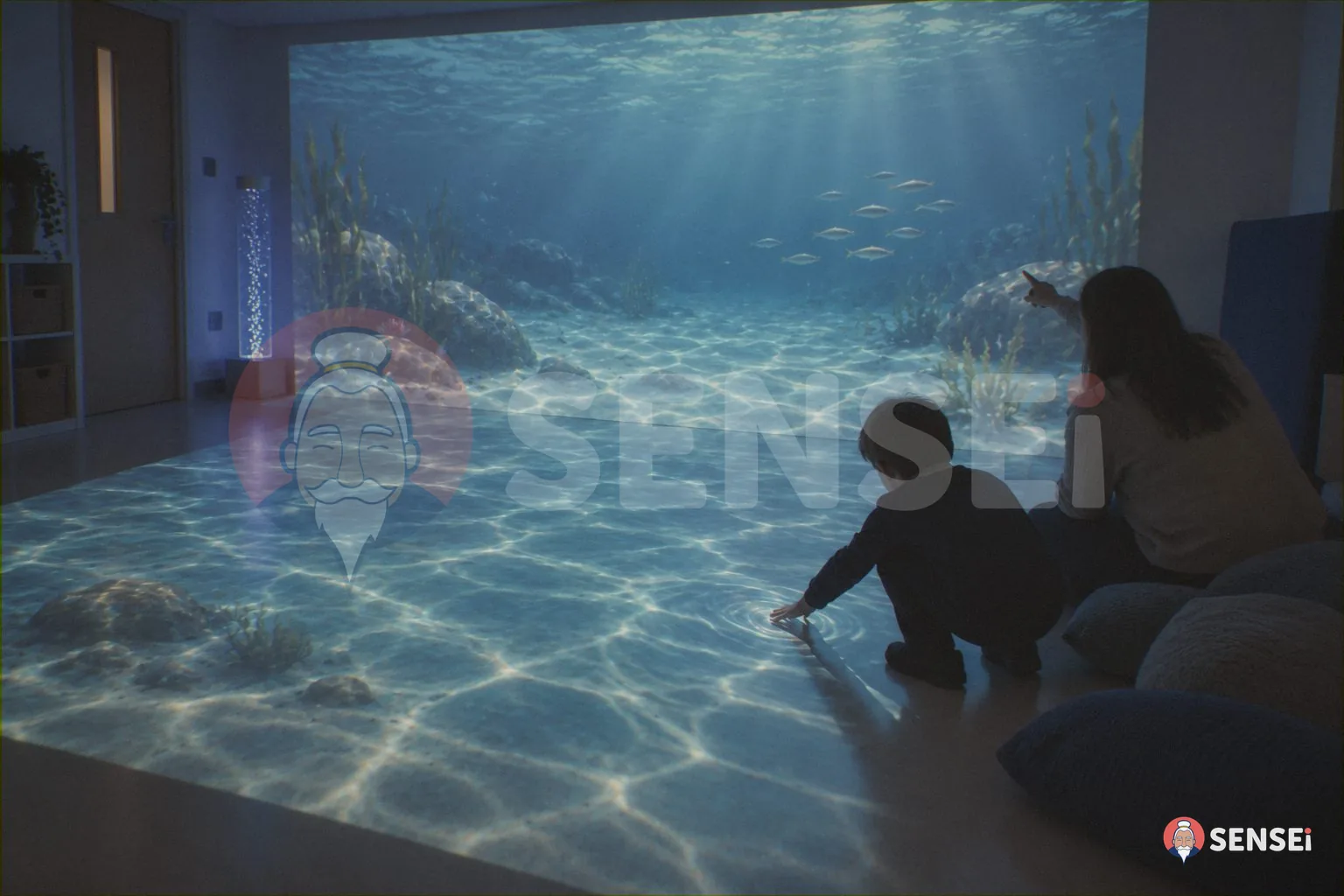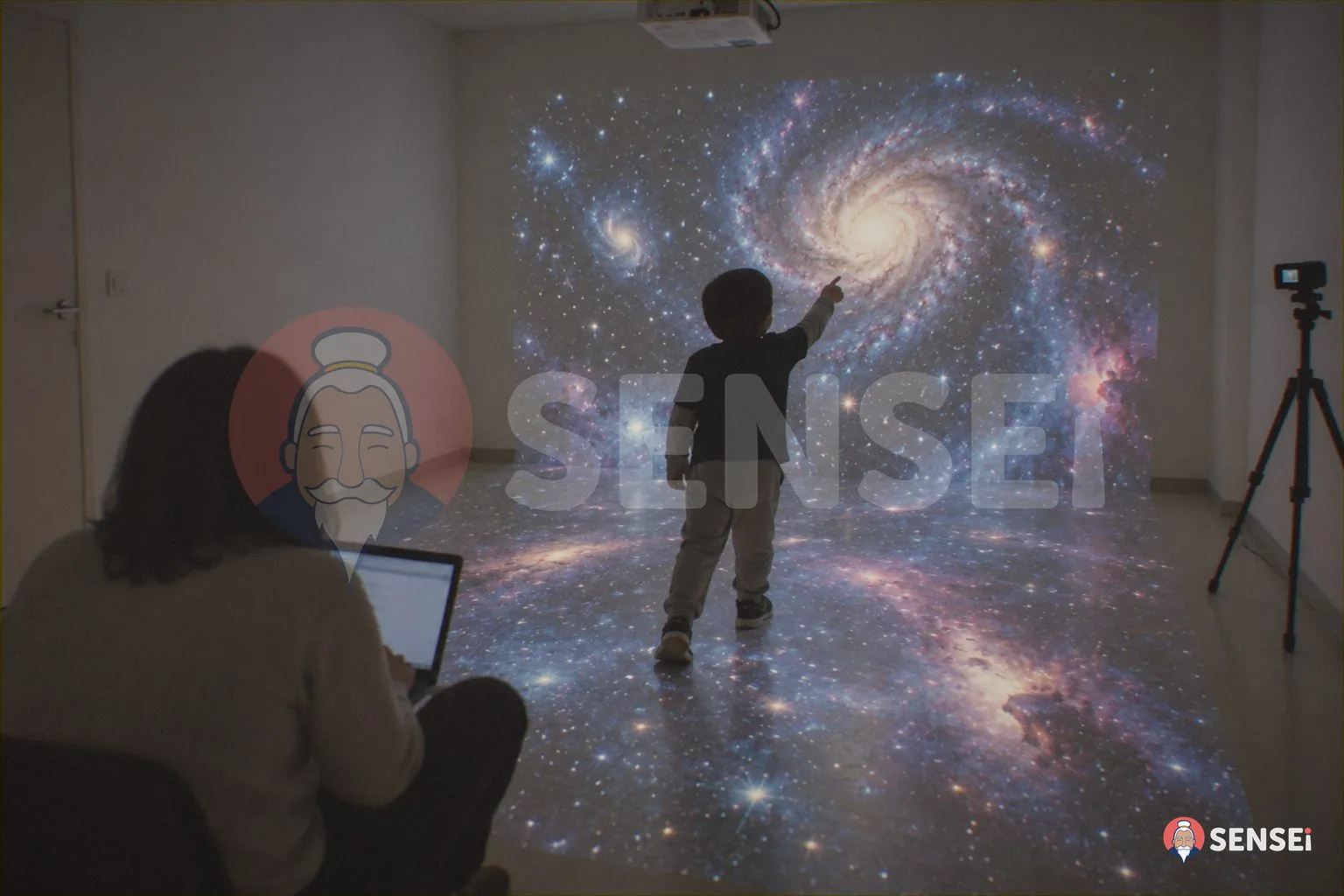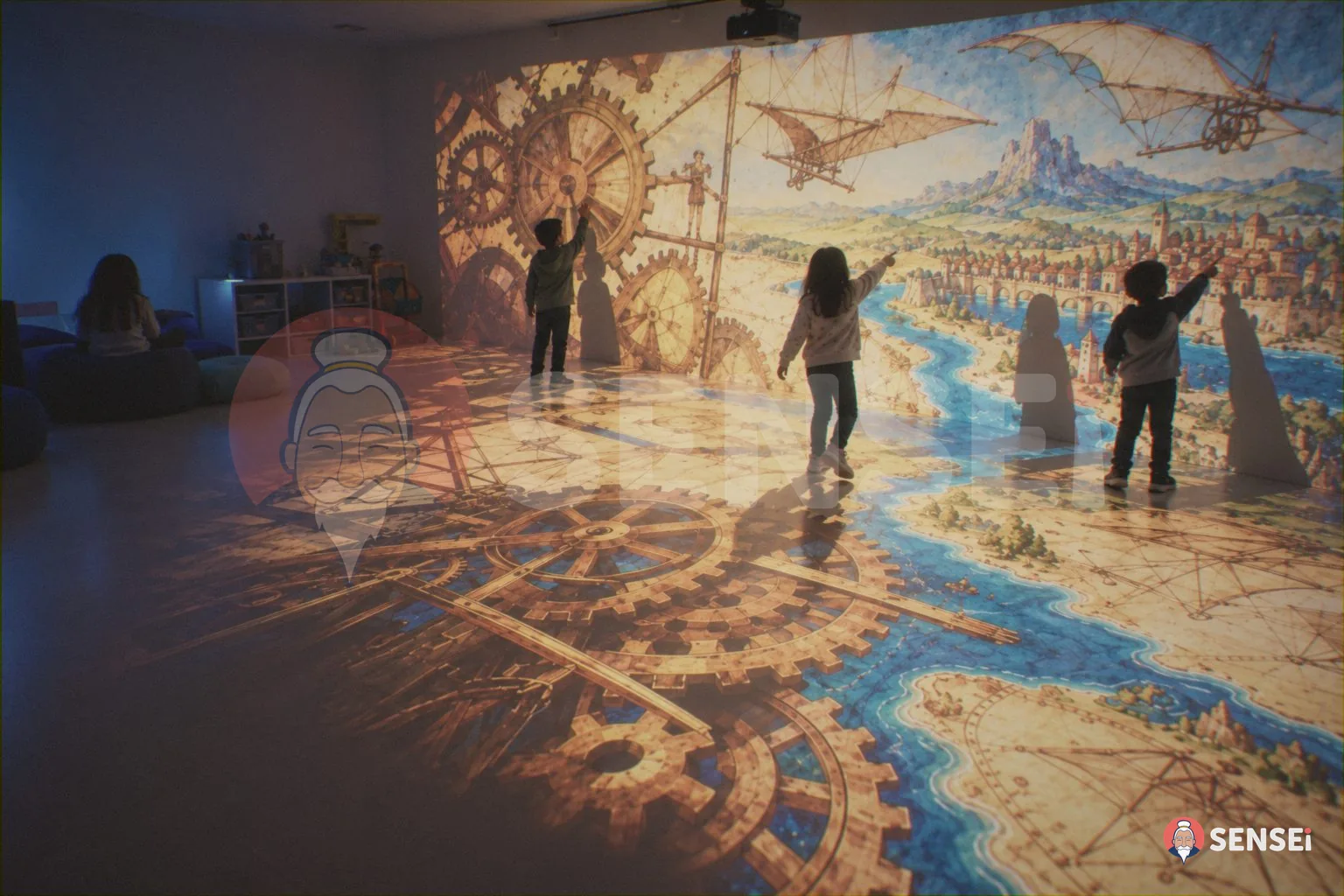

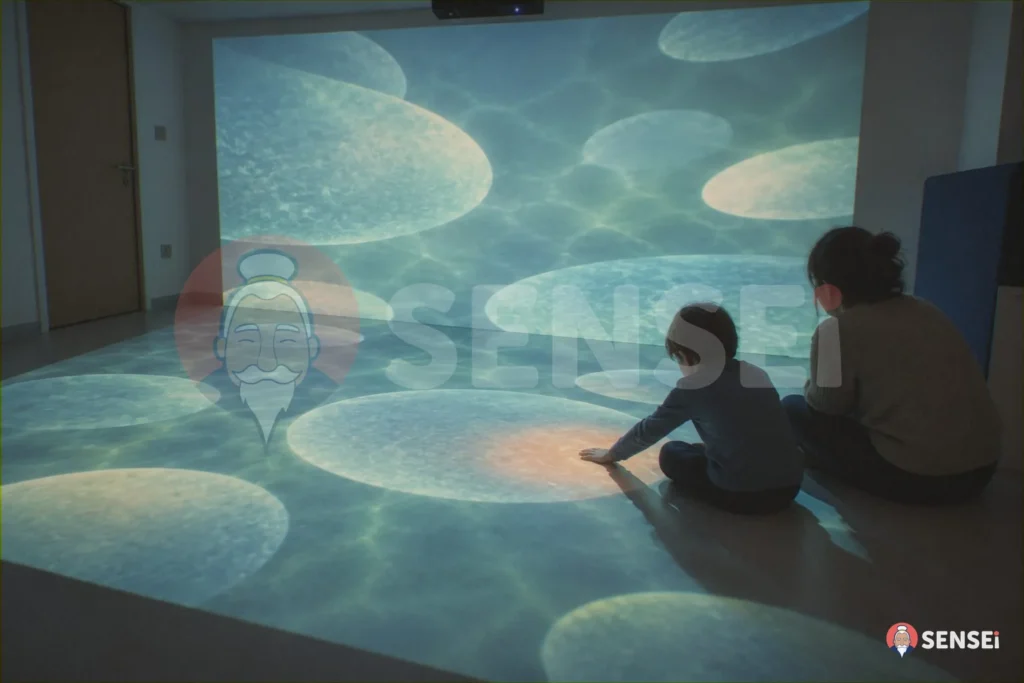
At school, a sensory room can help autistic pupils to regulate themselves, communicate and take part with their classmates, provided that the environment is predictable and the stimuli are tailored to the person. The most useful activities are short, structured and give the child some control over what happens.
Here you will find how to prepare, how to structure a session, ten practical activities and the signs to watch for. The guidance should always be shared with the family, the learning support teacher and the services that support the pupil.
What is a sensory room for, for autistic pupils?
Many autistic people perceive sensory input differently: some stimuli can feel too intense, others are barely noticed. A sensory room makes it possible to adjust light, sound and movement in a controlled way. At school it can be used for three main purposes:
- Regulation: a place to reduce stimulation and regain calm.
- Learning: structured activities on attention, imitation, communication, concepts.
- Relationships: games with one or more classmates, guided by the adult.
A sensory room is not a therapy in itself. It is an environment that, used with clear goals, can support educational work. For a general overview, read Multisensory rooms for autism: how they help.
What does the research say?
A study published in the journal Autism compares 41 autistic children aged between 4 and 12 in a multisensory room, with and without control over the sensory changes. With control, attention increases and some repetitive motor and sensory behaviours decrease. No significant effects emerge on anxiety and social behaviour. The authors suggest that giving control may create better conditions for learning.
A nine-month observational study in a class with autistic students, in which the founder of SENSEi takes part, observes that a collaborative movement game helps students initiate interactions with their peers. An “audience effect” also emerges: classmates who are not playing move closer to those who are, and vice versa. The study observes a positive effect on social behaviour even outside play time. We describe it in Moving to learn.
Other work by the research group from which SENSEi originates explores touchless, gesture-based games to practise imitation, body schema and social skills, and a smart room designed with specialists in which the activities can be personalised for each child. These are exploratory studies: they point to promising directions, not guaranteed results. They are part of a body of work that today counts more than 40 scientific publications, collected on the Research page.
Before you start: what to prepare?
- Sensory profile: what the pupil likes, what bothers them, which stimuli calm them. Ask the family and those who support the pupil.
- Goals: two or three, consistent with the PEI (the individualised education plan), observable (e.g. stays in the activity for 5 minutes, makes a request with a pictogram).
- Visual schedule: pictures of the room and the activities, to show before going in.
- Stop signal: a gesture or a card to ask for a break, always respected.
- Calm corner: a place inside or near the room to retreat to. See Soft corner and calm corner.
How is a session structured?
Predictability is the rule. A typical session lasts between 15 and 30 minutes and always follows the same sequence.
- Entry: the same light, the same welcome music, the visual schedule.
- Main activity: one or two activities, with a clear beginning and end.
- Closing: the light dims, goodbyes, accompanied return to class.
At first, stimulation should be kept low and increased only if the pupil is at ease.
Ten practical activities
1. The breathing light
The light in the room rises and falls slowly. The pupil breathes following the rhythm. Useful for regulation at the beginning or the end.
2. Cause and effect
A gesture or a step produces a clear effect: a colour, a sound, a bubble. It works on intentionality and a sense of control.
3. The mirror
A projected silhouette imitates the pupil’s movements, then the pupil imitates the silhouette. It trains imitation and body schema.
4. Taking turns
Two pupils take turns activating the same element. A visual signal shows whose turn it is.
5. Let’s look together
The adult points to an element that appears on the wall; the pupil follows it with their eyes or reaches it. It works on joint attention.
6. I ask with a pictogram
The pupil chooses the next activity by touching a pictogram. SENSEi integrates ARASAAC pictograms for augmentative communication.
7. The floor path
A projected path to follow by walking, jumping, stopping. Useful for coordination and following instructions.
8. Let’s build together
A small group collaborates to complete a picture: each person adds a piece. It encourages cooperation and participation.
9. The social story
An everyday situation (the canteen, break time, a school trip) shown step by step in the environment, with the expected actions. It prepares for moments that cause anxiety.
10. Going back
Two minutes of low light and soft sound before going back to class, with a picture of the next activity.
What signs should you watch for?
- Hands over the ears, eyes closed, moving away: reduce light and sounds immediately.
- An increase in repetitive movements or agitation: suggest a break in the calm corner.
- Smiling, coming closer, asking to repeat: the stimulus is welcome, you can build on it.
- Intense seeking of a stimulus: note it down, it can become a reinforcer.
In an interactive environment the adult can change intensity and pace in real time, including from a tablet. It is one of the advantages of an interactive room compared with a passive one.
How to involve classmates?
The room must not become a place of separation. After an individual phase, one or two classmates can be invited for a cooperative game. Activities designed starting from the most complex needs become interesting for the whole class: this is the idea behind SENSEi for schools. Ideas for a dedicated day are in World Autism Awareness Day: inclusive activities in class.
What changes for pupils, teachers and therapists?
For the pupil, the room becomes a familiar, predictable place where they can choose, ask for a break and try being with others. For the learning support teacher it is a space to work on the PEI goals with activities that also involve classmates. For therapists it is an environment in which to continue shared work in the school setting.
In specialist centres this approach is already part of daily life. At the Autism Centre of the San Paolo Hospital the team co-designs about 50 activities and also uses the room as a safe refuge for self-regulation. At I Gigli del Campo, young people with autism aged 13 to 25 practise independence with 19 co-designed activities.
How to document progress?
A simple record sheet is enough: date, duration, activity, level of stimulation, the pupil’s response, notes. SENSEi also produces reports on how activities are going, and sessions can be documented, which is useful for discussions with the family and therapists. For centres, see SENSEi for therapy and well-being.
Frequently asked questions
Does every autistic pupil benefit from the sensory room?
Not necessarily. Every person is different: some love the room, others find it tiring. It should be introduced gradually and observed.
How long should a session last?
Usually between 15 and 30 minutes, but at first even a few minutes is fine. Regularity is what counts.
Is the sensory room a therapy?
No. It is an educational environment that can support regulation, attention and participation if used with clear goals, in agreement with those who support the pupil.
Can it be used with several pupils together?
Yes, after a familiarisation phase. The SENSEi system recognises several people at once without wearable sensors.
How much does a sensory room at school cost?
It depends on the configuration and the space. Contact us for an assessment.
Want to design activities for your pupils?
We work with teachers and therapists to build tailor-made activities. Book a demo.
Sources
- Unwin, Powell, Jones (2022), The use of Multi-Sensory Environments with autistic children: Exploring the effect of having control of sensory changes, Autism
- Bhattacharya, Gelsomini, Pérez-Fuster, Abowd, Rozga (2015), Designing motion-based activities to engage students with autism in classroom settings, ACM IDC
- Garzotto, Gelsomini, Oliveto, Valoriani (2014), Motion-based touchless interaction for ASD children: a case study, AVI
- Garzotto, Gelsomini, Gianotti, Riccardi (2019), Engaging Children with Neurodevelopmental Disorder Through Multisensory Interactive Experiences in a Smart Space, Social Internet of Things