
The soft play corner is a padded space with mats, cushions and foam shapes, where children can move, roll and rest safely. The calm corner, on the other hand, is a low-stimulation place, with soft lighting and few objects, where a child can withdraw to regain balance when feeling overwhelmed.
The two spaces often coincide, especially at preschool. For children they are a safe place to find themselves again; for teachers, a simple tool to get through the day with less tension. In this guide we look at the differences, how to set them up, which rules to adopt and how they connect to a multisensory room.
What is the difference between a soft play corner and a calm corner?
| Aspect | Soft play corner | Calm corner |
|---|---|---|
| Main function | Motor play, exploration, rest | Self-regulation, pause, recovery |
| Level of stimulation | Medium | Low |
| Typical use | Small group | One person, sometimes with an adult |
| Materials | Mats, soft shapes, cushions | Beanbag, blanket, low light, a few comfort objects |
| When it is used | At scheduled times or during free play | When the child feels the need |
The most important difference concerns purpose. The soft play corner is a place for play. The calm corner is a place for regulation, and it only works if the child experiences it as a resource, not as a punishment.
Why are they needed at school?
Italy’s national curriculum guidelines (Indicazioni nazionali per il curricolo) describe the preschool space as “welcoming, warm, well cared for”, an expression of the school’s educational choices. A well-designed soft play corner meets this idea.
The guidelines of England’s Department for Education on inclusive school buildings go further. They observe that sensory overload and dysregulation make it harder to learn, communicate and be with others. They recommend calm, predictable, low-stimulation spaces for rest and self-regulation: dedicated rooms, defined zones, but also small spaces such as nooks, screened corners and soft dens.
The same guidelines note an interesting point: in some schools the need for calm spaces is greater than the need for sensory rooms, even if this is not always reflected in design choices.
How to set up a soft play corner?
Where to place it
In an area of the classroom away from doors and walkways, with clear space around it. Not under a window with sharp corners or radiators.
What you need
- a soft base mat, with edges that do not cause tripping;
- covered foam shapes: cubes, cylinders, ramps, large cushions;
- a low divider or a curtain to define the space;
- a closed container for storing materials.
Safety rules
- Washable, intact covers, with no accessible zips.
- No hard or small objects inside.
- A maximum number of children at a time.
- Adult supervision during motor play.
- Padded materials with the certifications required for school use, to be checked with the person responsible for safety.
How to set up a calm corner?
Where to place it
The English guidelines suggest placing low-stimulation spaces close to classrooms, so they can be reached with little disruption. It should be visible to the adult, but shielded from the group’s gaze.
What you need
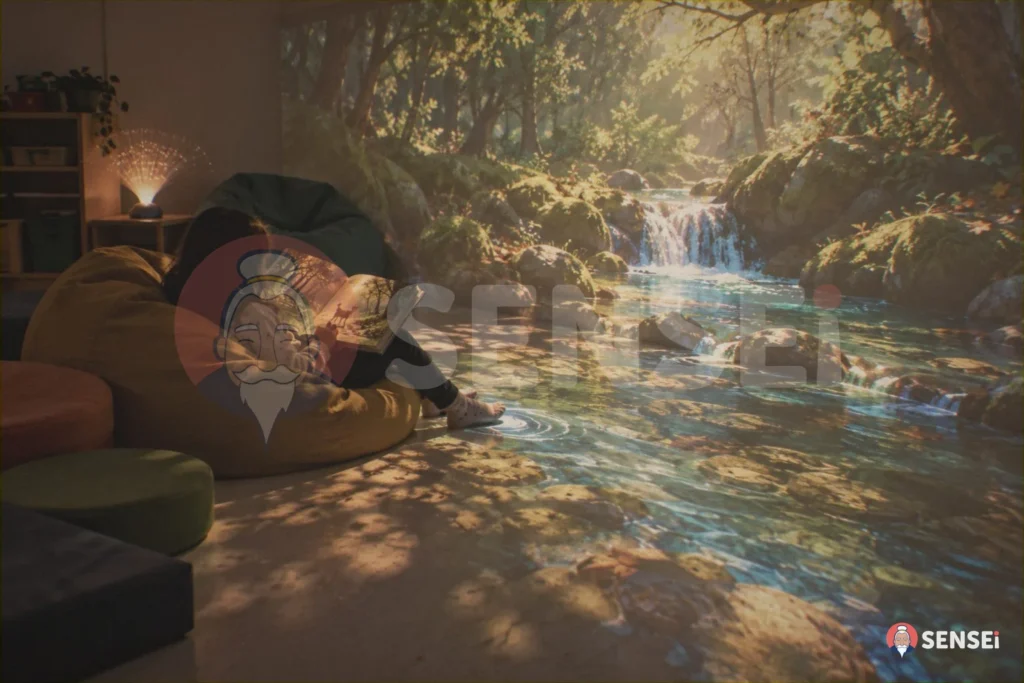
- an enveloping seat, such as a beanbag or a small armchair;
- low, warm light, never flashing;
- a soft blanket or a cushion, if the child likes them;
- ear defenders;
- a few comfort objects to touch;
- a visual support showing emotions and calming strategies, including with pictograms;
- a visual timer, for those who need to know how long the break will last.
What to avoid
- screens and highly stimulating electronic games;
- walls covered in posters;
- bright colours and moving coloured lights;
- using the corner as a punishment.
The English guidelines recommend muted colours or soft lighting to signal low-stimulation areas, and enough space for an adult to sit next to the child.
Which rules of use work?
A few rules, explained in advance and the same for everyone.
- Ask or signal. The child can ask to go, verbally, with a gesture or with a card.
- It is a choice. The adult can suggest the corner, but does not impose it.
- You know how long it lasts. A timer or an hourglass helps.
- Return calmly. The adult welcomes the child back, without commenting on the reason.
- Respect it. Whoever is in the corner is not disturbed.
It helps to introduce the corner to the whole class at a quiet moment, trying it out together. That way it becomes everyone’s space, not the space “for those who get agitated”.
And in the multisensory room?
Even the most interactive room needs a calm zone. After a movement game with projections and sounds, some children need to lower their arousal before going back to class.
The study by Unwin, Powell and Jones, published in the journal Autism, suggests another important element: being able to control what happens around you. With 41 autistic children, having control over sensory changes is associated with fewer repetitive behaviours and more attention, with limitations acknowledged by the authors. In a calm corner too, being able to choose light, sound and duration makes a difference: the child moves from spectator to protagonist of their own regulation.
How does a calm corner connect to a SENSEi environment?
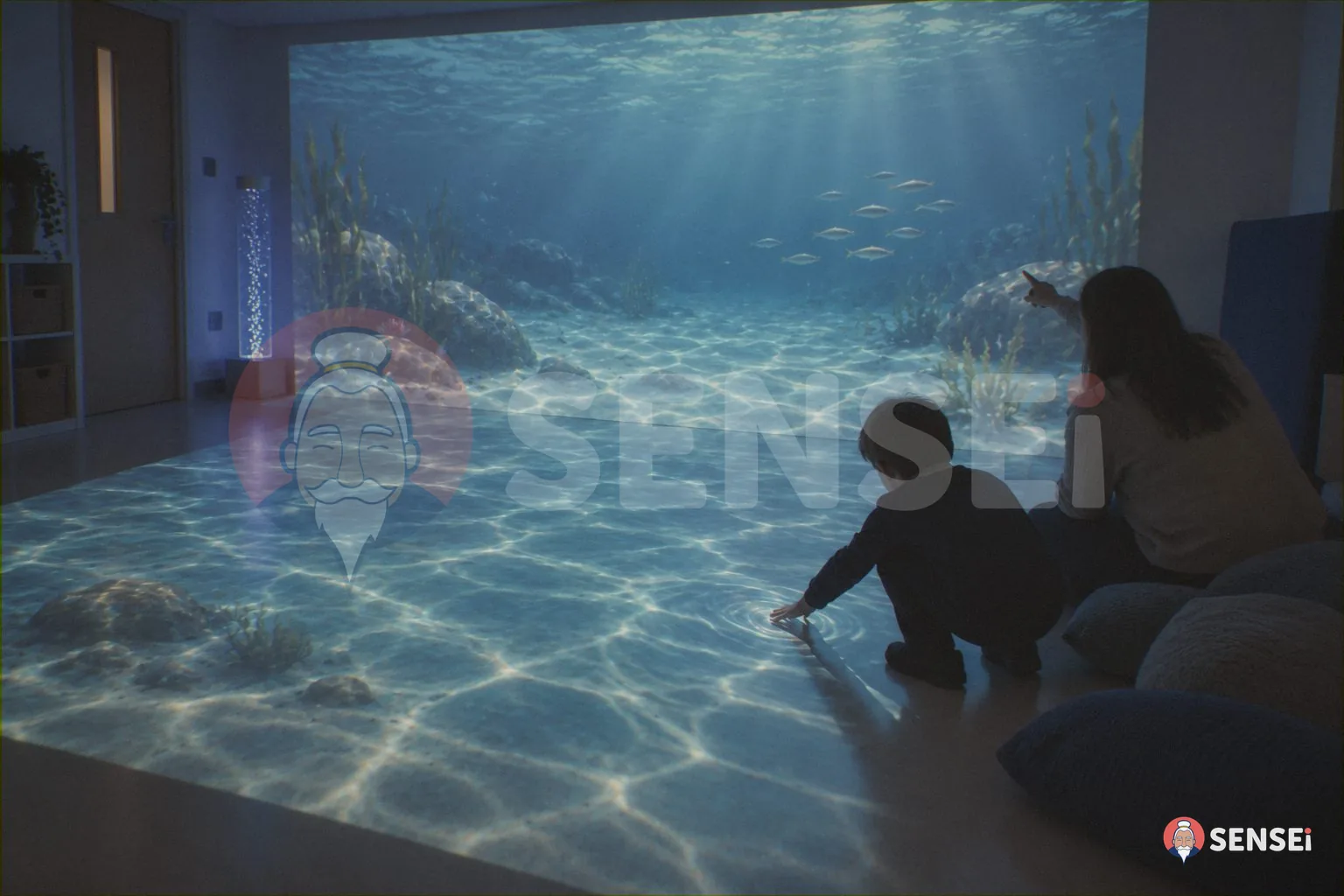
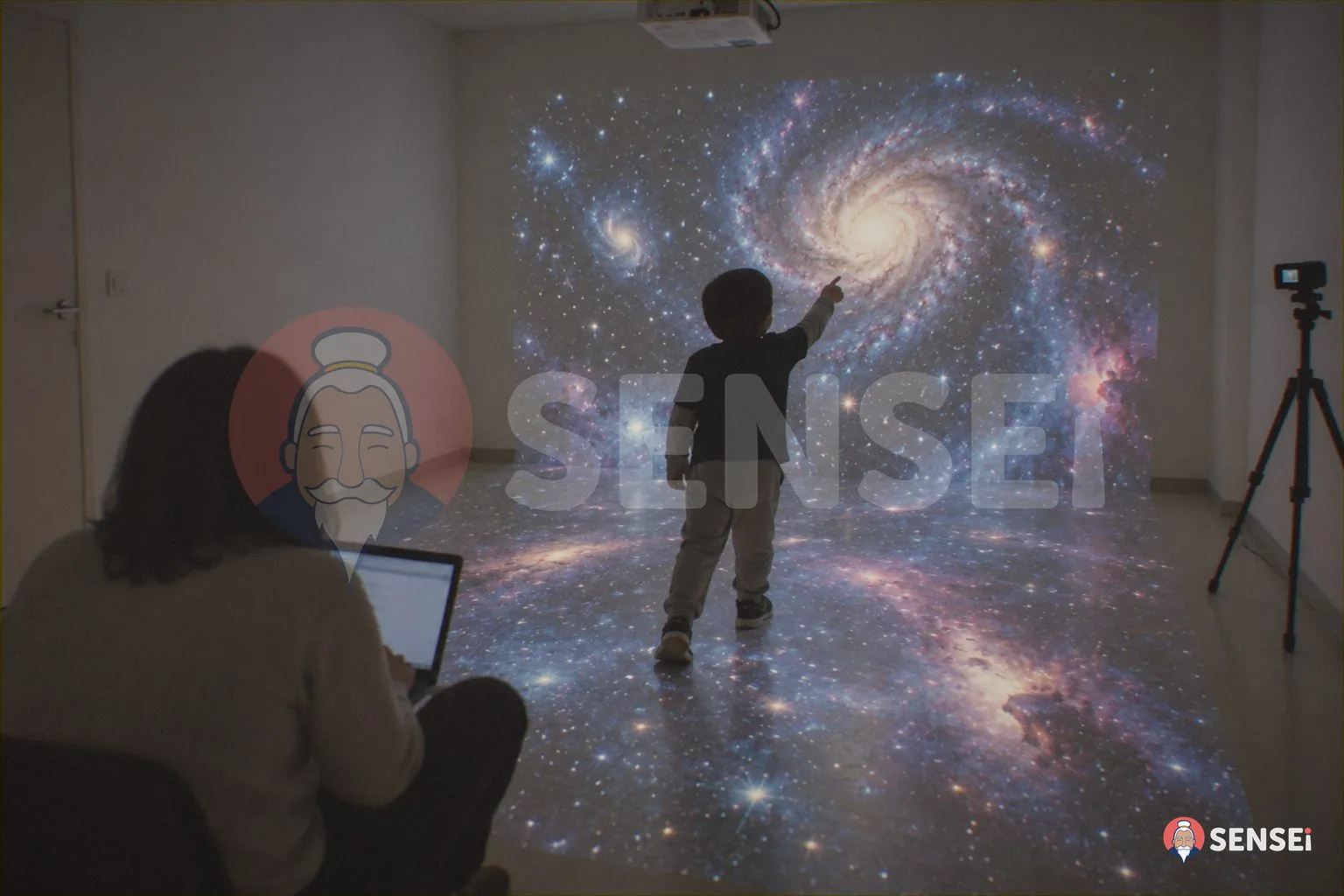
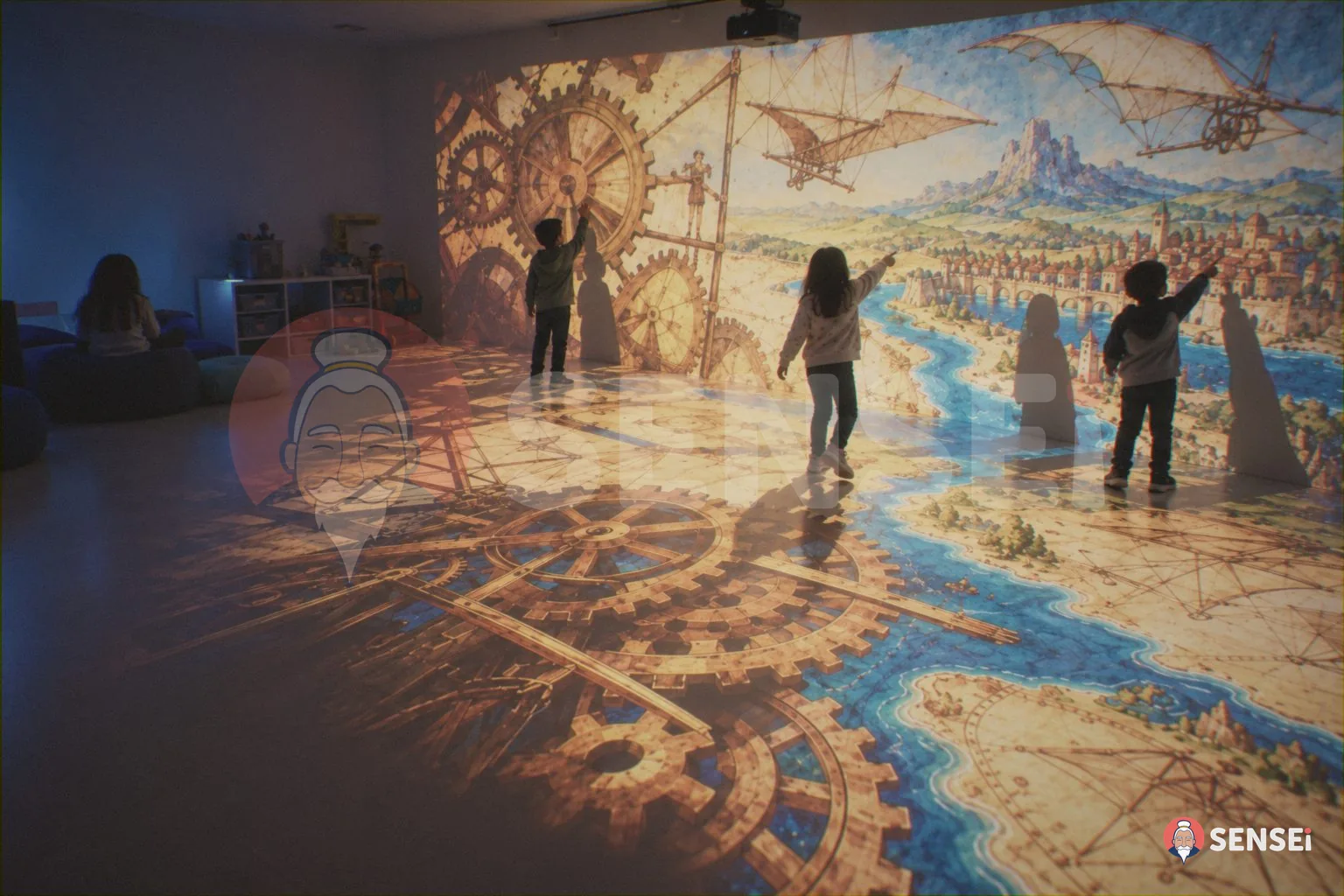
A SENSEi environment transforms an existing room into a space that responds to children’s gestures and movements, with no sensors to wear; the teacher guides everything from a tablet. It does not replace the calm corner: it can complement it.
- A calm zone inside the room. An area with mats and cushions, away from the projection surfaces, to withdraw to during the activity.
- A calm scene for everyone. The educator can switch from a movement activity to a slow scene: low light, natural sounds, slowly moving images.
- A predictable ending. Each session can always end the same way, with a calming ritual.
This ability to modulate stimuli comes from research. Magika, the Politecnico di Milano project from which SENSEi was born, presented at the international CHI conference, includes an interface with which educators adjust the intensity and progression of stimuli, adapting them to each child. It is one of the more than 40 scientific publications of the SENSEi research journey.
What changes in practice? A child who feels overwhelmed does not have to leave the group to calm down: they find a slow, predictable scene in the same space where they have just been playing. The teacher does not have to stop the activity for everyone, but can modulate the room in a few seconds. At the Autism Centre of the Ospedale San Paolo, the SENSEi room is also a safe refuge for regulation; at the ASL Salerno autism centre in Bracigliano, the slow scenarios are used precisely to regain calm.
To organise the zones of the room, read how to set up a multisensory classroom. For the equipment, sense by sense, the guide is what to put in a multisensory room. Fibre optics are a good addition to the calm zone. To get to know the environment, visit The magic room and the page SENSEi for preschool.
In the SENSEi room
Every SENSEi room alternates active moments and calm moments. The soft corner, with a relaxing scenario such as a sunset over the sea, is the place to return to in order to regulate, listen to a story or simply rest.
Activities to try in a SENSEi room
- Safe refuge: when the experience becomes too intense, withdraw among the cushions.
- Sunset story: the group sits in a circle and listens to a story with the sunset projected on the wall.
- Deep hug: beanbags and heavy cushions offer deep pressure and containment.
- Watching from a distance: shyer children can take part by watching before joining the game.
Discover all the tools in the guide to the tools of the SENSEi room.
Frequently asked questions
Is the calm corner also suitable for primary school?
Yes. The materials change to suit the age group, but the principle stays the same: a low-stimulation space used by choice.
How long can a child stay in the calm corner?
It depends on the child. A visual timer helps make the break predictable; the adult observes and supports the return.
Is the calm corner a punishment?
No. If it is used as a punishment it loses its function. It must be a space that is chosen, introduced to the whole class.
Do you need special materials?
Not necessarily. What matters is low light, few objects, comfort and the safety of the padded materials.
Can you create a calm corner inside the multisensory room?
Yes, and it is advisable. A soft zone away from the projections allows children to regulate without leaving the room.
Want to design a room with a real calm zone? Book a demo of a SENSEi environment.
Sources
- Department for Education, Inclusive education estates (June 2026), GOV.UK.
- Indicazioni nazionali per il curricolo della scuola dell’infanzia e del primo ciclo d’istruzione (2012), Italian Ministry of Education.
- Unwin, Powell, Jones, The use of Multi-Sensory Environments with autistic children: Exploring the effect of having control of sensory changes, Autism 2022, doi 10.1177/13623613211050176.
- Gelsomini et al., Magika, a Multisensory Environment for Play, Education and Inclusion, CHI EA 2019.