
World Autism Awareness Day is celebrated on 2 April and is an opportunity to work in class on differences, acceptance and different ways of perceiving the world. The most effective activities do not talk “about” autism in the abstract: they let everyone experience that each person feels, communicates and learns in a different way.
Here you will find the background to the day, some rules for talking about it respectfully and ten ready-to-use activities for primary school, with variants for preschool and lower secondary school and a few ideas for the immersive room.
When is it celebrated and why?
The day was established by the United Nations General Assembly in 2007 with resolution A/RES/62/139 and is celebrated every 2 April. The 2026 theme set by the United Nations is “Autism and Humanity, Every Life Has Value”.
The United Nations highlights a shift in perspective: from awareness alone to acceptance, appreciation and inclusion. It is a good compass for schools too.
How many autistic children are there in Italy?
According to data from the Progetto Osservatorio for monitoring autism spectrum disorders, coordinated by the Istituto Superiore di Sanità (Italy’s National Institute of Health) and the Ministry of Health, the prevalence in Italy is estimated at 1 in 77 children aged 7 to 9, with a frequency about 4.4 times higher in boys. This means that having autistic pupils in class is a common experience, not an exception.
How to talk about it in class respectfully?
- Start from everyone’s differences: everyone has sounds they love and sounds that bother them, things that are easy and things that are hard.
- Do not single anyone out: do not point to a classmate as an “example”. If a pupil or their family want to share their story, they decide how and how much.
- Use respectful language: avoid words like “illness” or “suffering from”. Prefer concrete descriptions: “loud noises bother him”.
- Avoid stereotypes: autism is a spectrum, and autistic people are very different from one another.
- Involve families: inform them before the activities and, if possible, invite them.
Ten inclusive activities for primary school
1. The senses trail
Five stations: sight, hearing, touch, smell, movement. At each station pupils show with a thumb whether the stimulus is pleasant, neutral or unpleasant. At the end the answers are compared: no two are the same.
2. The same sound, many ears
The class listens to a sound (applause, a blender, rain) at different volumes. Each person says when it becomes too much. Then they discuss how it feels to be in a noisy canteen.
3. The rules of our calm corner
Together the class designs a corner to go to when someone needs a break: what is in it, how it is used, how to ask for it. The result stays for the whole year.
4. Let’s talk with symbols
A morning in which pictograms are also used to communicate: to ask for the toilet, water, a game. Pupils discover that augmentative communication helps everyone, not only those who do not use words.
5. The turn-taking game
A game in pairs in which a visual signal shows whose turn it is. The class reflects on what makes waiting easy or difficult.
6. The talent portrait
Each pupil draws three things they are good at and one thing they find difficult. Together they build a class poster.
7. A predictable day
The class prepares a visual schedule of the school day. They discuss how it feels when something changes suddenly.
8. The cooperative movement game
A movement game that can only be won if everyone contributes. A nine-month study in a class with autistic students, in which the founder of SENSEi takes part, observes that a collaborative movement game helps classmates start interacting, even beyond play time. We describe it in Moving to learn.
9. Shared reading
A picture book about diversity and friendship, read aloud and discussed with open questions: how does the main character feel? How could we have helped?
10. The map of a welcoming classroom
Pupils draw a plan of the classroom and mark noisy places, quiet places and what could be changed. The best proposals are actually put into practice.
Variants for preschool and lower secondary school
- Preschool: focus on sensory play, music and movement; use pictures and few words; keep activities short.
- Lower secondary school: explore the concept of neurodiversity, analyse how autistic people are represented in the media, design proposals to make the school more accessible.
Ideas for the immersive room
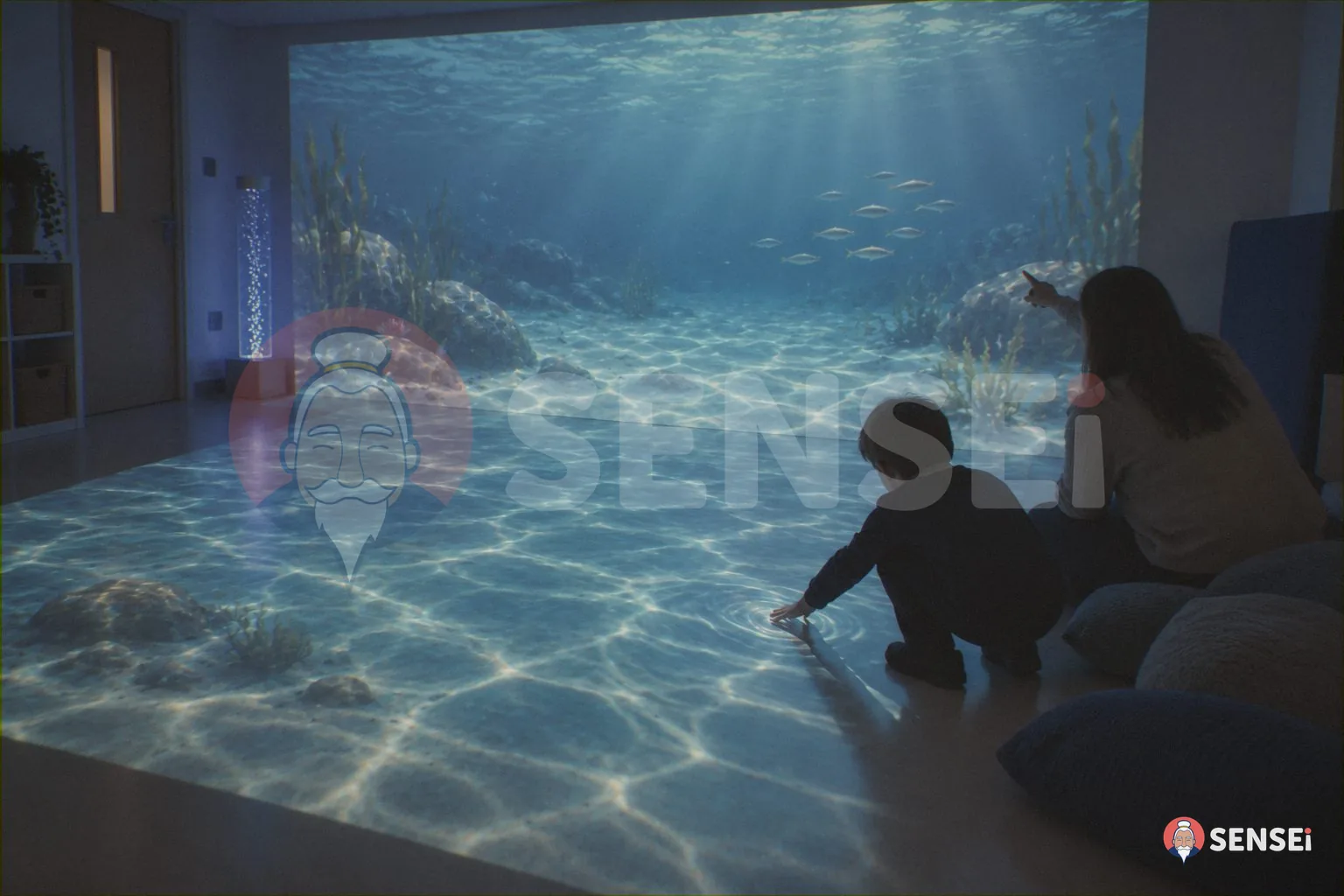
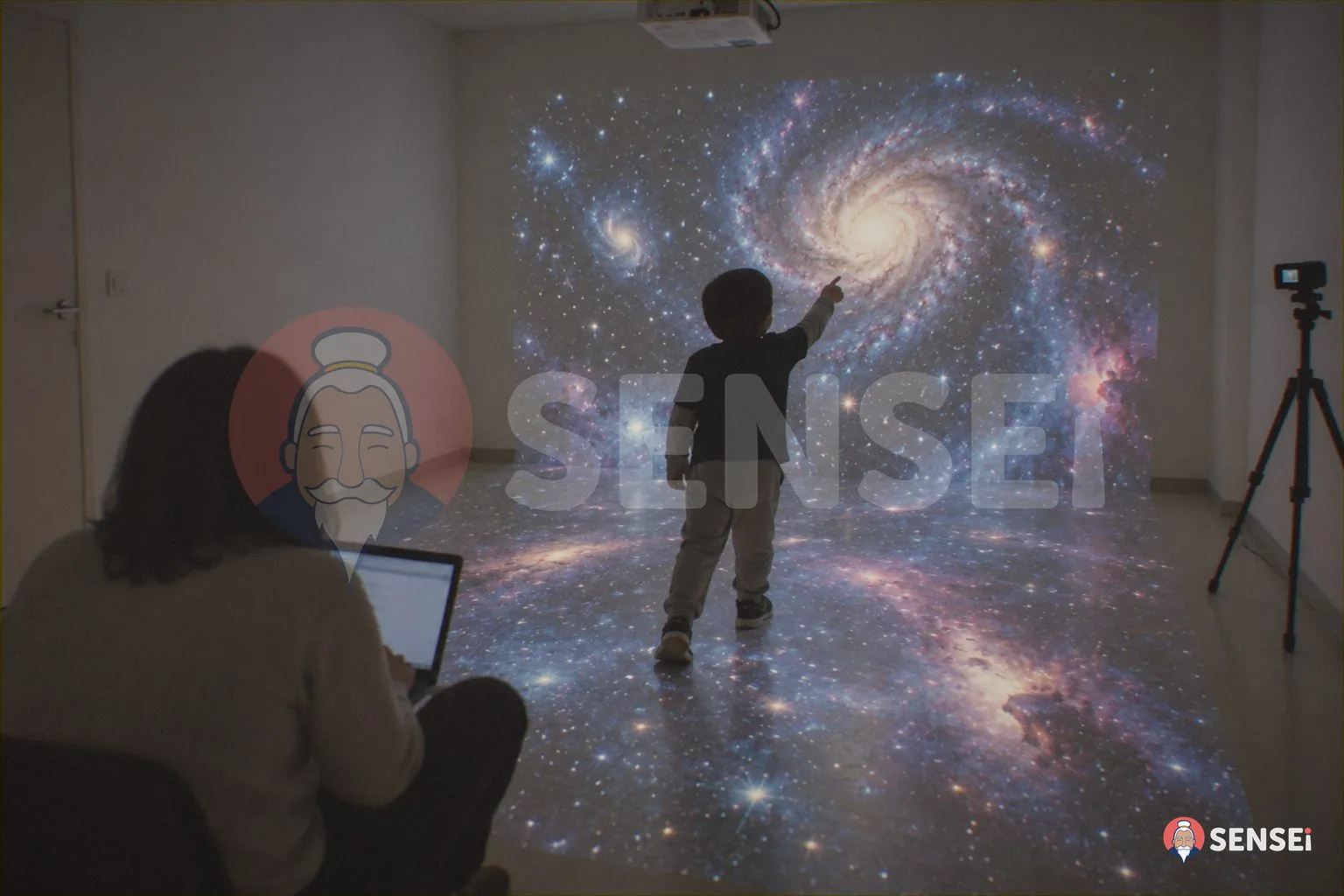
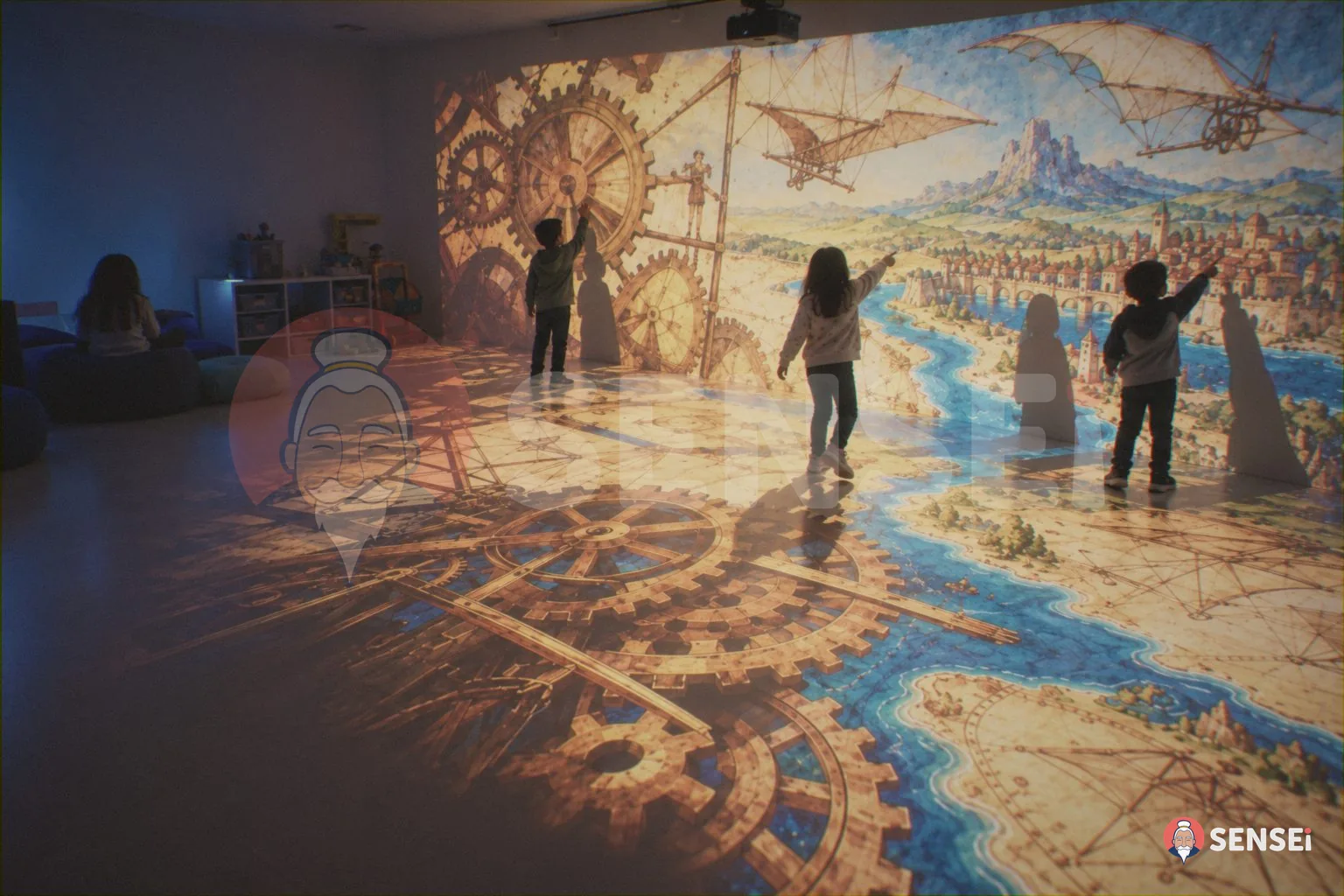
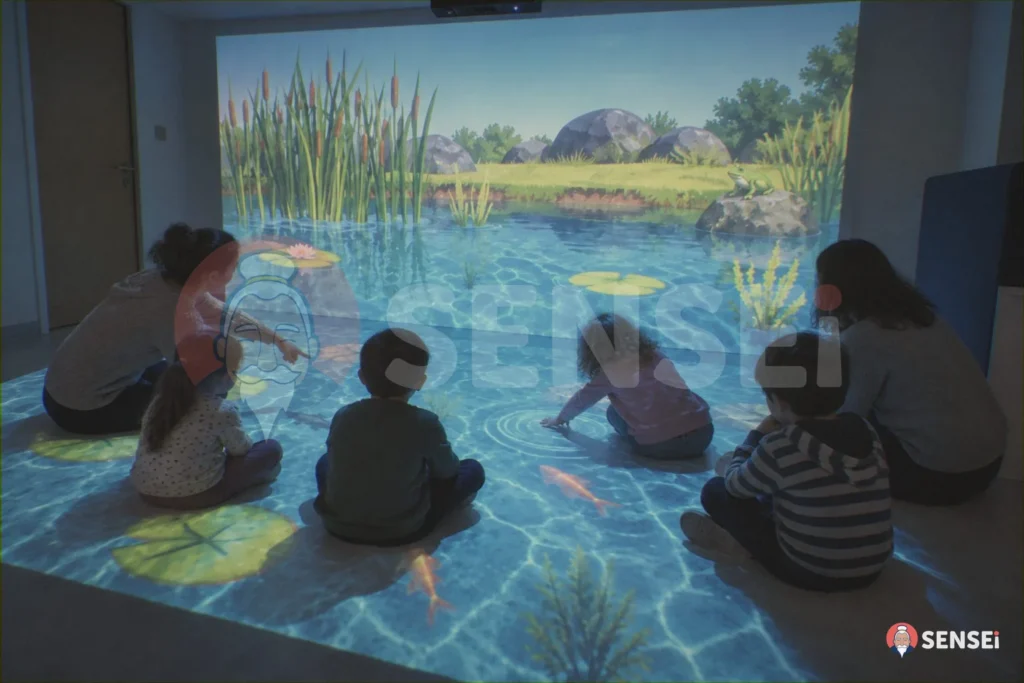
If the school has an immersive room, 2 April can become a day of shared experiences.
- Two ways of being in the room: first an environment full of lights and sounds, then the same scene with low stimulation. Pupils say which they prefer and why.
- Taking turns in control: each child can change the colour and sound of the environment. The class observes how the room changes when someone else decides.
- Calm waves: a slow scene of waves and blue light for a moment of breathing together in a circle.
The second exercise is not a minor detail: being able to decide what happens around you changes how you feel in an environment. The research group from which SENSEi originates has been studying movement and group games for autistic pupils for years, in a body of work that counts more than 40 scientific publications (you can find them on the Research page). In a SENSEi room the teacher adjusts light, sound and pace from a tablet, and the same activity can be lively for one group and calm for another.
For more structured activities with autistic pupils, see Sensory room and autism at school: practical activities. To better understand how sensory differences show up, read Children’s sensory needs: how to recognise them.
And after 2 April?
A single day is a starting point. Many of the activities suggested (the calm corner, the visual schedule, pictograms) can become a permanent part of class life. This is the idea of Universal Design for Learning: offering multiple ways to take part, represent and express oneself, to the benefit of everyone. For autistic pupils it means a more predictable class; for their classmates, the habit of recognising other people’s needs; for teachers, tools that last. In centres that use SENSEi every day, such as the autism centre of ASL Salerno in Bracigliano, children and young people move, play and communicate in a room designed for them. Another date in the calendar is 3 December: you will find ideas in International Day of Persons with Disabilities: inclusive activities. Discover also what SENSEi offers primary schools.
Frequently asked questions
When is World Autism Awareness Day?
Every 2 April. It was established by the United Nations in 2007.
How can autism be explained to primary school children?
By starting from the differences everyone has in perceiving sounds, lights and situations, with concrete examples and without pointing to individual classmates.
Is the family’s consent needed if there is an autistic pupil in the class?
It is good practice to inform families before the activities and to let them and the pupil decide whether and how to share their story.
How long should the activities last?
In preschool 15-20 minutes, in primary school 30-45 minutes, with a final discussion.
Can these activities be used all year round?
Yes. The calm corner, the visual schedule and pictograms work best when they become habits.
Create your own inclusive activities
With Eureka you can create and share multisensory activities for your class. Discover Eureka.
Sources
- United Nations, World Autism Awareness Day, 2 April
- AGI, Autism, World Awareness Day (2 April 2026), data from the ISS and Ministry of Health Progetto Osservatorio
- Bhattacharya, Gelsomini, Pérez-Fuster, Abowd, Rozga (2015), Designing motion-based activities to engage students with autism in classroom settings, ACM IDC
- CAST, About Universal Design for Learning