
A multisensory room needs elements for each sense: lights and images for sight, sounds and music for hearing, surfaces and materials for touch, gentle scents for smell, and seating, mats and soft spaces for movement and balance. But the list matters less than the direction: each element must create a specific experience, serve a goal, be safe and be adjustable by the adult.
This guide lists the most common equipment, sense by sense, describing the experience each item creates, who it is valuable for and what to watch out for. At the end we distinguish what is essential from what is optional, explain how the software holds everything together and what changes, in practice, for those who use the room every day.
Where to start before buying?
Before choosing the equipment, it is worth answering three questions:
- Who will use the room? Toddlers at nursery, primary school pupils, young people with complex disabilities, older people with dementia: their needs are very different.
- To do what? Relaxation and regulation, learning, communication, motor skills, or a mix.
- In which space? Size, natural light, the possibility of darkening the room and keeping the floor clear.
The recent guidance from England’s Department for Education on inclusive school estates recommends investing in a sensory room only where there is a clear and specific need, with input from specialists, and not as a generic intervention for everyone. It is a good principle in Italy too: goals first, then the list. If you are still working out what a multisensory room is, start from the guide to the multisensory room.
Sight: lights, projections and colours
Sight is often the most stimulated sense, and precisely for this reason it needs to be dosed with care.
Interactive projections on wall and floor
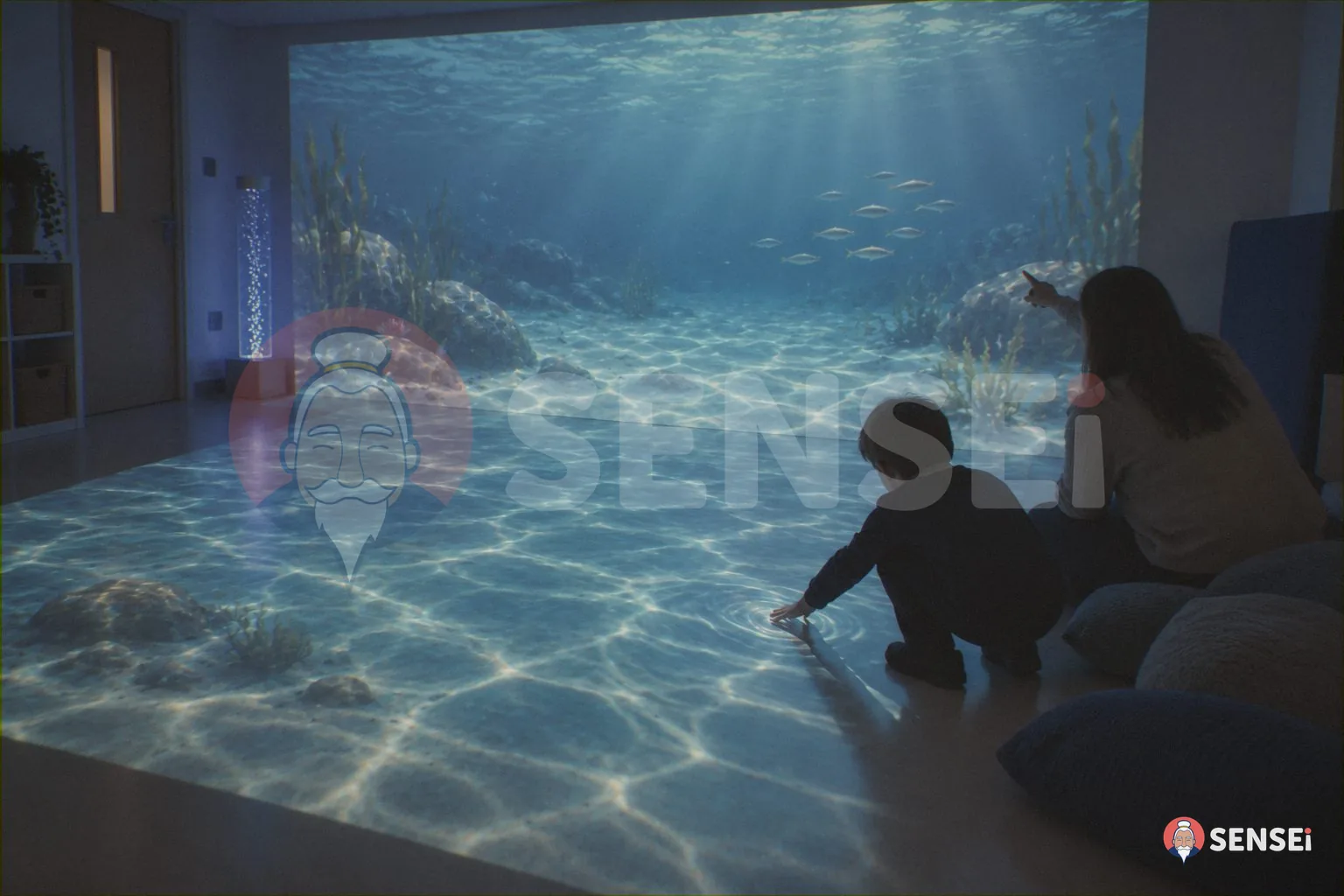
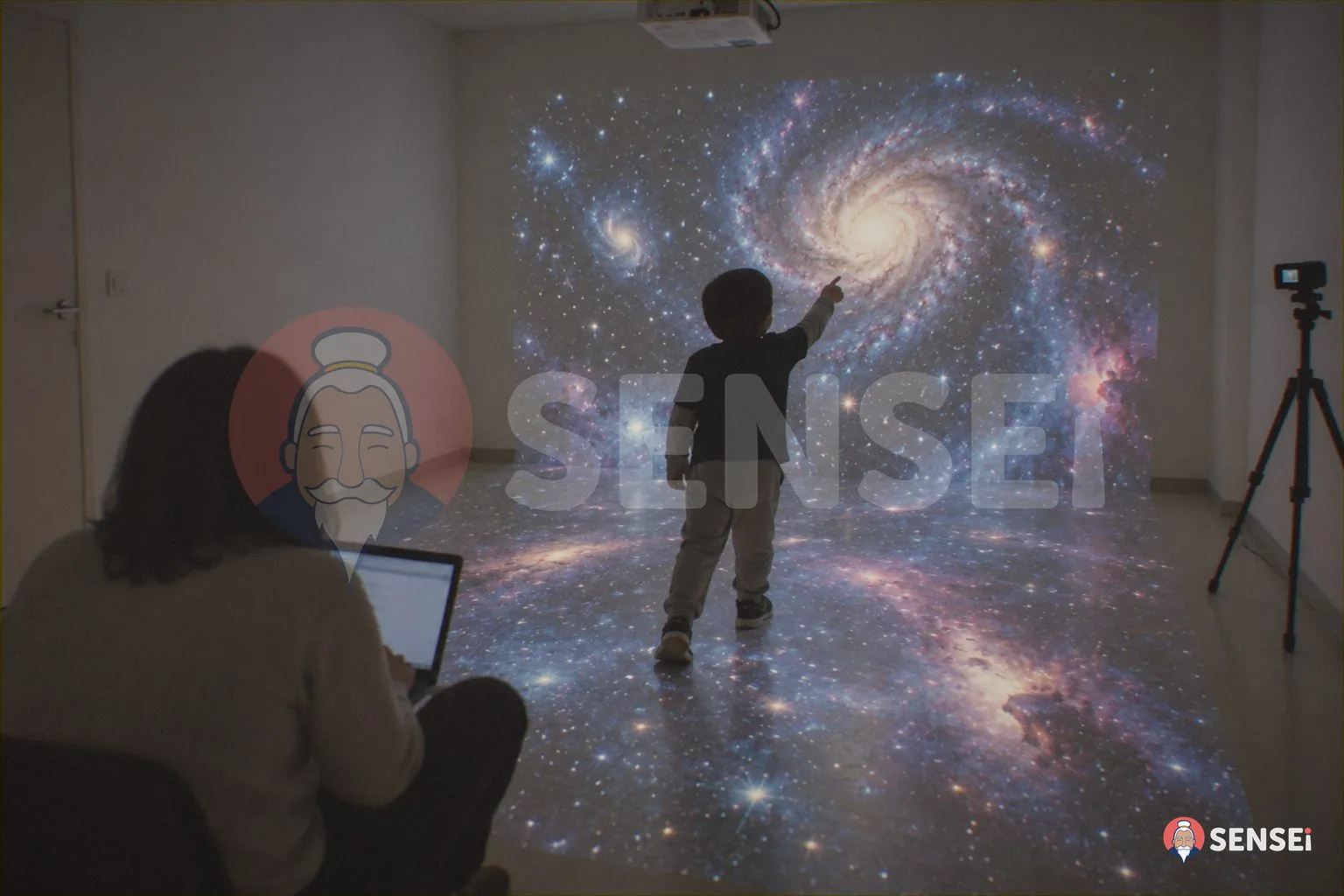
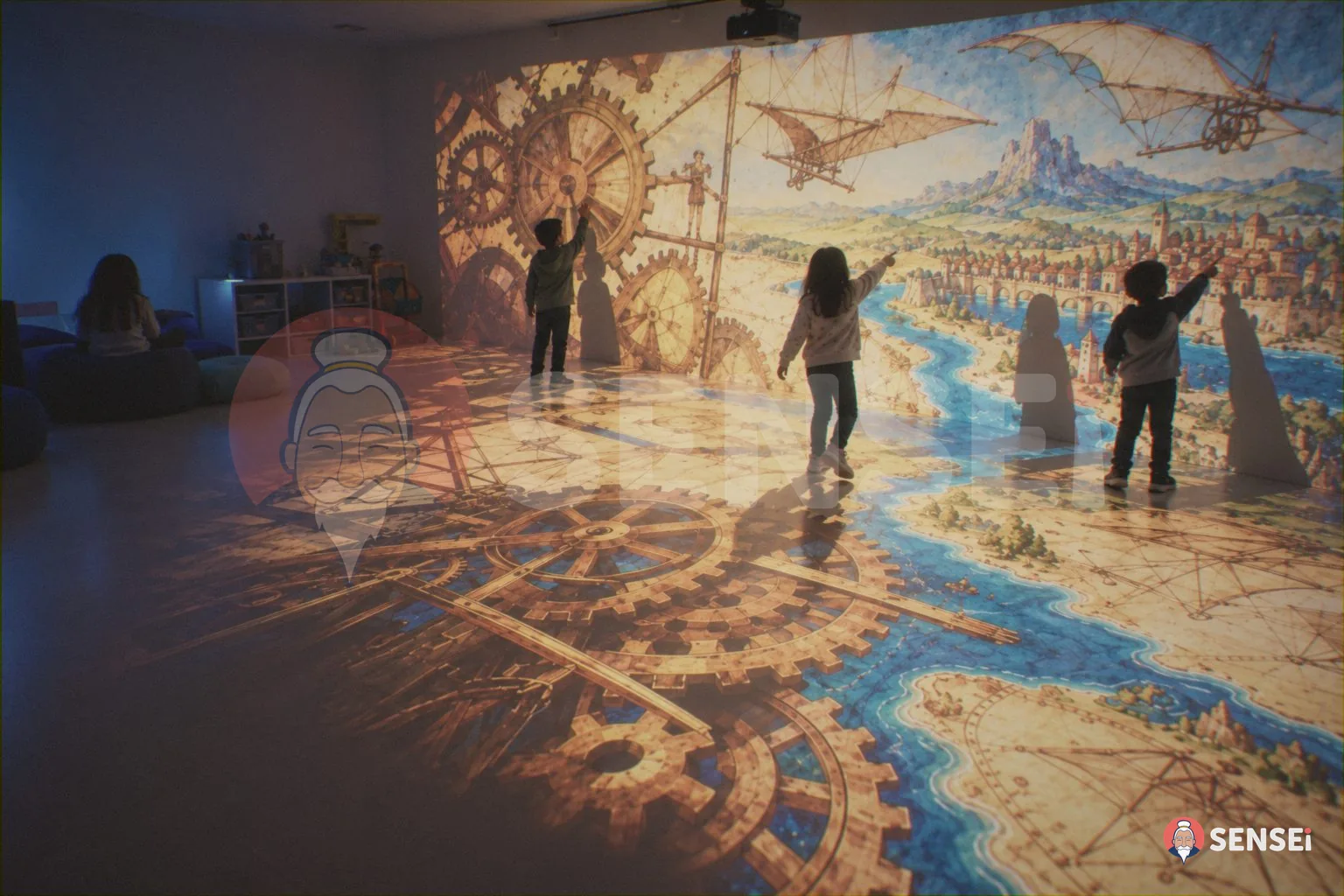
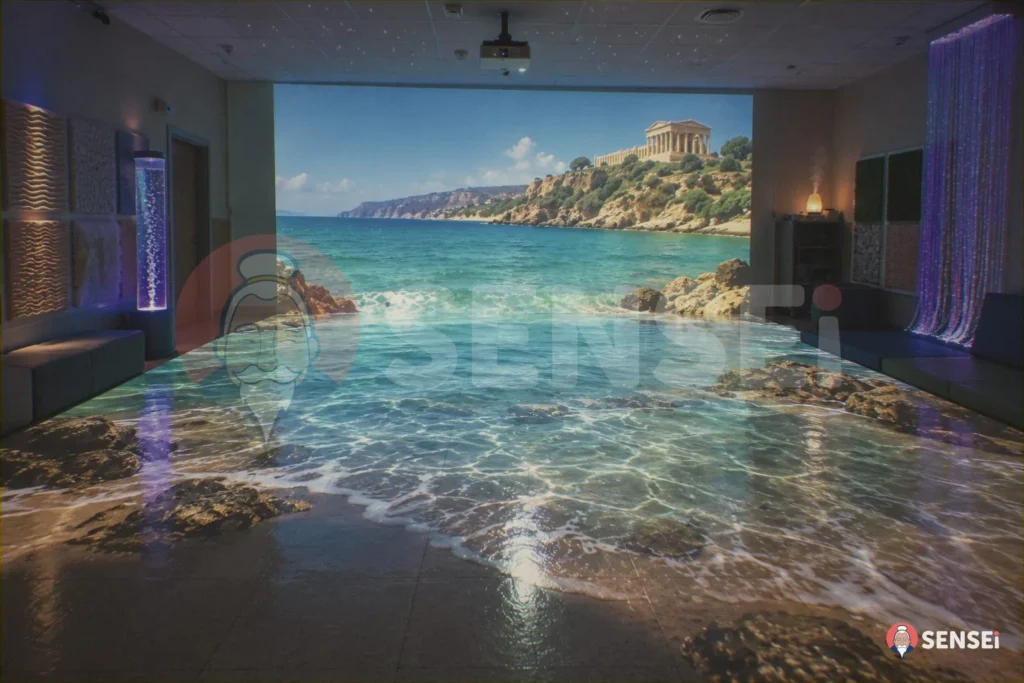
The walls and floor become a landscape to inhabit: the sea, a forest, outer space. With every step or gesture something changes, and the child discovers that they can make things happen. This is the element that turns the room into a place of shared play, joint attention and learning through the body.
It is useful from nursery to secondary school, for groups and whole classes, and for those with a neurodevelopmental condition who find movement a more natural channel than words. Watch out for just one thing: no flashing images, and technology always out of reach. Find out more in interactive floor and wall.
Adjustable coloured lights
Light sets the tone of the experience: warm to slow down, cool to enter the water, a specific colour to signal that the activity is starting or ending. For those who need visual routines it is a reassuring point of reference.
It is useful for everyone. The intensity must be able to drop in an instant, with no strobe effects and without ever reaching complete darkness. Find out more in lights and projections in a sensory room.
Bubble tube
A column of water in which bubbles rise and colours change: you follow it with your eyes, lean against it and feel the vibration. It creates a moment of calm and visual attention, and is often much loved.
It is valuable for people with complex disabilities, young children and older people. It must be stable, protected and securely fixed. Find out more in sensory bubble tube.
Fibre optics
Strands of light to touch, squeeze and let run through the fingers: sight and touch meet in a delicate experience that does not get hot and invites exploration with the hands.
They suit those who love to explore by touching and people with complex sensory needs, always with an adult nearby. Find out more in sensory fibre optics.
Mirrors and reflective surfaces
They multiply lights and colours and show children their own image in motion: a simple aid to body awareness, useful at nursery and in motor activities. Shatterproof materials only.
Hearing: sounds, music and silence
Audio system
Music, sounds of nature, voices, a sound that responds to a gesture: hearing guides the attention and the rhythm of the activity, and is often the first signal that something is about to change. It is useful for everyone, as long as the volume stays moderate and the adult can mute everything in an instant.
Instruments and sound objects
Rattles, soft drums, bells: here the sound does not come from outside, the child produces it. It is an experience of initiative and imitation, perfect for group play. At nursery, no small parts.
Acoustics and a quiet corner
Rugs, curtains and sound-absorbing surfaces make the room more welcoming; a quiet corner always offers a way out. For those with auditory hypersensitivity it makes the difference between staying and running away. Fire-retardant materials.
Touch: surfaces, materials, objects
Tactile panels
Smooth, rough, soft, raised: surfaces to explore with the hands that make what you see tangible. They are an important bridge for young children, people with visual or intellectual disabilities and older people.
They must be securely fixed, washable and non-toxic. Find out more in sensory panels and tactile materials.
Materials to handle
Fabrics, balls, soft objects, pine cones and leaves bring the real world into the room and connect the immersive experience to everyday life. They are chosen according to age, with attention to hygiene and, at nursery, to anything that could be swallowed.
Interactive objects
A card, a soft toy, a cube that, when moved or brought closer, changes what happens in the room. For those who struggle with gestures in empty space, having something concrete to hold is often the key to taking part. Size appropriate to age and no hazardous parts within reach.
Soap bubbles
Chasing them, touching them, watching them pop: few things engage young children like bubbles, which combine sight, touch and movement. They should be used for short periods, with a non-irritating liquid and attention to the floor, which becomes slippery.
Smell: scents and aromas
Aroma diffuser
A scent associated with a scene (the sea, the forest, the kitchen) makes the experience richer and more memorable. With older people, a smell can bring back distant memories.
It requires minimal intensity, one scent at a time, ventilation and a prior check for allergies and asthma.
Scent bags and jars
Scents to smell up close, chosen by the person: an individual experience of discovery and recognition. Closed containers and no undiluted essential oils in contact with the skin.
Movement and balance: proprioception and the vestibular system
Proprioception is the perception of the body’s position; the vestibular system concerns balance and movement. These senses are often forgotten, but they are very important for regulation.
Mats and soft surfaces
They let people lie down, roll and crawl without fear, and help divide the room into recognisable zones. At nursery they are essential. Non-slip, stable and washable.
Beanbags, enveloping seats, weighted cushions
They wrap around and contain: deep pressure helps many people calm down and regain their balance. They are valuable for autistic people, children with regulation difficulties and older people, always with an adult present.
Hammocks, swings, vibrating mattresses
Rocking and vibration respond both to those seeking movement and to those who need deep relaxation. These are specialist elements: certified anchoring, minimal height from the ground and constant supervision.
Free space to move
Running, jumping, dancing, following what appears on the floor: empty space is perhaps the most underrated element. Research on embodied learning places movement at the centre, and this is where group activities come to life, from preschool upwards. A clear floor and protected corners.
What is essential and what is optional?
You do not need to have everything. This table helps set priorities for a room intended for a school or an educational centre.
| Element | Priority | Why |
|---|---|---|
| Adjustable light and the possibility of darkening | Essential | Without control of the light there is no control of the experience |
| Interactive projection (at least one surface) | Essential for an interactive room | It is the heart of the shared and educational experience |
| Sounds with controllable volume | Essential | Guides rhythm, attention, transitions |
| Mats and soft seating | Essential | Safety and regulation |
| Calm corner | Essential | Always offers a way out |
| Tactile materials | Essential | Touch makes the experience tangible |
| Bubble tube | Useful optional | Much appreciated for relaxation and visual attention |
| Fibre optics | Useful optional | Combines sight and touch safely |
| Scents | Optional | Useful but to be used with caution |
| Soap bubbles | Optional | Engaging, requires managing the floor |
| Hammocks and swings | Specialist optional | Requires space, anchoring and trained staff |
| Mirrors | Optional | Useful for body awareness |
Priorities change in different contexts. In a care home for older people with dementia, for example, comfortable seating, warm light and familiar sounds matter more than projection on the floor. To learn more, read multisensory room for older people and Alzheimer’s.
Public funding calls follow a similar logic. Circular no. 11 of the Regione Siciliana on multisensory classrooms, for example, requires the environment to be equipped with lights, audio, tactile materials, aromas and soft furnishings, together with teacher training and monitoring. You will find an overview of funding in the guide on how to fund a multisensory classroom.
How does the equipment integrate with the software?
A room full of unconnected objects is like an orchestra without a conductor: each instrument plays on its own. The software turns the whole into a single, adjustable experience.
In the SENSEi magic room the software:
- coordinates images, lights, sounds, scents and bubbles, so that they change together (for example: the light dims, the sea appears, you hear the sound of the waves, the scent of sea salt arrives);
- responds to the gestures, movement, touch and voice of several people, with nothing to wear;
- lets the adult guide everything from a tablet, raising or lowering the intensity in real time;
- adapts the experience to the group or to the individual;
- documents sessions with interpretable progress reports.
This approach comes from research, collected in more than 40 scientific publications. The Magic Room project brings together images, bubbles, scents, lights and toys in a single smart space, designed with specialists and used in two therapy centres. The MOVES system shows that it is possible to go beyond hardwired environments: a lightweight, mobile structure allows interaction in five ways (feet, hands, cards, wand and voice), always leaving the teacher in control.
A field study with 175 children aged 6 to 10, carried out with MOVES, compares these five interaction modalities and finds differences between the modalities, which are useful for designing activities (see Interaction Modalities and Children’s Learning in Multisensory Environments). In practice: there is no single best interaction. Having several ways to interact allows everyone to find their own.
With Eureka, educators can also create and share new activities, using the elements already in the room.
What changes when the elements work together?
A well-designed room is not measured by the number of objects, but by what happens inside it. A child who usually stays on the sidelines finds a way to take part. A group learns to play together. A practitioner can offer a moment of calm after a lively activity in a few seconds, without changing room.
This is what the organisations that use SENSEi report. At the Cooperativa Amicizia in Codogno the room grows out of the care staff’s answers, with shared goals and tailored activities that the educators lead independently. At Gigli del Campo it becomes a safe place where autistic young people aged 13 to 25 practise independence.
Final checklist before buying
- Have I defined users and goals?
- Can the space be darkened and does it leave the floor clear?
- Does each element have a clear function?
- Does the equipment have certifications suited to the intended use (school, healthcare)?
- Is there a calm corner?
- Can adults easily adjust lights, sounds and scents?
- Is training planned for those who will use the room?
- Are support, warranty and maintenance clear?
Frequently asked questions
What is the most important equipment in a multisensory room?
Control of light and sound. Without the ability to adjust intensity and rhythm, every other element risks becoming an overload.
Is a bubble tube a must?
No. It is a much appreciated element, but a room can work very well without one, especially if it has interactive projections, adjustable lights and tactile materials.
How much space is needed?
It depends on users and activities. SENSEi uses the walls and floor of an existing room, with discreet ceiling-mounted technology and no building work.
How much does it cost to set up a multisensory room?
It depends on the configuration and the goals. Contact us for a tailored proposal.
Are scents and bubbles safe?
Yes, if used with caution: minimal intensity, allergy checks, ventilation and attention to slippery floors.
Can I add equipment over time?
Yes. It is best to start with the essential elements and add the optional ones based on what emerges from observation.
Book a demo
Want to understand which equipment your school or centre really needs? Book a demo: we design the room together, starting from the goals, not from the list.
Sources
- Department for Education (2026). Inclusive education estates
- Regione Siciliana, Circolare n. 11 del 30/03/2026, Aule multisensoriali
- Garzotto F, Gelsomini M (2018). Magic Room: A Smart Space for Children with Neurodevelopmental Disorder. IEEE Pervasive Computing
- Cosentino G, Gelsomini M, Giannakos M (2023). MOVES: Going beyond hardwired multisensory environments for children. IDC 2023. doi:10.1145/3585088.3594493
- Cosentino G, Gelsomini M, Sharma K, Giannakos M (2023). Interaction Modalities and Children’s Learning in Multisensory Environments. IDC 2023. doi:10.1145/3585088.3589385