
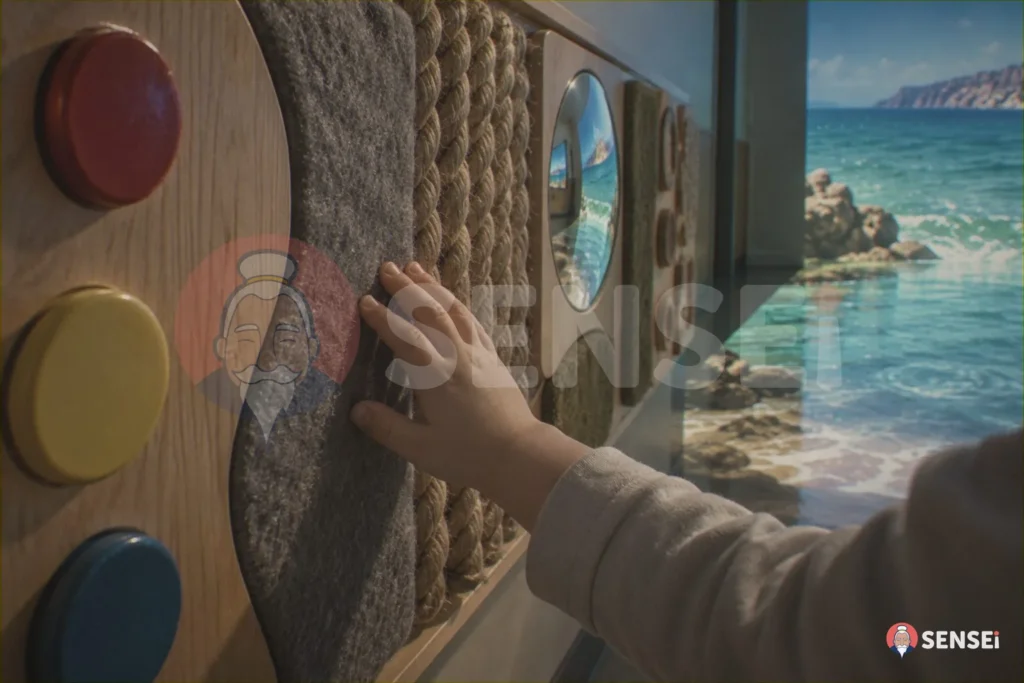
Sensory panels are surfaces, usually fixed to a wall or placed on a table, that bring together materials and objects to touch, handle and observe: different textures, gears, mirrors, buttons, fastenings. They are used to explore with the hands, train fine motor skills and connect touch to the other senses.
Choosing them well means starting from the people who will use them: age, sensory needs, mobility. In this guide we look at types, uses, what research says, selection criteria and safety, and how touch interacts with an interactive environment.
What types of sensory panels are there?
There are five main categories, each offering a different experience.
| Type | Examples | What they are for |
|---|---|---|
| Tactile panels | Wood, felt, rope, rubber, brushes, fabrics | Distinguishing surfaces, calm exploration |
| Manipulative panels | Gears, zips, padlocks, abacuses, mazes | Fine motor skills, hand-eye coordination |
| Mirror panels | Flat or distorting shatterproof mirrors | Body awareness, imitation |
| Light and sound panels | Buttons that switch on lights or produce sounds | Cause and effect, choice, communication |
| Tactile floor paths | Tiles with different textures | Proprioception, balance, exploring with the feet |
Loose materials can be added to the list: textured balls, sensory bags, fabrics, natural objects. They are valuable, but should be chosen by the same rules as the panels.
What are sensory panels for?
Touch is a fundamental channel of knowledge, often overlooked at school. Panels put it centre stage.
- Exploration. Touching different surfaces helps children get to know the world and put names to sensations: rough, smooth, soft, cold.
- Fine motor skills. Turning, pulling, opening and closing train fingers and wrists.
- Cause and effect. A button that switches on a light shows that one’s own action produces a result.
- Regulation. For some people, touching a predictable texture is calming.
- Language. Describing what you touch enriches vocabulary.
- Body awareness. The guidelines of England’s Department for Education mention mirror panels as a support for body awareness and movement regulation.
Who are they suitable for?
- Nursery and preschool: free exploration of large, sturdy textures, under supervision.
- Primary school: sorting, comparison and description activities.
- Autistic pupils: predictable materials, with the option to choose and to avoid. Some children seek intense tactile stimuli, others reject them: both reactions must be respected.
- People with visual impairments: strong tactile contrasts and a consistent layout, to help them find their way.
- People with motor disabilities: panels at a height reachable when seated, with elements that are easy to operate.
- Adults with intellectual disabilities and older people: familiar objects and everyday materials, respectful of their age.
To recognise each child’s needs, read children’s sensory needs.
What does research say about physical and digital objects?
The research from which SENSEi was born studies in depth the relationship between physical objects and digital content, one of the strands of a journey that counts more than 40 scientific publications. The study on phygital interfaces, published in Multimedia Tools and Applications, involves 17 young adults with intellectual disabilities and 8 specialists at a social care centre. The system studied, Reflex, combines physical objects and digital content. Compared with purely digital or purely paper-based approaches, phygital approaches show better participant performance. It is described in the publication Phygital interfaces for people with intellectual disability.
The study by Unwin, Powell and Jones in the journal Autism also includes a tactile button panel with eight coloured keys that play piano notes. With 41 autistic children, direct control of the equipment is associated with fewer repetitive behaviours and more attention, with limitations acknowledged by the authors.
For educators the message is clear: an object you can touch becomes more meaningful when it is linked to what is happening around it, and when it is the person who is in control.
How to choose safe sensory panels?
Safety comes before effect. Here are the criteria to check.
Construction
- Rounded edges and splinter-free surfaces.
- Solid wall fixing or a stable base.
- No small parts that could come loose, especially with children under three.
- Cords and ropes short and secured at both ends.
- Shatterproof mirrors, never glass.
Materials and hygiene
- Washable materials or removable covers.
- No materials that crumble or shed fibres.
- A cleaning procedure between one group and the next.
Standards
When a panel or object is sold as a toy, in the European Union it must comply with Directive 2009/48/EC on the safety of toys and carry the CE marking. The European Commission points out that the requirements cover physical and mechanical risks, flammability, chemical substances, electrical properties and hygiene. The new Regulation (EU) 2025/2509 will replace the directive and will apply from 1 August 2030.
Other rules apply to products that are not toys. In any case, ask the supplier for the conformity documentation and the instructions for use.
Accessibility
- A height reachable both standing and seated, or panels on several levels.
- Clear space in front for a wheelchair.
- Elements that can be operated with little force.
How many panels do you need?
Fewer than you might think. A wall full of stimuli can become confusing, especially for those with sensory processing difficulties. The English guidelines recommend limiting visual clutter and keeping layouts simple.
Better a few well-chosen panels, placed in a recognisable tactile area, and some materials to change over time. Sturdiness and ease of use matter too: at Cooperativa Amicizia in Codogno, it is the practitioners themselves who ask for robust materials suited to intensive use. For organising the space, read how to set up a multisensory classroom.
How do panels fit into a SENSEi environment?
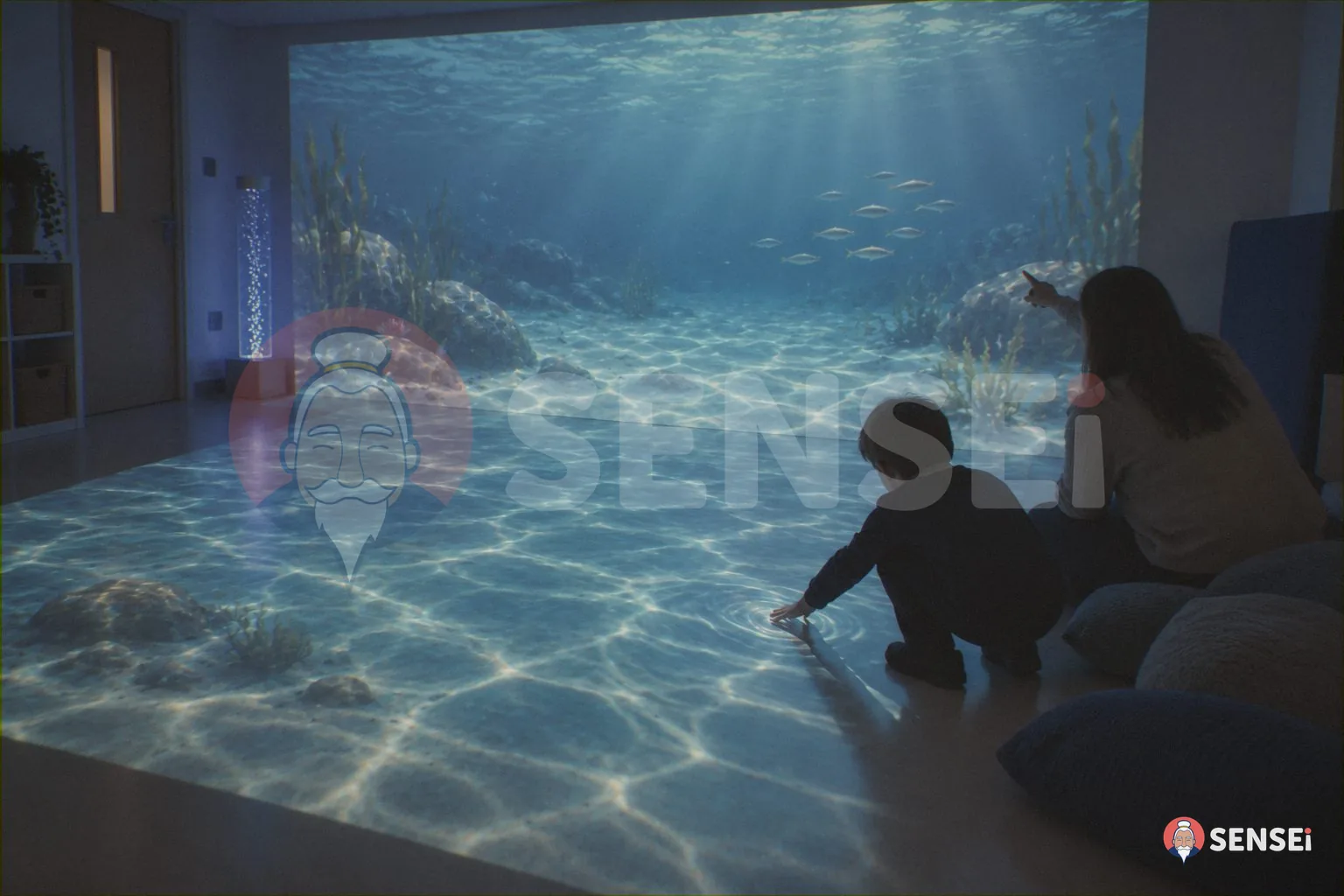
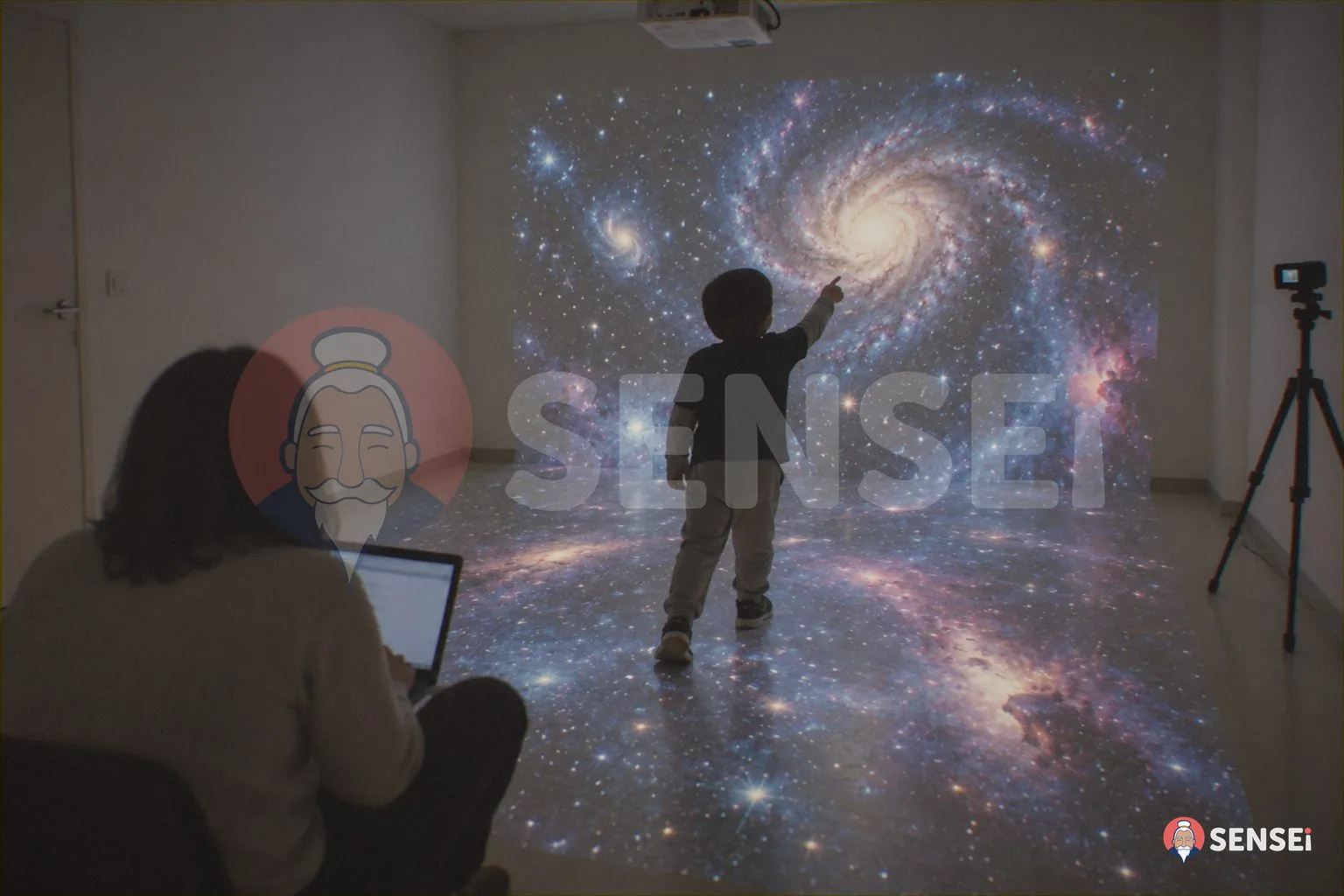
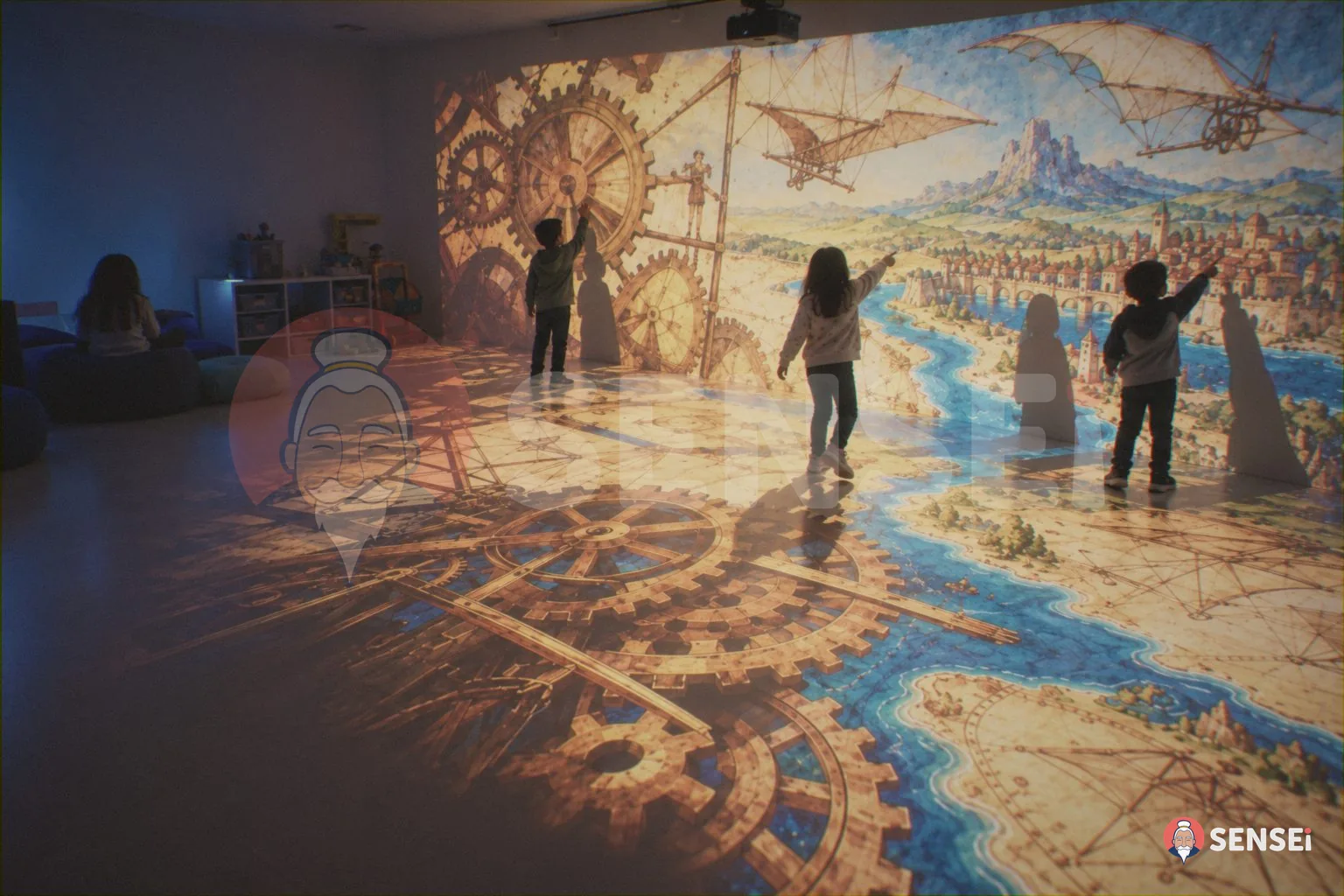
A SENSEi environment transforms an existing room into a world to explore: walls and floor respond to gestures, while lights, sounds, scents, bubbles and physical objects follow the same story, guided by the educator from a tablet. Tangible objects are part of the experience, not a separate element.
Here is how touch and projections can interact:
- during a woodland scene, the children touch bark, leaves and moss on the panel while the walls show the trees;
- in an activity on animals, each texture corresponds to a projected animal: fur, feathers, scales;
- in an individual session, the therapist alternates tactile exploration and the interactive wall to work on attention and communication.
Magika, the research project from which SENSEi was born, combines precisely this: worlds projected on walls and floor with toys, lights, materials and connected objects, to offer tactile, auditory, visual and olfactory stimuli.
Touch also goes beyond the room. At IC Silvio Pellico in Arluno, in addition to a SENSEi environment in every school building, there is an outdoor classroom with wall-mounted play panels for fine motor skills, hand-eye coordination and social skills.
If you already have panels with buttons or sensors, we can assess together whether and how to connect them to the environment: this is a check to be done case by case. The complete picture, sense by sense, is in the guide what to put in a multisensory room. To see a complete environment, visit The magic room and the page SENSEi for therapy and well-being.
In the SENSEi room
In a SENSEi room, tactile panels bring real nature alongside projected nature: the moss of the woods, the bark, the river stones. Touch confirms what the eyes see and makes the experience more concrete.
Activities to try in a SENSEi room
- The woodland path: touch the material that matches the projected element: bark, moss, stone.
- Rough or smooth?: comparison and vocabulary games to describe sensations.
- Curious hands: for the youngest, free exploration with an adult nearby.
- Gradual desensitisation: for those with tactile defensiveness, start from the best-tolerated material.
Discover all the tools in the guide to the tools of the SENSEi room.
Frequently asked questions
Are sensory panels suitable for nursery?
Yes, if they are sturdy, have no small parts and are used under supervision. Large, simple textures are best.
DIY or bought panels?
DIY panels can work for home use, but at school you need certified materials and secure fixings. We discuss this in DIY multisensory room.
How are tactile panels cleaned?
It depends on the materials. Choose washable surfaces or removable covers and plan cleaning between one group and the next.
Is a panel with lights and sounds better than a purely tactile one?
Not always. Light-up panels help with understanding cause and effect; purely tactile ones are better suited to calm moments.
How much do sensory panels cost?
It depends on type, size and number. Contact us for a tailored proposal for your room.
Want to see how touch and projections work together? Book a demo of a SENSEi environment.
Sources
- European Commission, Toy safety.
- Gelsomini, Spitale, Garzotto, Phygital interfaces for people with intellectual disability, Multimedia Tools and Applications 2021.
- Unwin, Powell, Jones, The use of Multi-Sensory Environments with autistic children: Exploring the effect of having control of sensory changes, Autism 2022, doi 10.1177/13623613211050176.
- Department for Education, Inclusive education estates (June 2026), GOV.UK.
- Gelsomini et al., Magika, a Multisensory Environment for Play, Education and Inclusion, CHI EA 2019.