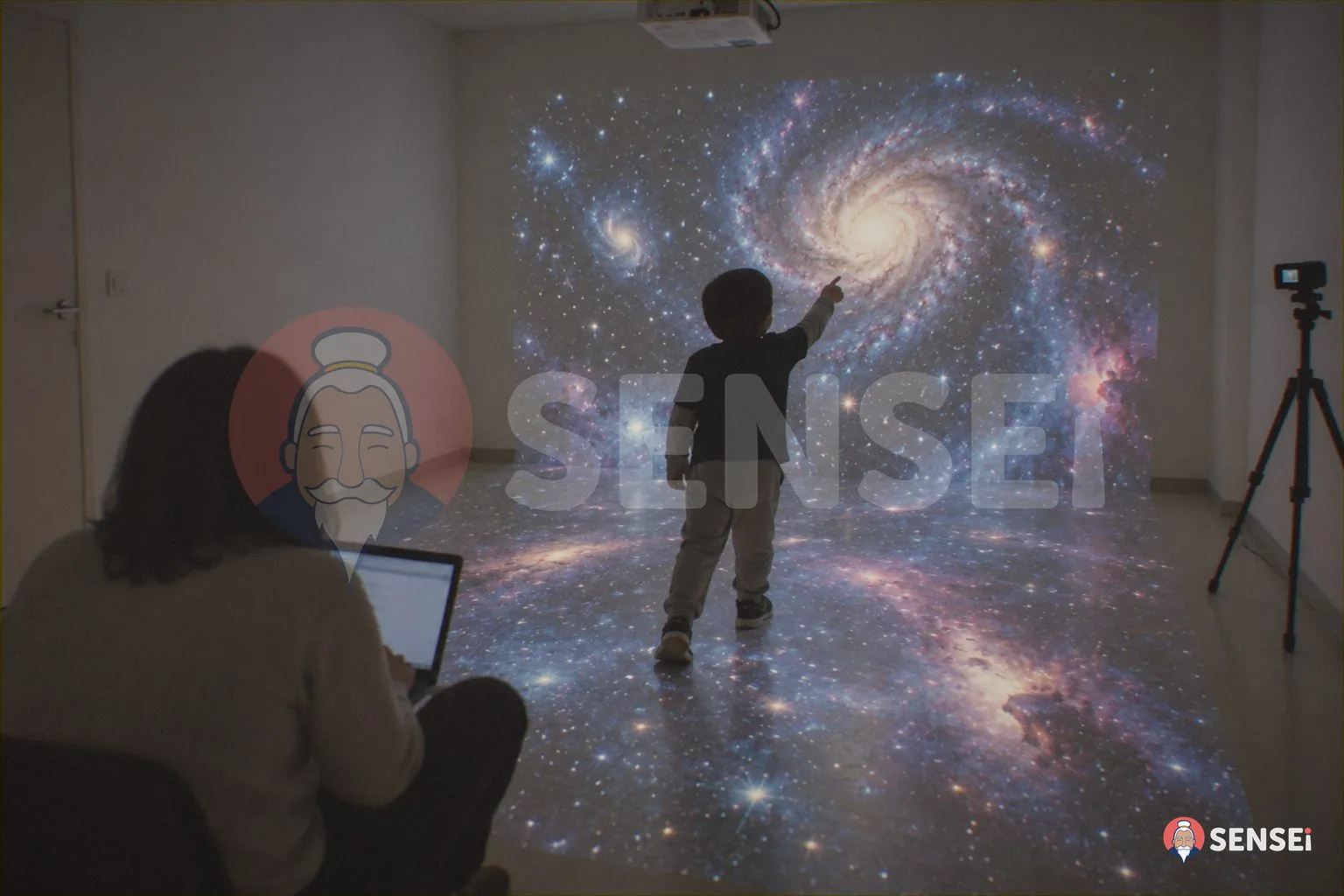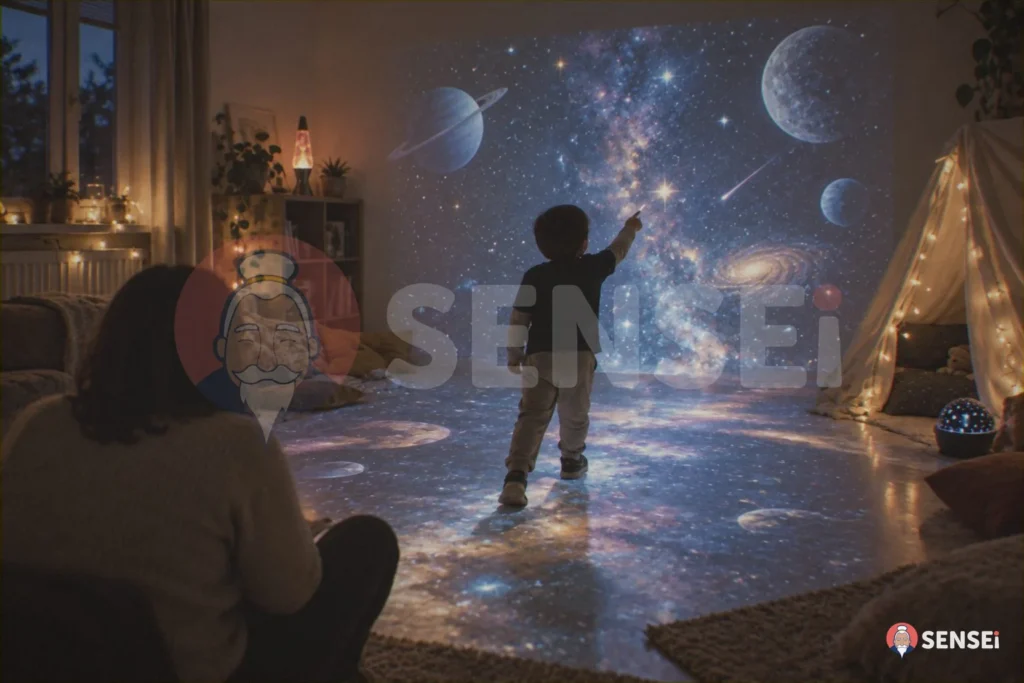
A DIY multisensory room is possible: with warm lights, fabrics, cushions, music and a few objects to touch, you can create a pleasant corner at home or in class to relax and play with the senses. It does, however, have clear limits: it offers no real interaction, it cannot be adjusted precisely and, if used by many children or within a service, it must meet safety requirements that DIY can hardly guarantee.
This guide is honest: we tell you what works, what to avoid, what research says and when it makes sense to turn to a professional.
What can be done at home with simple materials?
A lot, if the goal is a quiet corner for a child or for the family. Here are the most useful elements, divided by sense.
Sight
- Warm, adjustable lights: a lamp with a dimmer or warm-white LED bulbs. Indirect light is better than light shining straight into the eyes.
- Low-voltage LED string lights, fixed up high and out of reach of the youngest children.
- A star or wave projector for the ceiling, choosing models with slow movement.
- Sensory bottles with water, glitter and oil, with the cap glued and sealed.
Hearing
- Slow music, nature sounds, white noise at low volume.
- Simple instruments: rattles, tambourines, a rain stick.
- Noise-cancelling headphones for those who are sensitive to sound.
Touch
- A basket with different fabrics (fleece, velvet, jute, silk), soft brushes, balls with different surfaces.
- Cushions, poufs, a weighted blanket to be used only under adult supervision.
- A soft rug on the floor.
Movement and proprioception
- A pouf or a soft bean bag to sink into.
- A “den” made with a sheet and a table, or a play tent.
- Pushing and pulling games with large cushions.
Smell
- Lavender sachets or citrus peel. With young children, use essential oils with great caution or avoid them, and ask your paediatrician in case of allergies or asthma.
Which mistakes should be avoided? Safety first
DIY becomes risky when certain details are underestimated.
- Flashing lights. Some people have photosensitive epilepsy and can have seizures triggered by flickering lights and visual patterns. The main international guidelines agree on a limit: no more than 3 flashes in one second (International Guidelines for Photosensitive Epilepsy). Turn off the “strobe” and “flash” modes of LED lights.
- Cables and sockets. No extension leads on the floor, no cables where children crawl or walk, power supplies out of reach.
- Heat. Some decorative lamps, such as lava lamps, get hot: they must be kept away from hands and fabrics.
- Small objects and batteries. With children under three, avoid small objects and check that battery compartments are closed with a screw.
- Suffocation. Heavy sheets and blankets should only be used with an adult present; no long cords.
- Too many stimuli at once. Switching everything on at the same time does not relax: it tires. Start with one stimulus at a time.
- Water and electricity. Keep water containers and mains-powered devices apart.
What can DIY not provide?
Honesty is needed here. A homemade corner is a passive environment: the lights change on their own or the adult changes them. The child watches.
Research suggests that control matters. In a study with 41 autistic children, when the children themselves controlled the changes in the sensory equipment, fewer repetitive and sensory-seeking behaviours and more attention were observed than with automatic changes (Unwin and colleagues, Autism). At home, you can get closer to this principle with simple cause-and-effect games: a large switch that the child turns on by themselves, an instrument that plays when they touch it. We discuss this in the post on interactive and passive rooms.
With DIY, however, it is difficult to achieve:
- walls and floor that respond to the movements of several children at once;
- single control that makes lights, sounds, images and scents work together;
- fine adjustment of intensity, adapted to the individual child in real time;
- structured educational activities linked to teaching or therapeutic goals;
- documentation of sessions to observe progress.
When is a professional solution needed?
The dividing line is not the budget, but the use. Here are the situations in which DIY is not enough.
| Situation | DIY | Professional solution |
|---|---|---|
| Relaxation corner for a child at home | Suitable | Not necessary |
| Calm corner in a classroom | Suitable, with attention to safety | Useful if used by many pupils every day |
| Classroom used by the whole school | Not very suitable | Recommended: robustness, safety, simple control |
| Therapy or rehabilitation centre | Not very suitable | Recommended: adjustable stimuli, individual profiles, documentation |
| Hospital or care home (RSA) | Not suitable | Necessary: hygiene, safety, support |
| Project funded through a call | Not suitable | Necessary: calls usually require specific criteria |
On the last point, a concrete example: the Regione Siciliana circular on multisensory classrooms requires a supplier certification for school use, support for at least five years, a five-year manufacturer’s warranty and teacher training, and for purchases to go through public procurement procedures (Regione Siciliana, Circular no. 11 of 30/03/2026). Requirements of this kind are beyond the reach of a DIY set-up. Learn more in the post on how to fund a multisensory classroom.
Is there a middle way?
Yes, and research has worked on it for a long time. The research group from which SENSEi was born, with more than 40 scientific publications, has studied simple and affordable solutions to bring interaction out of the lab. Reflex is a tablet game that, with a mirror over the camera, recognises physical objects placed on the table and enables learning beyond the screen (CHI). MOVES brings a complete multisensory experience into any room, without permanent wiring (IDC).
These experiences gave rise to the idea of the SENSEi magic room: no building work, no dedicated room. The existing walls and floor become interactive, and the elements you have built (a bubble tube, a soft corner, tactile materials) can stay. To choose what to keep and what to add, read what to put in a multisensory room and how to set up a multisensory classroom.
What changes for those who use it every day?
The real leap is not technological: it is in the educators’ work. With an environment designed together with them, activities grow out of the service’s goals, are repeated and adapted, and staff become autonomous. At Cooperativa Amicizia in Codogno, the SENSEi room grows precisely out of the staff’s answers: shared goals and 10 tailor-made activities. With Cooperativa ORSA, a mobile SENSEi kit brings a multisensory programme to six municipal preschools in Milan, without a dedicated room.
Frequently asked questions
Is a DIY sensory corner useful for an autistic child?
It can be, as a space for calm and discovery. It is best to build it starting from the child’s preferences, with few stimuli and the possibility for the child to switch them on and off.
Which lights should I choose?
Warm LED lights, with adjustable intensity and no rapid flashing. Avoid strobe modes.
Can I use an ordinary projector?
Yes, to project slow images and videos. It will not be interactive, and it should be positioned so that the light does not shine into the children’s eyes and the cables are out of reach.
How much does a professional multisensory room cost?
It depends on the configuration, the space and the services included, such as installation and training. Contact us for an assessment of your case.
Can I combine what I have already made with a professional solution?
Often yes. Well-made DIY elements, such as a soft corner or tactile materials, can stay alongside the interactive activities.
Want to find out whether DIY is enough in your case or whether you need something more? Book a demo.
Sources
- International Guidelines for Photosensitive Epilepsy: Gap Analysis and Recommendations (2024). ACM Transactions on Accessible Computing
- Unwin K. L., Powell G., Jones C. R. G. (2022). The use of Multi-Sensory Environments with autistic children: Exploring the effect of having control of sensory changes. Autism
- Reflex: Learning Beyond the Screen in a Simple, Fun, and Affordable Way. CHI EA 2018
- Cosentino G., Gelsomini M., Giannakos M. (2023). MOVES: Going beyond hardwired multisensory environments for children. IDC 2023
- Regione Siciliana, Circular no. 11 of 30/03/2026, multisensory classrooms