
With D.D.G. (Director General’s Decree) no. 3107 of 1 August 2026, the Regione Siciliana admitted 46 primary and lower secondary schools to funding to create a multisensory classroom, for a total of €2,499,447.10. The admitted schools must complete the classroom and activities by 31 August 2027 and submit their reports by 31 October 2027.
This guide summarises what Circular no. 11 of 30 March 2026 provides and what to do now: for funded schools, how to choose equipment and supplier while meeting the obligations; for schools on the list but not yet funded, how to prepare for a possible further allocation down the list. We report only what is written in the official documents, cited at the end.
What does Circular no. 11/2026 on multisensory classrooms provide?
The circular, dedicated to the creation of multisensory classrooms (Snoezelen® Room) in primary and lower secondary schools, makes €2.5 million available from the 2026 and 2027 regional budget. Each state primary or lower secondary school could submit only one proposal, for only one classroom, subject to a resolution of its governing bodies.
| Item | What the circular says |
|---|---|
| Maximum contribution | €55,000 per school |
| Main item A | Up to €50,000: specific furnishings, tactile and olfactory materials, necessary software and accessories, with limits for transport (1%), testing (1%), technical system adjustments (2%), administrative staff (1.5%) and teacher participation in training (up to €5,000, at least 20 teachers) |
| Main item B | Up to €5,000 for teaching and support staff in extracurricular activities |
| Payment | 80% advance and balance of up to 20% after the report has been checked |
| Completion | Classroom and trial by 31/08/2027 |
| Reporting | By 31/10/2027 |
Not eligible: management or coordination costs, technologies intended for workshops other than the multisensory classroom, and expenses incurred before the application or after the end of the project.
Which activities are mandatory?
Article 5 of the circular lists five phases that every project must include:
- setting up the multisensory environment, with lights, audio, tactile materials, scents and soft furnishings;
- training teachers on the method, on using the equipment and on managing sensory experiences;
- personalisation and workshops, with activities based on learning styles and interests, especially for pupils with special educational needs (BES);
- monitoring, with a system for observing results and collecting pupils’ feedback;
- a closing event with institutions, families and the educational community, whose costs are not reimbursed.
Funded schools: how to choose equipment and supplier
The circular sets precise requirements for equipment purchased under main item A. It is worth turning them into a checklist to use during the purchasing phase.
- Certification for school use: the equipment must have a specific supplier certification for use in schools. Ask for it in writing.
- Support for at least five years from a qualified supplier.
- Five-year manufacturer’s warranty.
- Teacher training included in the supply. Check the content and length of the programme, such as those described on the Training page.
- Public procurement procedures: the start of the programme is a legally binding instrument, for example an order on MEPA (the Italian public administration e-marketplace), a contract or a decision to contract.
- Consistency with the classroom: every item must serve the multisensory classroom, not other workshops.
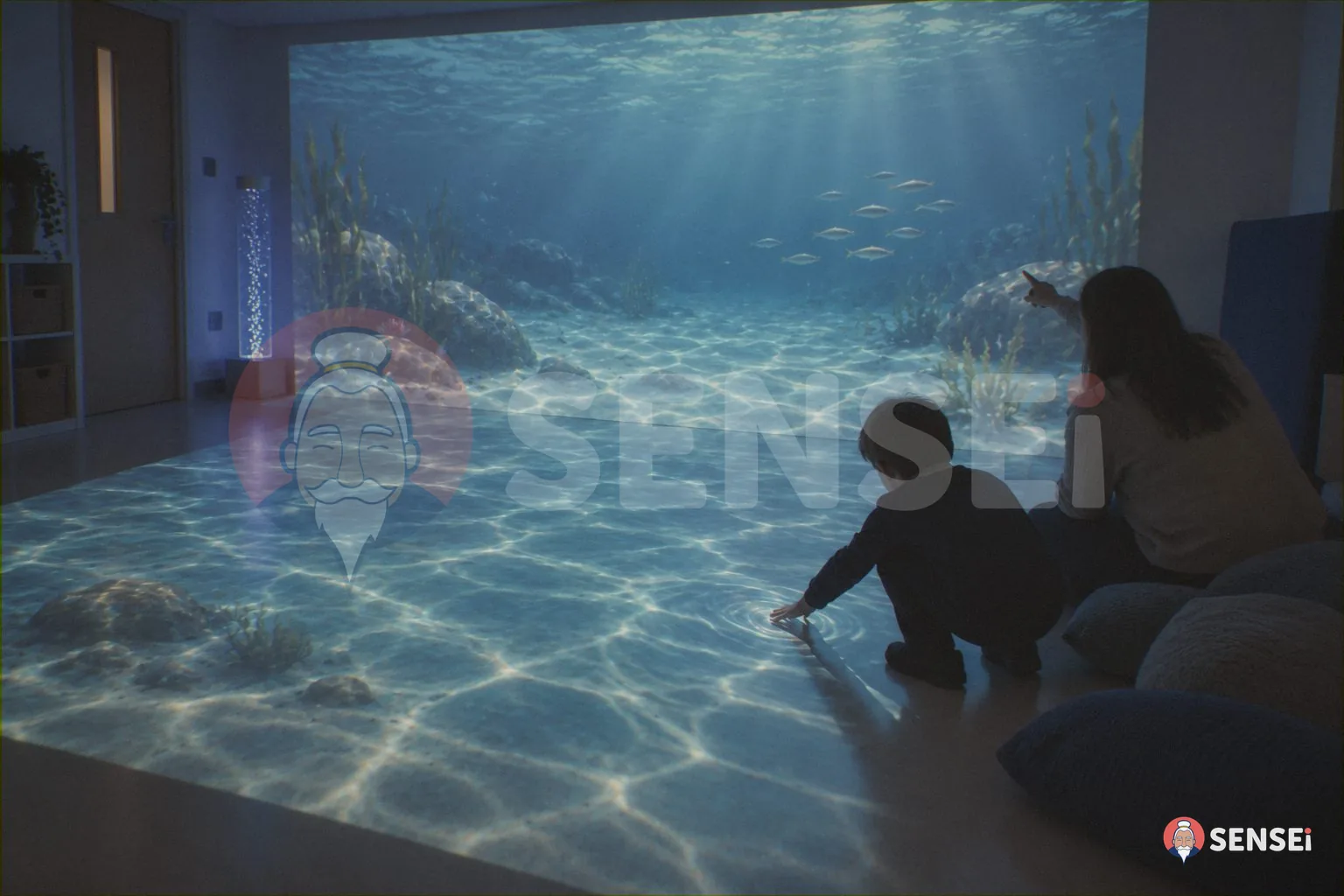
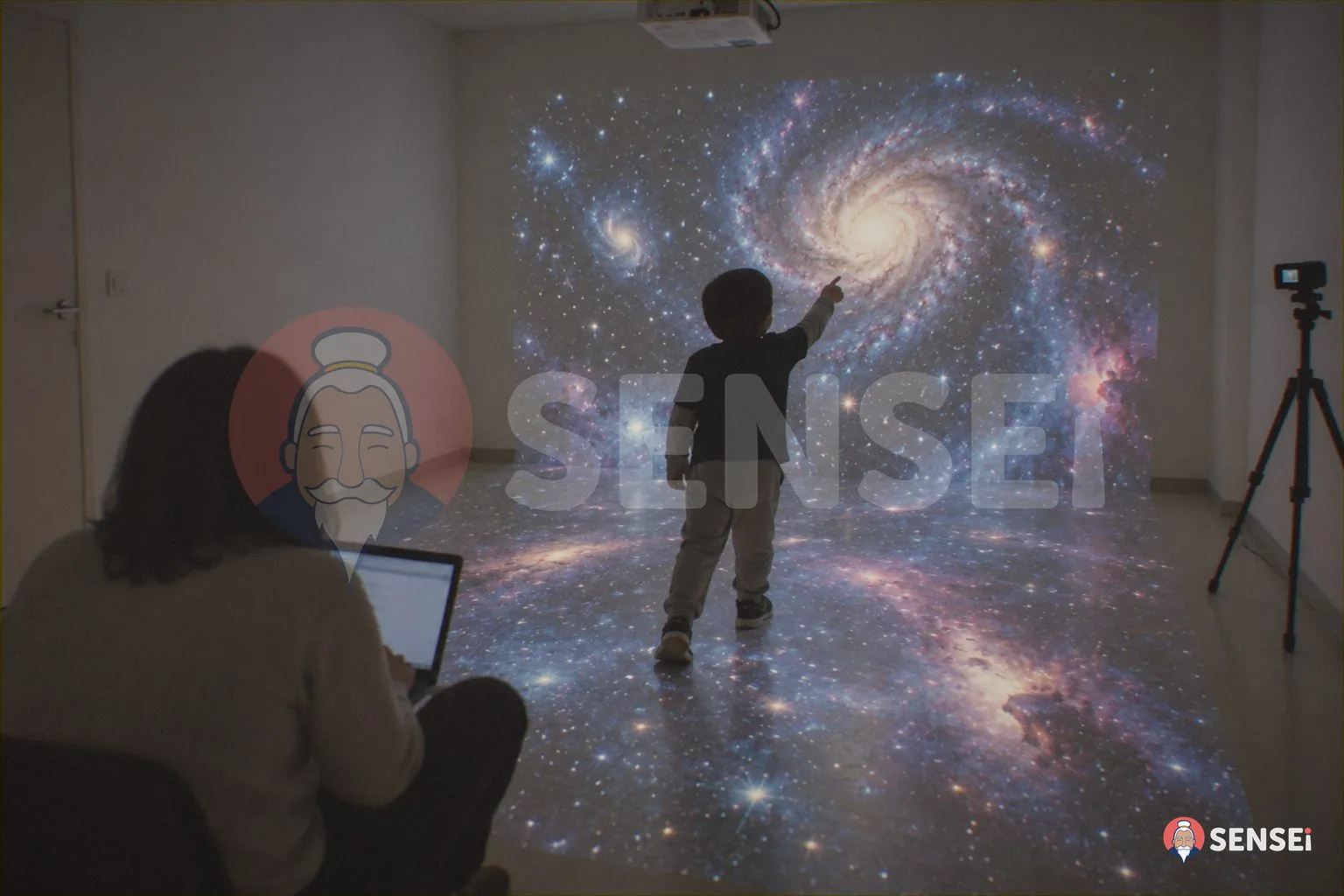
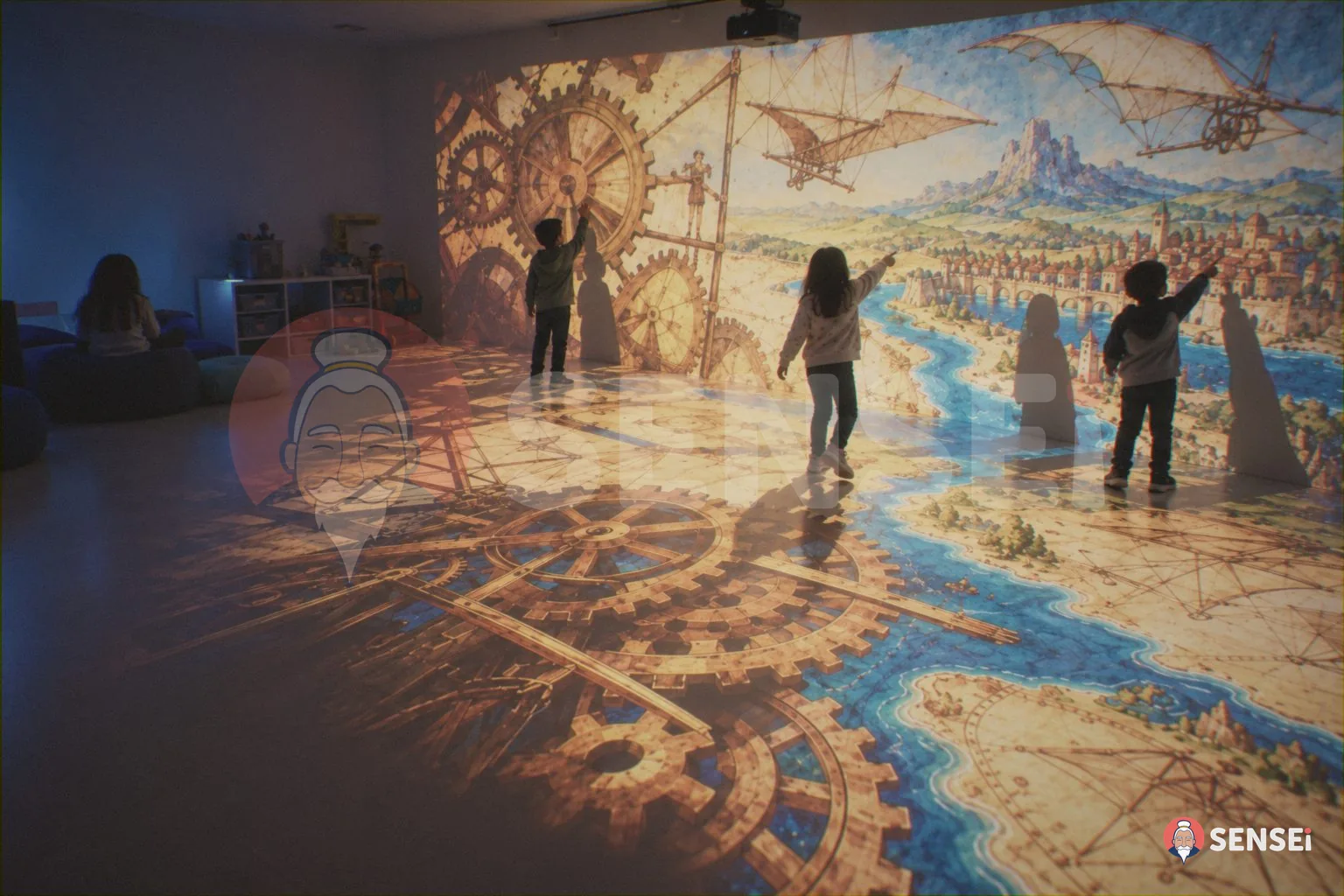
Beyond the obligations, there are educational choices to make. Who will use the classroom? Only small groups or whole classes as well? Do you need only relaxation experiences or learning activities too? An interactive room, in which the environment responds to pupils’ movements, can complement the relaxation side with group activities and documentation of progress: this is the approach of SENSEi EDU for schools, born from more than ten years of research at Politecnico di Milano and described in more than 40 scientific publications. You will find a comparison in the guide to the multisensory room and a reasoned list in the guide on what to put in a multisensory room.
What can change for pupils and teachers?
The call requires personalised activities, especially for pupils with special educational needs, and a monitoring system. These are two requirements that go beyond the purchase: they ask the school to turn the classroom into a place of participation. In a well-designed room, a pupil who struggles in class can find a different way of being present, with the body, with a gesture, with the voice; classmates learn to play together with them.
For teachers, the classroom becomes a space in which to observe the class from a different perspective and try new forms of lessons. Research on interactive environments in schools, such as the field study with 175 children described in the publication on interaction modalities, shows that the way children interact is an educational choice, not a technical one. This is also why the training required by the call is decisive.
How to plan the timeline up to August 2027
The schedule is tight, because the classroom has to be set up and then used for the trial. A possible sequence:
- Autumn 2026: define the educational project, choose the space, start the purchasing procedure.
- Winter 2026-2027: installation, testing and teacher training.
- Spring 2027: activities with the classes and monitoring.
- By 31 August 2027: completion of the trial and closing event.
- By 31 October 2027: submission of the report by PEC (certified email).
This is just an example: each school must adapt it to its own administrative timelines. It is wise, however, to leave enough time for activities with pupils to collect data and documentation.
Reporting: video, report and final event
The 20% balance is paid only after reporting. Article 10 of the circular requires the submission of:
- the payment request and the financial report (Annex D), with the minutes of the Board of Auditors;
- the head teacher’s declaration on the completion of the programme and on the full functionality of the classroom (Annex E), with audiovisual material showing at least one trial activity and the classroom in operation, including with the trained teachers present;
- a report on the trial including training delivered (minimum 20 teachers), pupils and classes involved, a description of the activities and the classroom, start and end dates, goals achieved and replicability.
Within 90 days of the balance payment, a certificate from the Auditors on payment of the reported commitments is also required. Pay attention to privacy: for videos and images with pupils, the circular requires informed parental consent and compliance with the GDPR. A system that keeps track of the activities carried out can help prepare the report and the monitoring, to be combined with teachers’ observations: this is one of the points where an interactive room genuinely simplifies the school’s work.
Schools on the waiting list: how to prepare for further allocations
The final list of applications received contains 258 applications, processed in chronological order of PEC arrival until the funds run out. After the 46 admitted and the 10 excluded, around 200 schools remain on the waiting list. The circular provides that, if further resources become available, the Administration may select other proposals in order of arrival. It is an option, not a commitment: it is worth preparing without taking anything for granted.
- Check your position and the ID number assigned, to be quoted in every communication.
- Make sure the application, project form, declaration on the premises and resolution of the School Council are complete and digitally signed.
- Keep the educational project up to date and identify the space.
- Prepare an analysis of the available solutions, so that you can start the purchasing procedure quickly.
- Follow announcements on the website of the Region’s Education Department.
Mistakes to avoid: what the exclusions teach
Of the 10 excluded applications, 9 came from the province of Messina. Almost all were declared inadmissible because documentation was missing or did not meet the requirements of Article 8; in one case the applicant did not meet the requirements of Article 3. The lesson is simple: in a first-come, first-served call, complete documentation counts as much as the quality of the project. For a broader overview of funding channels, read the guide on how to fund a multisensory classroom.
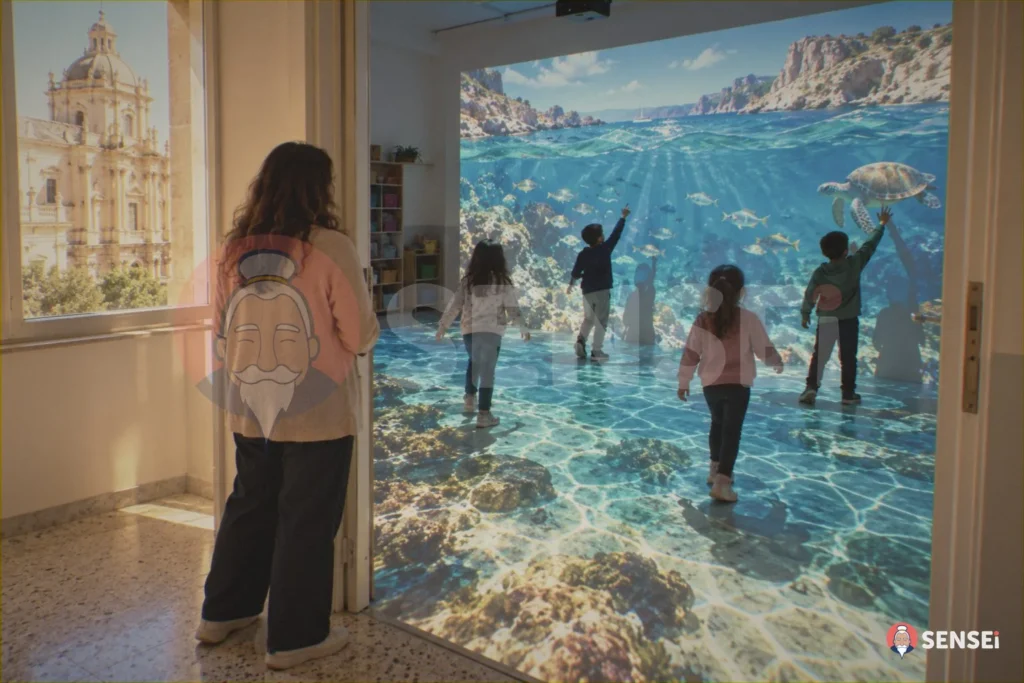
The Region has previously also funded immersive classrooms, with Circular no. 24 of 2024 and a second edition in 2025: many Sicilian schools already have experience with these environments. In the case study on SENSEi immersive classrooms in Sicily we describe how they come about, with local technicians and activities that also tell the story of the island. Other projects are on the Projects page.
Frequently asked questions
How many schools were funded by the Sicilian multisensory classroom call?
46 primary and lower secondary schools, with D.D.G. no. 3107 of 1 August 2026, for a total of €2,499,447.10.
By when must the classroom be completed?
The classroom and trial activities must be completed by 31 August 2027. The report must be submitted by 31 October 2027.
What must the supplier guarantee?
Certification of the equipment for school use, at least five years of support, a five-year manufacturer’s warranty and teacher training.
Can excluded or waitlisted schools still hope?
The circular allows the Region to fund other proposals in order of arrival if new resources become available. It is not guaranteed, but it is worth keeping the documentation ready.
How much does the classroom proposed by SENSEi cost?
It depends on the configuration and the school’s spaces. Contact us for a proposal consistent with the limits and obligations of the call.
Is your school among those funded or on the waiting list?
We will show you how an interactive multisensory classroom works and how it fits with the obligations of the circular. Book a demo.
Sources
- Regione Siciliana, Circular no. 11 of 30/03/2026, Multisensory Classrooms
- Regione Siciliana, Notice ref. 16635 of 19/05/2026, final list of applications
- Regione Siciliana, D.D.G. no. 3107 of 01/08/2026 (PDF)
- Regione Siciliana, Education: a further 3.5 million allocated for immersive classrooms (2025)
Snoezelen® is a registered trademark of its respective owners.