
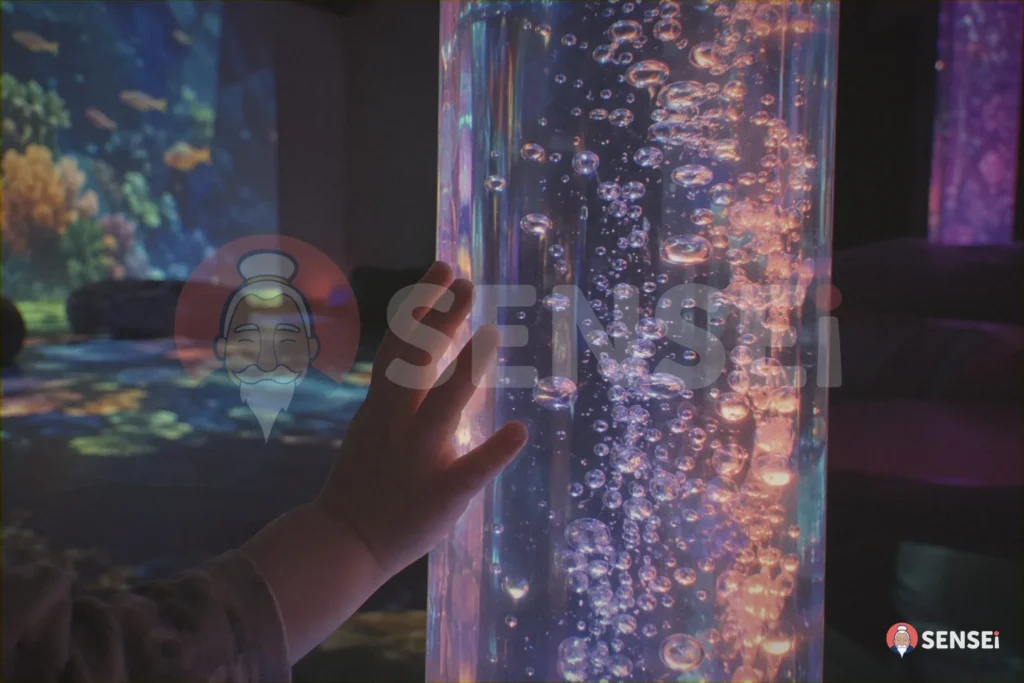
The sensory bubble tube is an illuminated column of water in which air bubbles rise and change colour. It captures the gaze, offers a gentle vibration to feel with the hands and creates a calm, predictable point of reference in the room.
It is one of the most recognisable objects in a multisensory room, and one of the most loved by children and adults alike. In this guide we look at the experience it creates, who it suits, what the research says, how to choose it and use it safely, and how it becomes part of an interactive environment.
What is a bubble tube and how does it work?
Imagine a transparent column as tall as a child or an adult. Slow bubbles rise from the bottom, the water moves, the light shifts from blue to green to red. You hear a gentle gurgling and, resting your hands on it, feel a delicate vibration.
Many models let you choose the colour, slow down or stop the cycle, or control it with a button or a remote. This possibility of control, as we will see, matters more than any other detail: it turns the tube from a spectacle to watch into a tool to use.
The bubble tube is one of the typical elements of Snoezelen® rooms, the relaxation environments that originated in the Netherlands. The story is told in our guide to the Snoezelen room.
What is a sensory bubble tube for?
The bubble tube works on several channels at the same time. That is why it is useful in different settings.
- Sight. The slow, steady movement of the bubbles invites the eyes to follow and helps sustain attention.
- Touch. Resting your hands or back against the column, you feel a gentle vibration.
- Hearing. The gurgling of the water is a continuous, predictable sound.
- Cause and effect. If the child can change the colour with a button, they understand that their action produces a result.
- Communication. Asking for “more”, choosing a favourite colour, pointing: small gestures that become opportunities for dialogue with the adult.
- Regulation. Many educators use it as a pause point, to lower arousal after a movement activity.
In the English Department for Education’s guidance on inclusive school buildings, bubble tubes appear among the immersive equipment of sensory rooms, alongside projected image systems. The same guidance, however, points out that a sensory room should be created when there is a clear, specified need.
Who is the bubble tube useful for?
It suits a very wide audience, with different considerations.
| Users | Possible use |
|---|---|
| Nursery and preschool | Observing, pointing to colours, naming, touching with supervision |
| Primary school | Attention games, cause and effect, moments of pause |
| Pupils with autism | Predictable point of reference, choosing the colour, regulation |
| People with complex disabilities | Visual and tactile stimulus that is accessible even when lying down or in a wheelchair |
| Older people and people with dementia | Moments of calm and shared attention |
For older people, you will find more guidance in the article on the multisensory room for older people and Alzheimer’s.
What does research say about the bubble tube?
There are few studies on individual objects. More often, rooms are studied as a whole. A study published in the journal Autism by Unwin, Powell and Jones involves 41 autistic children aged 4 to 12 in a room with coloured lights, a bubble tube, fibre optics and a light-and-sound button panel.
The researchers compare two conditions. In one, the child controls the changes in the equipment; in the other, the colours change on their own. When the children are in control, the authors observe fewer repetitive motor behaviours and more attention. They find no differences, however, in anxiety, social behaviour and physiological arousal.
The study has acknowledged limitations: individual sessions with an adult, no comparison with a non-sensory environment, only partial control. The practical message remains interesting: a bubble tube that the child can control seems more useful than one that changes colour on its own. We also discuss this in interactive or passive room.
It is the same direction as the research from which SENSEi originates: giving the person an active role in the environment. The journey, which began at Politecnico di Milano with Magic Room and Magika, now counts more than 40 scientific publications.
How to choose a bubble tube for a school or centre?
Before looking at models, be clear about where it will go, who will use it and for what goals. Then check these points.
- Proportions. The tube must suit the room and the age group. A very tall tube in a small room dominates the space.
- Stability. A column full of water is heavy. It needs a solid base and, often, a wall fixing or a protective structure.
- Control. Check whether the colour can be chosen, whether the cycle can be stopped and whether it can be controlled externally.
- Quietness. In a small room a continuous hum can disturb people who are sensitive to sound.
- Ease of care. Ask how the water is changed and how often.
- Certifications, warranty and support. Ask for the documentation for use in school or healthcare settings and for the terms of support.
- Surroundings. Mirrors and soft platforms multiply the effect, but they must be made of shatterproof materials.
What safety rules should be followed?
Water and electricity require care. Manufacturers’ instructions contain rules that apply in general:
- connect the tube to an earthed socket and use only the power supply provided;
- keep water away from the base when filling and emptying;
- do not use the tube if the cable is damaged or if the device has been dropped;
- unplug it before cleaning and when not in use;
- position the cable so that nobody trips over it or pulls it;
- always lift the tube by the base and not by the column.
The manual we consulted states that children under 8 must be supervised and that cleaning and maintenance are not to be carried out by children. At school the practical rule is simple: an adult always present, nobody climbs, nobody pushes the column.
How is maintenance carried out?
Regular care prevents algae, bad smells and weak bubbles, and keeps the experience pleasant over time. Manufacturers’ most common recommendations are few:
- use distilled or deionised water, especially where the water is hard;
- change the water periodically, and immediately if the bubbles weaken;
- use only the additives indicated by the manufacturer, handling them with care;
- keep the tube away from direct sunlight;
- clean the outside with a soft cloth, with no bleach inside.
The recommendations vary from model to model. Always follow your product’s manual.
How does the bubble tube fit into a SENSEi environment?
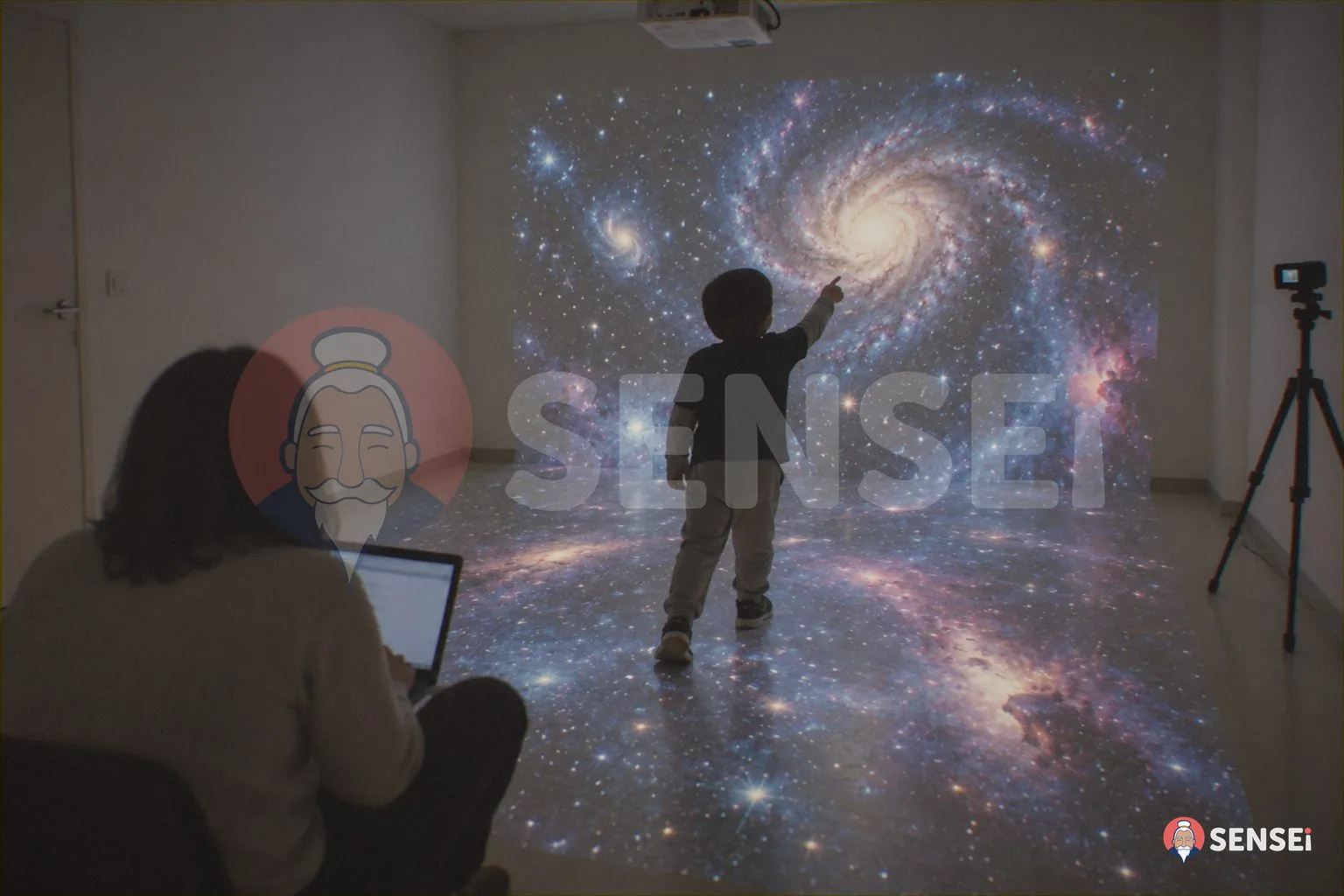
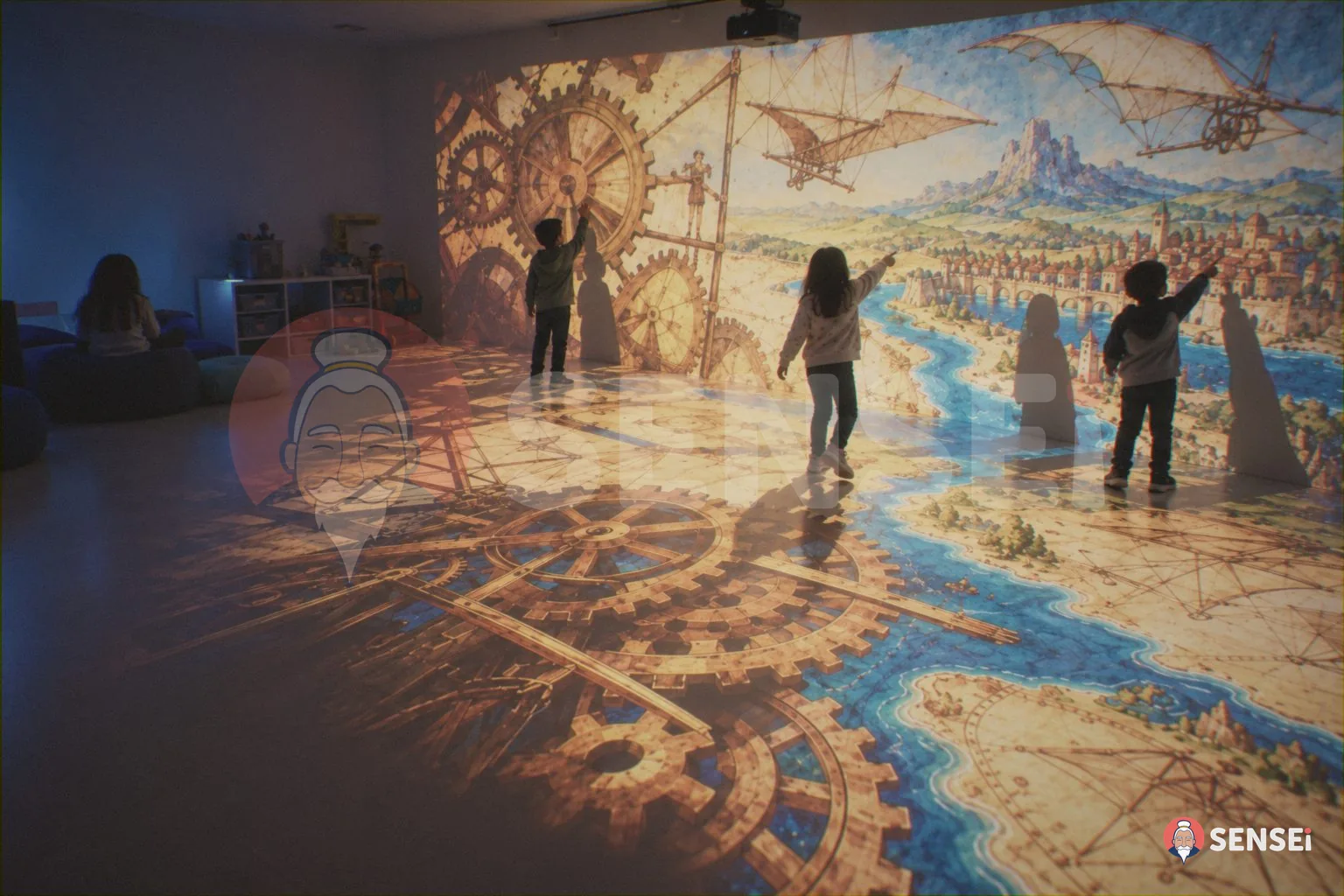
A SENSEi environment transforms an existing room into a world to explore: walls and floor respond to gestures and movement, while lights, sounds, scents, bubbles and physical objects follow the same story. The educator leads the experience from a tablet.
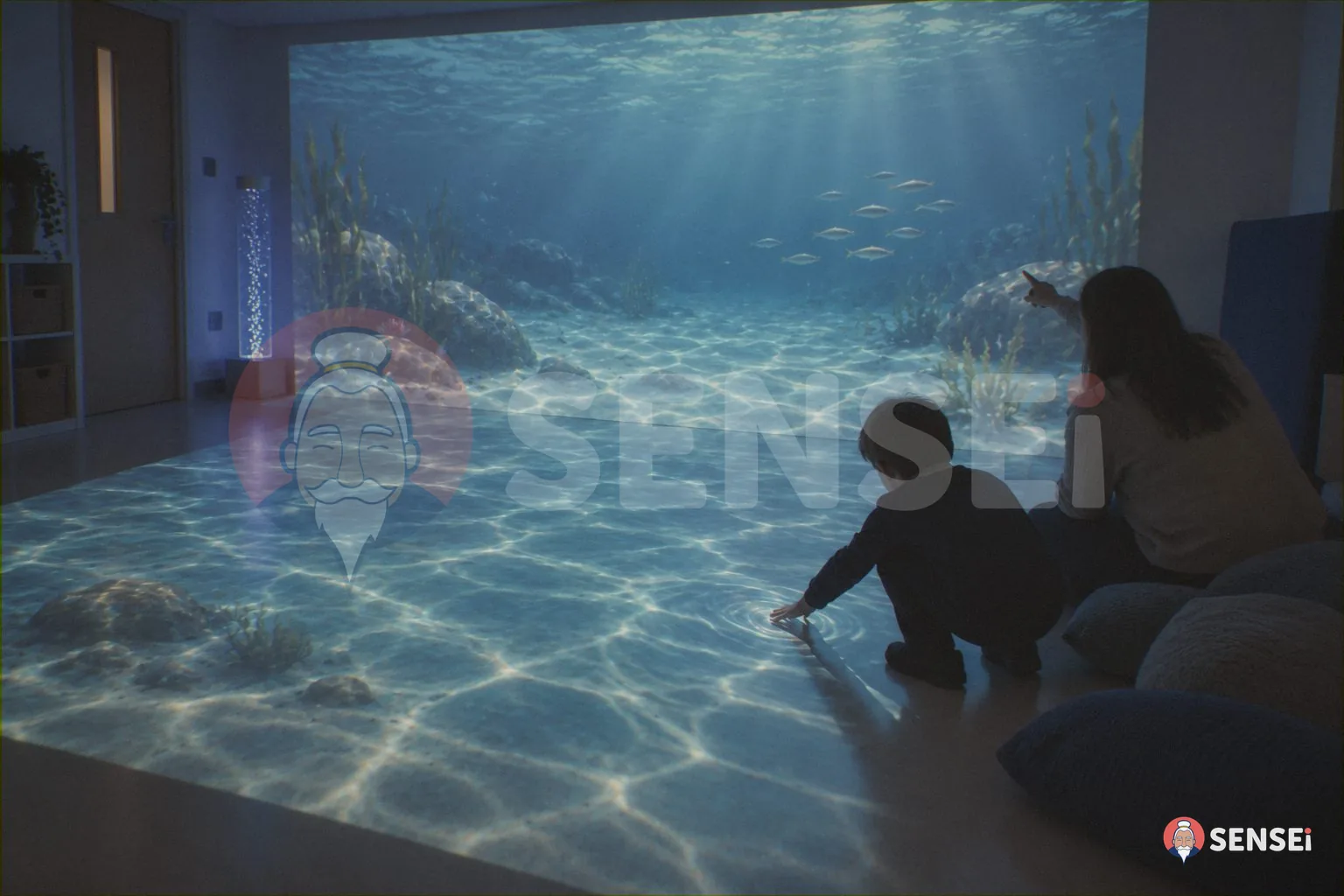
The bubble tube fits well into this room. Think of an activity about the sea: the walls show the seabed, the lights turn blue, the sound of the waves fills the space and the tube becomes the column of water to touch. Or think of a moment of pause: the projection switches off and only the tube remains, with a low light.
This already happens in the centres we work with. At the Fondazione Angelo Custode (the Angelo Custode Foundation) in Bergamo, bubble tubes are integrated into the soft furnishings and interact with the interactive projections, in four environments that are part of the care teams’ daily work. In Cava de’ Tirreni, in the room at La Nostra Famiglia, bubbles, lights and vibrations accompany the projected scene and the children also play from their wheelchairs.
The idea of combining the digital world and physical objects is at the heart of Magika, the research project from which SENSEi originates: projected worlds, smart objects, lights and materials, with an interface for adjusting the intensity and progression of the stimuli.
If the tube you already have can be controlled externally, we can assess together whether and how to connect it to the environment. It is something to check case by case. For the full picture, go back to the guide what to put in a multisensory room and see the The magic room page.
In the SENSEi room
In a SENSEi room the bubble tube changes colour along with the projected scene: blue on the seabed, green in the forest, red at sunset. It thus becomes part of the story and a stable point of reference in the room.
Activities to try in a SENSEi room
- Choose the colour: the child points to or touches a colour and the tube lights up accordingly: communication and choice.
- Relaxing hug: leaning against the tube and feeling its vibration helps to calm down after a moment of agitation.
- Follow the bubbles: tracking the rising bubbles with the eyes trains visual attention.
- Turn-taking traffic light: the colour shows whose turn it is in a group activity.
- Colours and emotions: each colour is associated with an emotion to recognise and name.
Discover all the tools in the guide to the tools of the SENSEi room.
Frequently asked questions
Is the bubble tube suitable for young children?
Yes, with constant supervision. Young children can watch it and touch it, but they must not climb on it or push it.
How often should the water be changed?
It depends on the model. The manual we consulted indicates at least every 10-12 weeks, sooner if the bubbles weaken or if the tube is near a window.
Does the bubble tube help calm an agitated child?
Many educators use it for regulation, but the effect varies from person to person. Studies indicate that control by the child can make the difference.
Can the bubble tube be connected to the room’s software?
It depends on the model. It needs to be checked case by case with the supplier.
How much does a bubble tube cost?
It depends on the size, accessories and configuration of the room. Contact us for a tailor-made proposal.
Want to see how physical objects and projections work together? Book a demo of a SENSEi environment.
Sources
- Unwin, Powell, Jones, The use of Multi-Sensory Environments with autistic children: Exploring the effect of having control of sensory changes, Autism 2022, doi 10.1177/13623613211050176.
- Department for Education, Inclusive education estates (June 2026), GOV.UK.
- Bubble Tube User Guide 2025 (manufacturer’s instructions), Sense Sensory.
- Gelsomini et al., Magika, a Multisensory Environment for Play, Education and Inclusion, CHI EA 2019.
Snoezelen® is a registered trademark of its respective owners.