
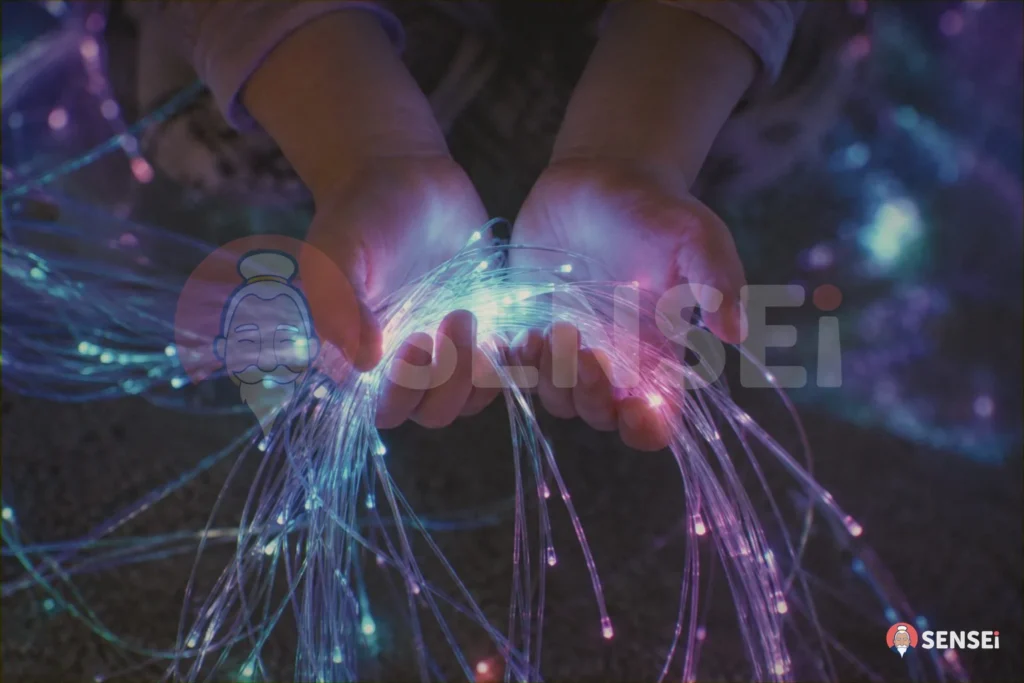
Sensory fibre optics are bundles of thin, flexible strands that carry light to their tips, where they glow and change colour. They are used to explore sight and touch together: you look at them, stroke them, hold them and move them around effortlessly.
They are among the most popular objects in multisensory rooms because they also work for people with limited mobility: the light comes straight into the hand, onto the legs, onto the wheelchair tray. In this guide we look at shapes, uses, possible benefits, safety rules and their role in an interactive environment.
What are sensory fibre optics?
A fibre optic system has two parts: a light source, which switches on and colours the light, and a bundle of fibres that carries it to the tips.
No electric current runs along the strands: only light. This is why the fibres can be touched and allowed to slip through the fingers. The light source, on the other hand, is an electrical device and must be treated as such.
Fibres are experienced in different ways depending on their shape:
- tail or bundle, to hold on the lap or lay on a mat, for focused exploration;
- curtain or waterfall, to walk through or stroke, for group play;
- starry sky, to look at lying down, for relaxation;
- light carpet, with points of light to discover with hands and feet.
Fibre optics are part of the tradition of Snoezelen® rooms, which we discuss in the guide to the Snoezelen room.
What are sensory fibre optics used for?
Their value lies in the combination of light and contact. Here are the most common uses at school and in therapy.
- Tactile exploration. The strands are soft and bendable. They invite touch, even from those who usually avoid new materials.
- Visual attention. Points of light that change colour help to direct and hold the gaze.
- Hand-eye coordination. Picking up a tuft, moving it, letting it fall.
- Shared attention. The adult and the child look at the same bundle together, name the colours, pass the fibres to each other.
- Relaxation. In a low-light area, the fibres create a calm atmosphere.
- Communication. You can ask for “more” or choose a colour, including with symbols or pictograms.
Who are they suitable for?
Fibre optics work with very different groups, as long as the adult adapts how they are used.
| Users | How they are usually used |
|---|---|
| Nursery and preschool | Exploration with the hands under close supervision, naming the colours |
| Children with motor disabilities | Fibres laid on the legs or on the wheelchair tray |
| Autistic children | A predictable stimulus, to pick up and put down at will |
| People with intellectual disabilities | Tactile exploration and choice-making activities |
| Older people and people with dementia | Moments of calm and contact, guided by a practitioner |
For adults and older people, also read the article on the multisensory room for older people and Alzheimer’s.
What benefits do studies point to?
Research on individual objects taken one by one is rare. More often a whole room is studied, in which fibre optics are one of the elements.
The study by Unwin, Powell and Jones, published in the journal Autism, is a good example. It involves 41 autistic children aged 4 to 12 in a room with coloured lights, a bubble tube, fibre optics, an illuminated button panel and a mirror ball. When the children can control the changes, the authors observe fewer repetitive behaviours and more attention than with automatic changes. No differences emerge for anxiety and social behaviour.
The authors themselves point out important limitations, such as the individual sessions and the absence of a comparison with a non-sensory environment. The useful finding for designers is this: control by the person can change the experience. We discuss it in interactive or passive room.
The research from which SENSEi was born also points in this direction. The study on phygital interfaces, published in Multimedia Tools and Applications, involves 17 young adults with intellectual disabilities at a social care centre. Approaches that combine physical objects and digital content show better performance than purely digital or purely paper-based ones. It is one of the strands of a journey that counts more than 40 scientific publications.
How to use fibre optics safely?
Fibre optics are among the safest objects in a sensory room, but a few precise rules apply.
The light source
Manufacturers’ instructions contain common guidance:
- connect the light source to an earthed socket;
- do not use it if the cable is damaged or if it has been dropped;
- do not immerse it in water or other liquids;
- route the cable so that no one trips over it or pulls it;
- do not stare into the light of the source when it is on, because it is very intense.
The strands
- Constant adult supervision, especially with the youngest children.
- No fibres in the mouth.
- Never wrap the fibres around the neck or limbs.
- Do not walk on the fibres or bend them sharply: they can be damaged and stop carrying light.
- Insert the fibres into the light source without forcing them.
Cleaning
First switch off the light source. Then wipe the fibres with a slightly damp cloth and a mild detergent, drying them well. For details, the product manual always applies. Between one group and the next, it is advisable to follow the facility’s hygiene procedures.
How to choose fibre optics?
Before comparing models, decide where they will go, who will use them and for which experience.
- Shape. A lap bundle for individual work, a curtain for group exploration, a starry sky for relaxation.
- Size. They must suit the space and the age group, without getting in the way.
- Control. Check whether you can choose the colour or stop the cycle, and whether the light can be controlled externally.
- Durability. Ask about how robust the strands are and whether they can be replaced.
- Documentation. Ask for certifications, instructions for use and warranty and support conditions.
How do they fit into a SENSEi environment?
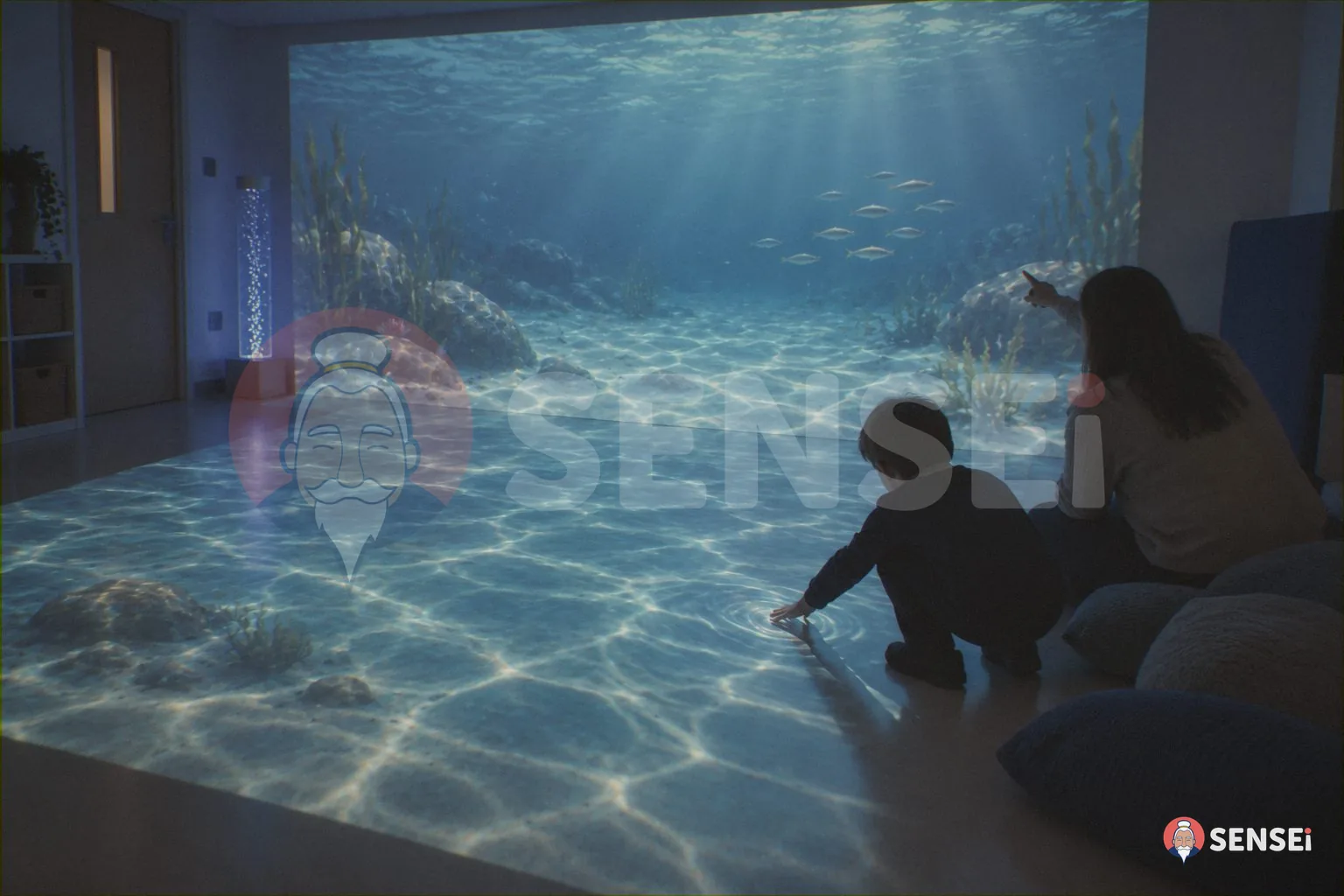
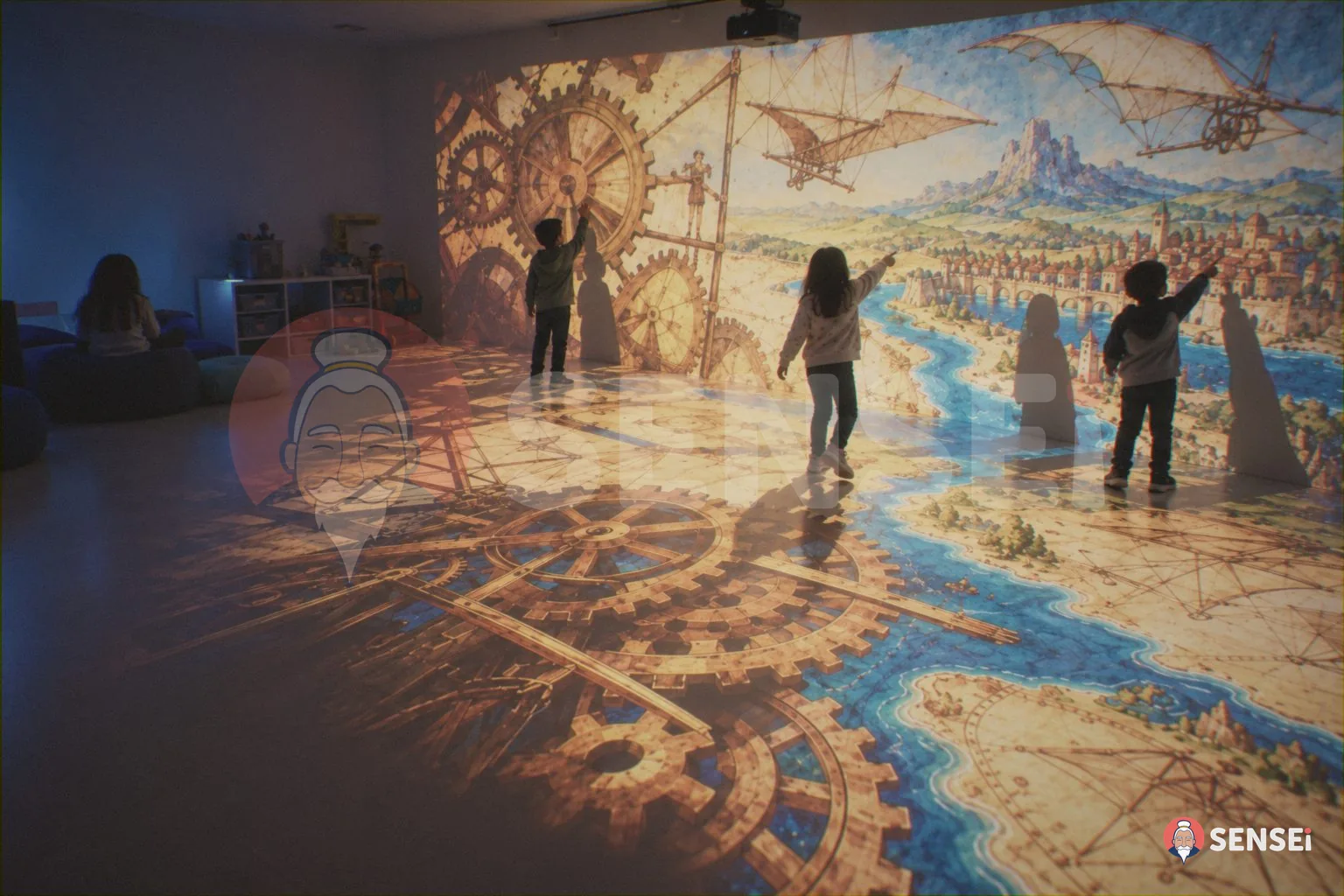
A SENSEi environment transforms an existing room into a living space: walls and floor respond to the gestures and movement of several people, with nothing to wear, while lights, sounds, scents and physical objects follow the same story. The educator guides everything from a tablet.
Fibre optics complete this room in the calm area or during transitions. Some examples:
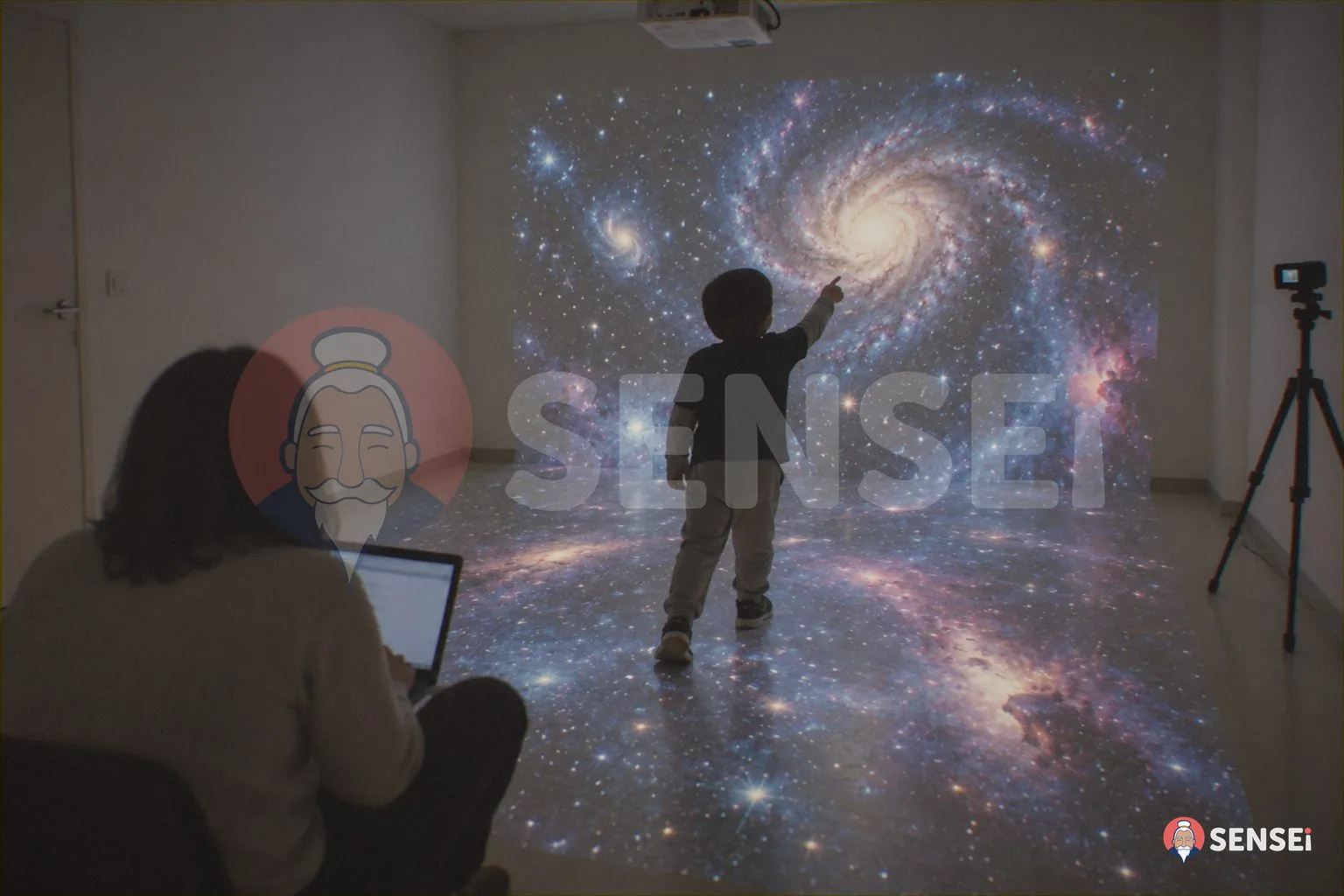
- during an activity on the night sky, the wall shows the constellations and the children hold the fibre “stars” in their hands;
- after a movement game on the floor, the projections dim and the fibres become the focus of a moment of calm;
- in an individual session, the therapist alternates between the interactive wall and tactile exploration of the fibres.
The Magic Room, the research project from which SENSEi was born, stimulates touch, balance and body awareness in a controllable way with sounds, projections, bubbles, scents, lights and physical objects. Fibre optics fit naturally into this approach.
We see this in the centres. In Cava de’ Tirreni, in the room at La Nostra Famiglia, lights, materials to touch and projections coexist, and children with motor limitations take part in the same activities as the others. At Fondazione Sacra Famiglia in Inzago, a mobile cart brings light, sounds and scenarios directly to the adult residents, many of them wheelchair users, with content redesigned for their age.
If you already have a light source that can be controlled externally, we can assess together whether to connect it to the environment. This check has to be done model by model. The complete picture, sense by sense, is in the guide what to put in a multisensory room. To see how the environment works, visit The magic room.
In the SENSEi room
Fibre optic waterfall
In a SENSEi room, fibre optics change colour with the scenario and become part of the environment: the glowing jellyfish of the seabed, the rain in the forest, the stars in the night sky.
- The curtain of light: walk through the waterfall like a magic door to enter a new scenario.
- Combing the light: running your fingers through the fibres encourages tactile exploration and fine motor skills.
- Counting the colours: the fibres change colour and you count how many times it happens.
- Glowing hide-and-seek: hide behind the fibres and find each other again.
- Relaxation: lying under the waterfall, watch the colours flow slowly.
Fibre optic carpet
In the SENSEi room, the carpet brings light to the level of those on the floor, including the youngest children or those who cannot stand. The colours follow the projected scenario, like a glowing trail linking floor and wall.
- The river of light: the fibres become the river of the aurora projected on the wall.
- Gather the stars: gather handfuls of fibres and look at them up close.
- Tummy time: for the youngest, an invitation to lift the head and stretch out the arms.
- Light massage: the adult strokes arms and hands with the fibres for gentle tactile stimulation.
Discover all the tools in the guide to the tools of the SENSEi room.
Frequently asked questions
Do fibre optics get hot?
Only light runs along the strands, not current. The electrical part is in the light source, which should be placed away from children’s hands and from liquids.
Are fibre optics suitable for nursery?
Yes, with constant supervision. Contact with the mouth and any use of the strands around the neck or limbs must be avoided.
Can they be cleaned with water?
The fibres must not be immersed. They are usually cleaned with a slightly damp cloth and a mild detergent, with the light source switched off, following the manual.
Is a lap bundle or a curtain better?
The bundle is ideal for individual work and for people with limited mobility. The curtain works better for group exploration and for marking out an area.
How much do sensory fibre optics cost?
It depends on shape, size and light source. Contact us for a tailored proposal for your room.
Want to see how light, touch and projections work together? Book a demo of a SENSEi environment.
Sources
- Unwin, Powell, Jones, The use of Multi-Sensory Environments with autistic children: Exploring the effect of having control of sensory changes, Autism 2022, doi 10.1177/13623613211050176.
- LED Light Source User Guide (manufacturer’s instructions), TTS.
- Garzotto, Gelsomini, Magic Room: A Smart Space for Children with Neurodevelopmental Disorder, IEEE Pervasive Computing.
- Gelsomini, Spitale, Garzotto, Phygital interfaces for people with intellectual disability, Multimedia Tools and Applications 2021.
Snoezelen® is a registered trademark of its respective owners.