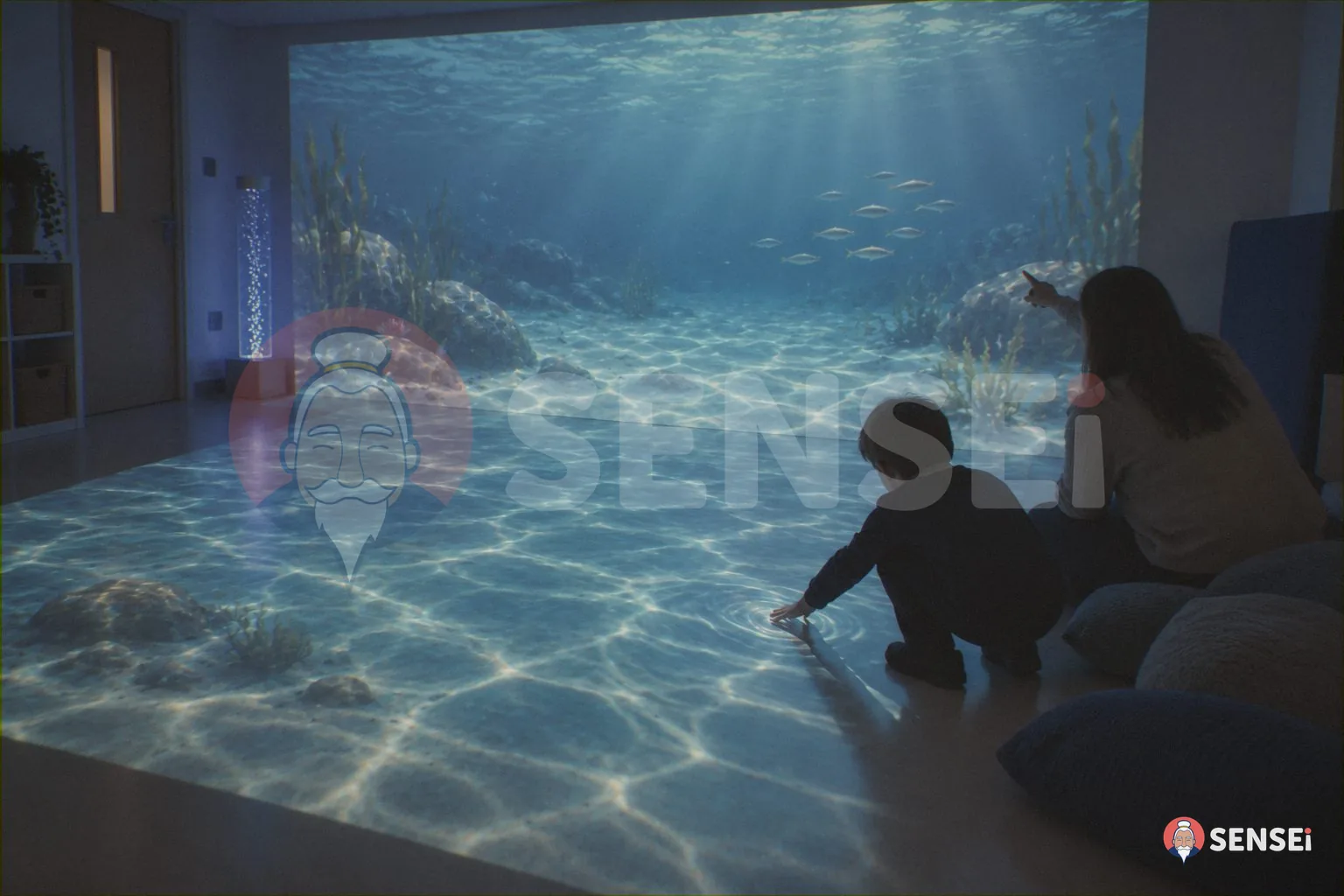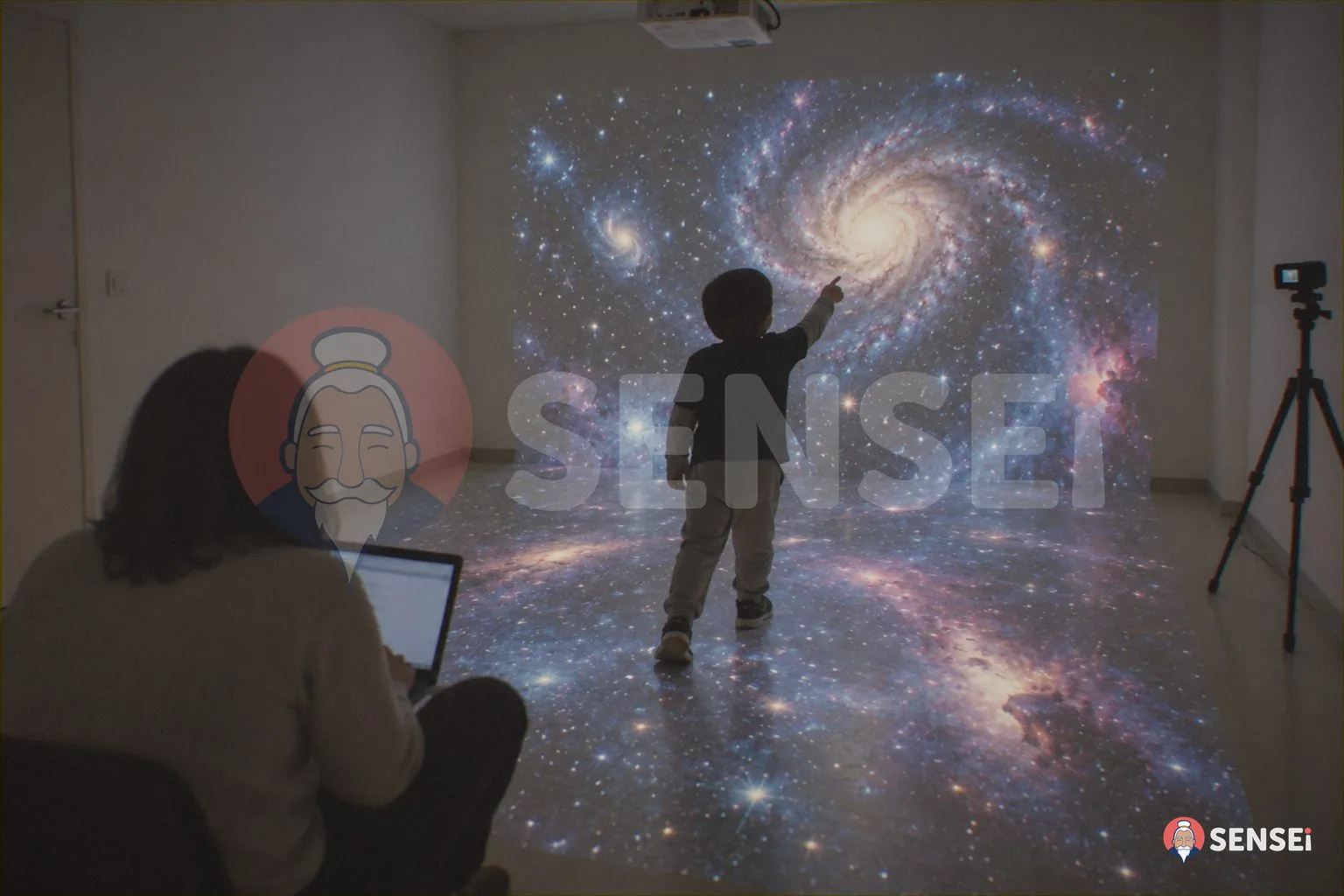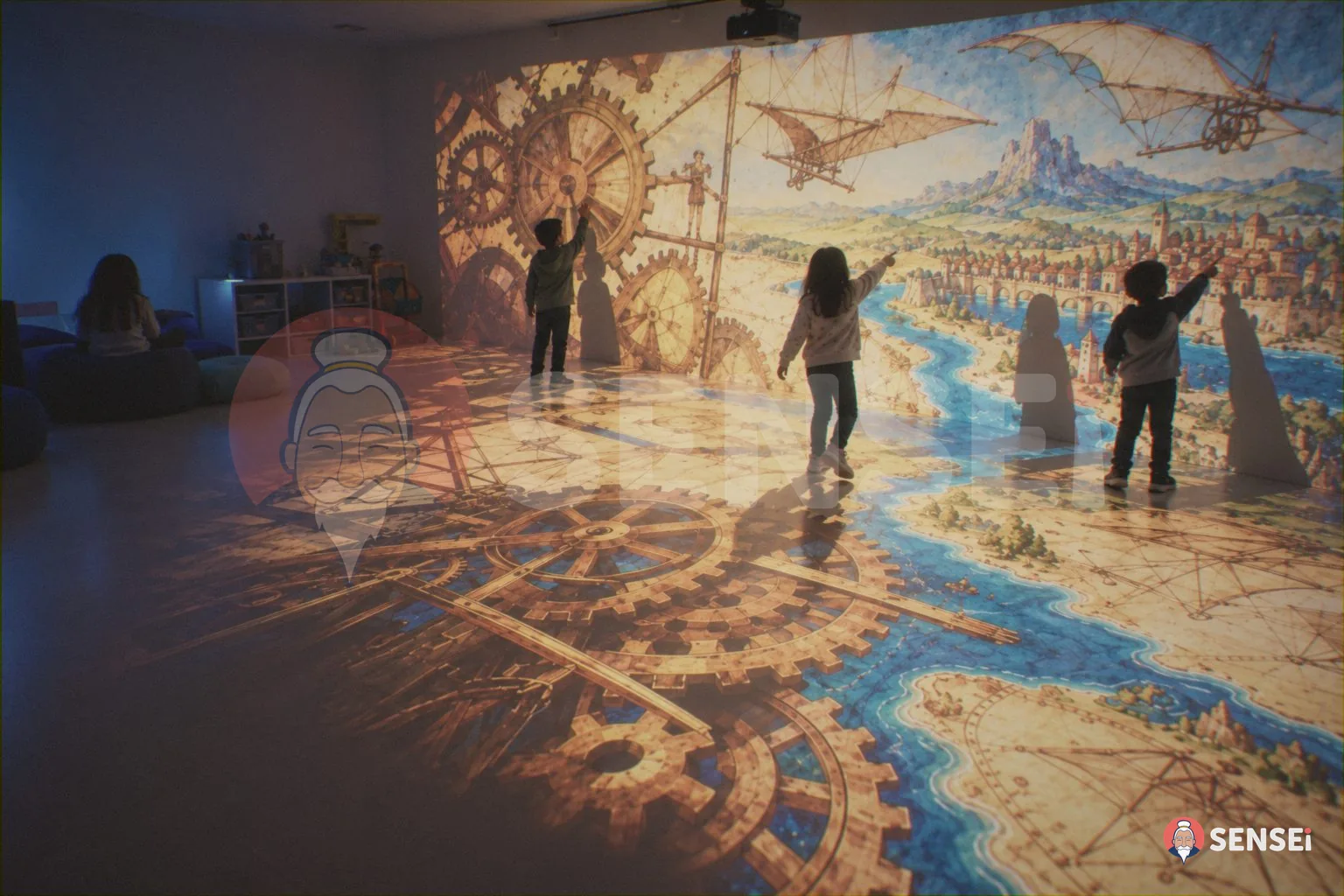

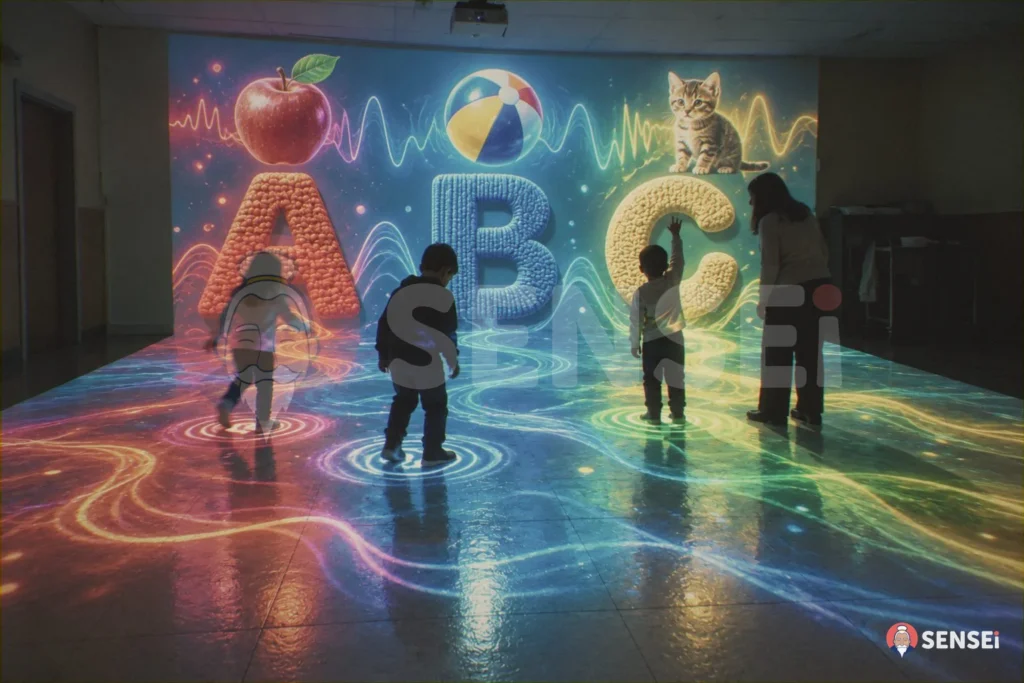
Multisensory teaching is a way of teaching that presents the same content through several sensory channels at the same time: sight, hearing, touch, movement and, where it makes sense, smell. The idea is simple: if a concept arrives through several consistent routes, every pupil has more opportunities to grasp it, remember it and use it.
It is neither a fad nor something reserved for pupils with special educational needs. It is a design principle that applies to the whole class, from nursery to secondary school, supported by neuroscience, pedagogy and more than ten years of research on immersive spaces. In this guide you will find a definition, the evidence, examples for each school level and what changes, in concrete terms, for pupils and teachers.
Multisensory teaching: what is it in simple terms?
Think of a lesson on the letters of the alphabet. In a traditional version, the child looks at the letter on the board and listens to the teacher. In a multisensory version, the same letter appears large on the wall, its sound is heard, it is traced with a finger on a rough surface and it is formed with the body together with classmates.
Three elements characterise a truly multisensory activity:
- Consistency: the different stimuli tell the same story. A sound that has nothing to do with the image distracts rather than helps.
- Action: the pupil does not just receive stimuli, but does something (touches, moves, chooses, answers).
- Dosage: stimuli are adjusted in intensity and number, according to the age and profile of the class.
Why does it work? What the research says
Cognitive neuroscience indicates that the brain has evolved to learn in environments rich in combined stimuli. In a widely cited review published in Trends in Cognitive Sciences, Ladan Shams and Aaron Seitz argue that training protocols based on a single sense may not be optimal, whereas multisensory ones come closer to natural situations and are more effective for learning (Shams and Seitz, Trends in Cognitive Sciences).
A second strand is embodied cognition: thought and body are not separate, and movement can support the understanding of even abstract concepts. On this basis, the research group from which SENSEi originates has studied IMAGINE, an immersive space in which children learn by moving inside content projected on wall and floor. A controlled study in a primary school, with 48 children aged 6 to 8, highlighted its educational potential, including in comparison with traditional methods (Embodied Learning in Immersive Smart Spaces, CHI).
The third reference is Universal Design for Learning (UDL). The CAST guidelines, now at version 3.0, call for multiple means of engagement, representation, and action and expression (CAST, UDL Guidelines 3.0). Multisensory teaching is one of the most concrete ways to put them into practice.
These studies are part of a broader body of work: SENSEi grew out of research at the Politecnico di Milano (Magic Room and Magika) and today continues with SUPSI, NTNU and UC Berkeley, with more than 40 scientific publications collected on the Research page.
What are the principles for designing a multisensory lesson?
Before choosing materials or technologies, it is worth setting a few design rules.
- Start from the goal, not the tool. Ask yourself what pupils should be able to do at the end.
- Choose two or three channels, not all of them. More stimuli do not mean more learning: what matters is that they are consistent.
- Get the body moving. Touching, moving, pointing, jumping onto an answer are gestures that fix the concept.
- Design for the most complex need. This is the principle we call reverse inclusion: if the activity works for the pupil with the greatest difficulties, it works better for everyone.
- Plan a calm moment. After the active phase, time for low-stimulation reflection is needed.
- Observe and document. Note who takes part, how, and what changes over the weeks.
Examples of multisensory teaching by school level
Nursery and preschool
- The colours of fruit: apples, bananas and blueberries appear on the floor; children walk on them and listen to their names; then they touch and smell real fruit.
- Big and small: a projected animal grows when the children spread their arms and shrinks when they crouch down.
- The story with lights: the room’s light changes colour at each moment of the story (dawn, night, a storm), with matching sounds.
More ideas for the youngest children are collected in the guide to the immersive room at nursery and on the page dedicated to preschool.
Primary school
- Letters and sounds: giant letters on the wall, the associated sound, tracing rough letters with a finger.
- The number line: a line projected on the floor; pupils move along it to solve addition and subtraction with their steps.
- The water cycle: rain, evaporation and clouds on the walls, ambient sounds and a few misted drops to feel the humidity.
- Geography on foot: a map of Italy on the floor; pupils move from region to region listening to music and dialects.
Subject-by-subject ideas are in the post on the multisensory classroom in primary school.
Secondary school
- Functions and graphs with the body: students move their hands to different heights to build a projected graph. This is the approach studied with UC Berkeley and NTNU in the project on embodied mathematics (British Journal of Educational Technology), also described in the article on hybrid teaching intelligence.
- Immersive history: a Roman forum projected on three walls, with the sounds of the city; students find their bearings and describe what they see.
- Foreign languages: a market or a station recreated on the wall, with dialogues to complete by moving towards the right objects.
Which way of interacting works best?
There is no single answer. In a field study with 175 children aged 6 to 10, the SENSEi research group compared five ways of interacting with a mobile multisensory environment: with the feet, with the hands, with cards, with a wand and with the voice. The study describes the advantages and trade-offs of each and suggests choosing the interaction according to the goal and the group (Interaction Modalities and Children’s Learning, IDC).
In practice: movement with the feet is excellent for group games and spatial concepts; hand gestures for precise choices; cards and objects for those who need something concrete to hold; the voice for working on language.
Multisensory teaching and inclusion: why does it help pupils with special educational needs?
Pupils with neurodevelopmental conditions, intellectual disability or language difficulties often struggle with a purely verbal lesson. Offering several channels allows each of them to find a way in. At the same time, an overloaded environment can tire those with a different sensory sensitivity: this is why dosage and the ability to adjust stimuli are as important as the richness of the experience. We discuss this in the post on children’s sensory needs.
What changes in the classroom for pupils and teachers?
When multisensory teaching becomes a habit, three things change above all.
- Everyone takes part. Those who struggle with the written word can answer with a step, a gesture, a choice. The lesson no longer has spectators.
- The teacher observes more. While the class moves inside the content, the teacher sees who has understood, who hesitates, who needs another route.
- The work is shared. Activities are designed together, reused and adapted: an asset of the school, not of the individual.
This is what the schools working with SENSEi report. At the IC Perlasca in Bareggio the immersive environments accompany pupils from preschool to lower secondary school, redesigned together with the teachers. At the Leonardo da Vinci in Cornaredo the primary schools use more than 27 activity templates for every subject.
What do you need for multisensory teaching?
You can start with simple materials: objects to touch, music, images and a clear space. An environment like the SENSEi magic room goes one step further: walls and floor become interactive and respond to the movements of several children at once, with no sensors to wear, while lights, sounds and scents follow the activity. The teacher guides everything from a tablet and adjusts the intensity in real time. With the Eureka platform, activities are created starting from the goal and adapted to your own class. To see how it is used in schools, visit the Education page; for a collection of ready-made ideas, read the 30 examples of multisensory activities.
Which mistakes should you avoid?
- Adding stimuli just for the “wow” effect, with no link to the goal.
- Keeping the intensity high for the whole lesson, with no moments of calm.
- Leaving pupils as spectators: passive multisensory experiences achieve less than active ones.
- Forgetting assessment: even an immersive activity needs a moment to check what has been understood.
Frequently asked questions
Are multisensory teaching and the Montessori method the same thing?
No, but they are close. Montessori placed great value on the education of the senses through concrete materials. Multisensory teaching is a broader principle, which can be applied with materials, movement and technology.
Is a dedicated room needed?
Not necessarily. Many activities can be done in the classroom. An immersive classroom, however, makes it easier to combine images, lights and sounds and adjust them precisely, and SENSEi transforms an existing room without building work.
Does it also work at secondary school?
Yes. With older students the content changes (graphs, history, languages, science) and the reflective part grows, but the principle remains valid.
Are there any risks?
The main risk is sensory overload. It is avoided by dosing stimuli, observing reactions and always leaving a calm way out.
How is effectiveness assessed?
With the usual tools (observation, tests, rubrics) plus attention to participation. In a SENSEi room the teacher also has reports on interactions, which are useful for tracking progress.
Want to see how a multisensory lesson is designed in a SENSEi room? Book a demo.
Sources
- Shams L., Seitz A. R. (2008). Benefits of multisensory learning. Trends in Cognitive Sciences
- CAST (2024). Universal Design for Learning Guidelines version 3.0
- Gelsomini M., Leonardi G., Garzotto F. (2020). Embodied Learning in Immersive Smart Spaces. CHI 2020
- Cosentino G., Gelsomini M., Sharma K., Giannakos M. (2023). Interaction Modalities and Children’s Learning in Multisensory Environments. IDC 2023
- Cosentino G. et al. (2024). Hybrid teaching intelligence: Lessons learned from an embodied mathematics learning experience. British Journal of Educational Technology