
In primary school, the multisensory classroom is used to teach with the body: pupils move, touch, listen and act on projected content, instead of just looking at it. It can be used in every subject, from Italian to maths, from science to English, with short activities built into the curriculum plan.
In this guide you will find activity ideas organised by subject, a three-step lesson model and some guidance on inclusion and assessment. They are suggestions to adapt to your class, not a rigid programme.
What happens in a multisensory classroom at primary school?
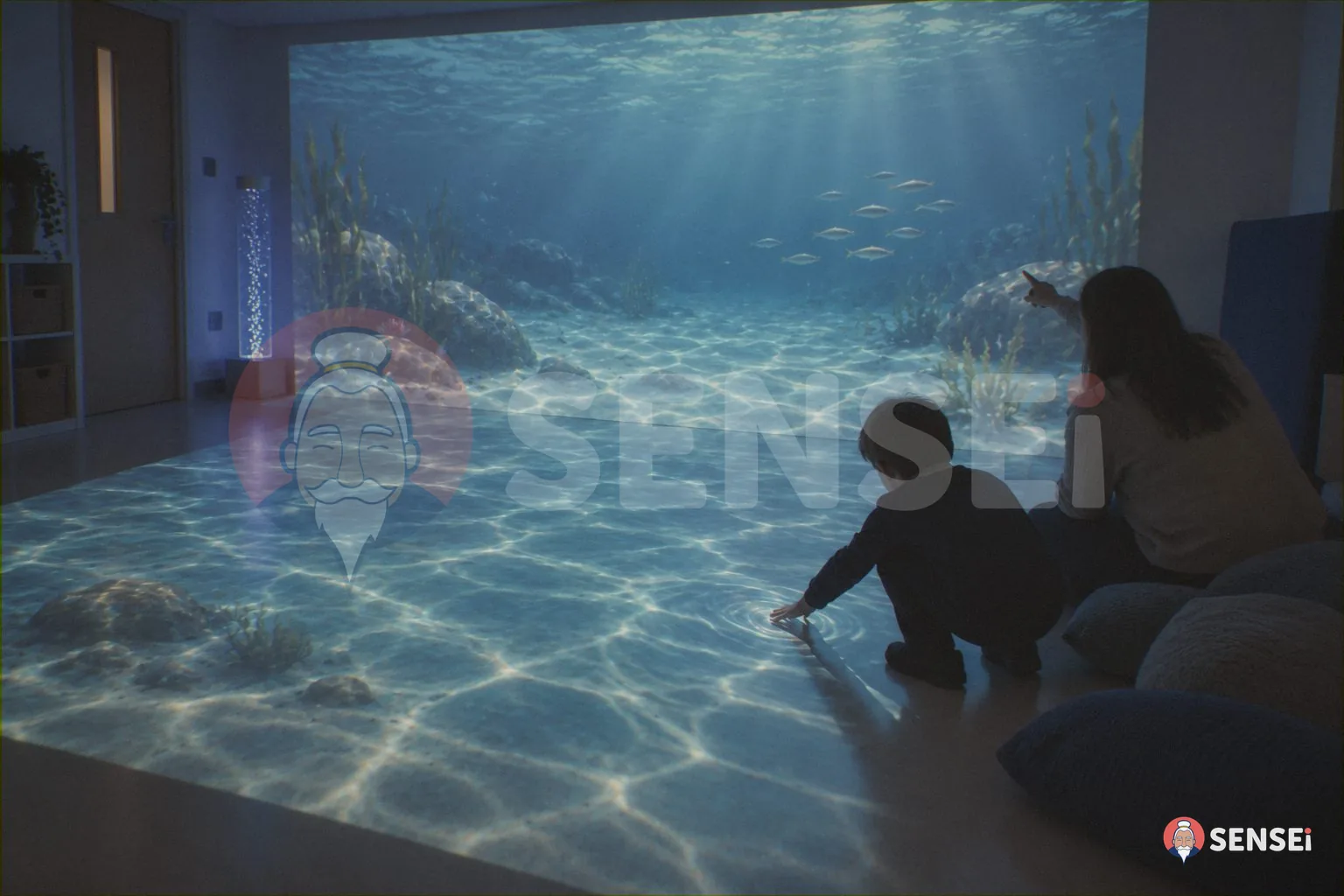
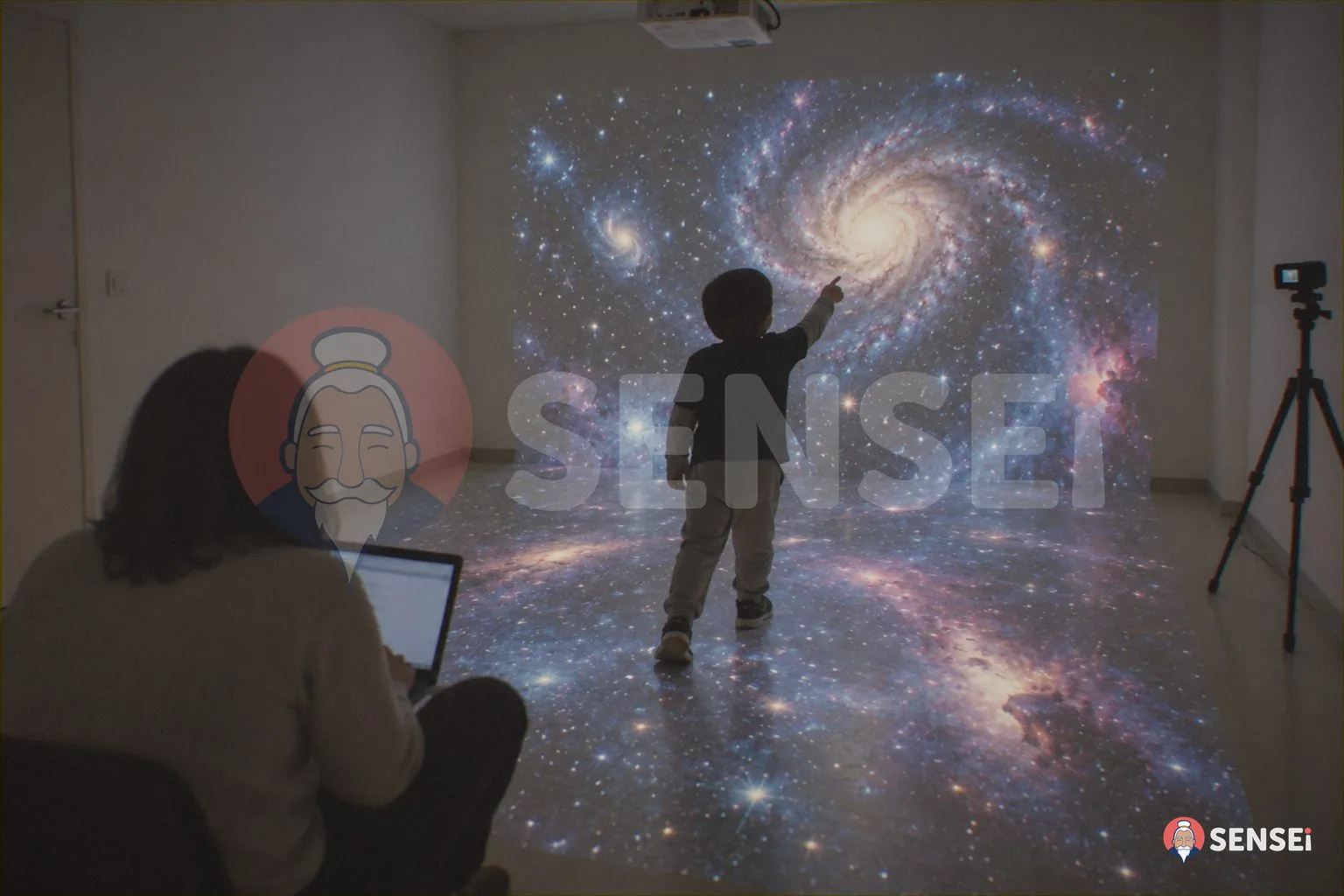
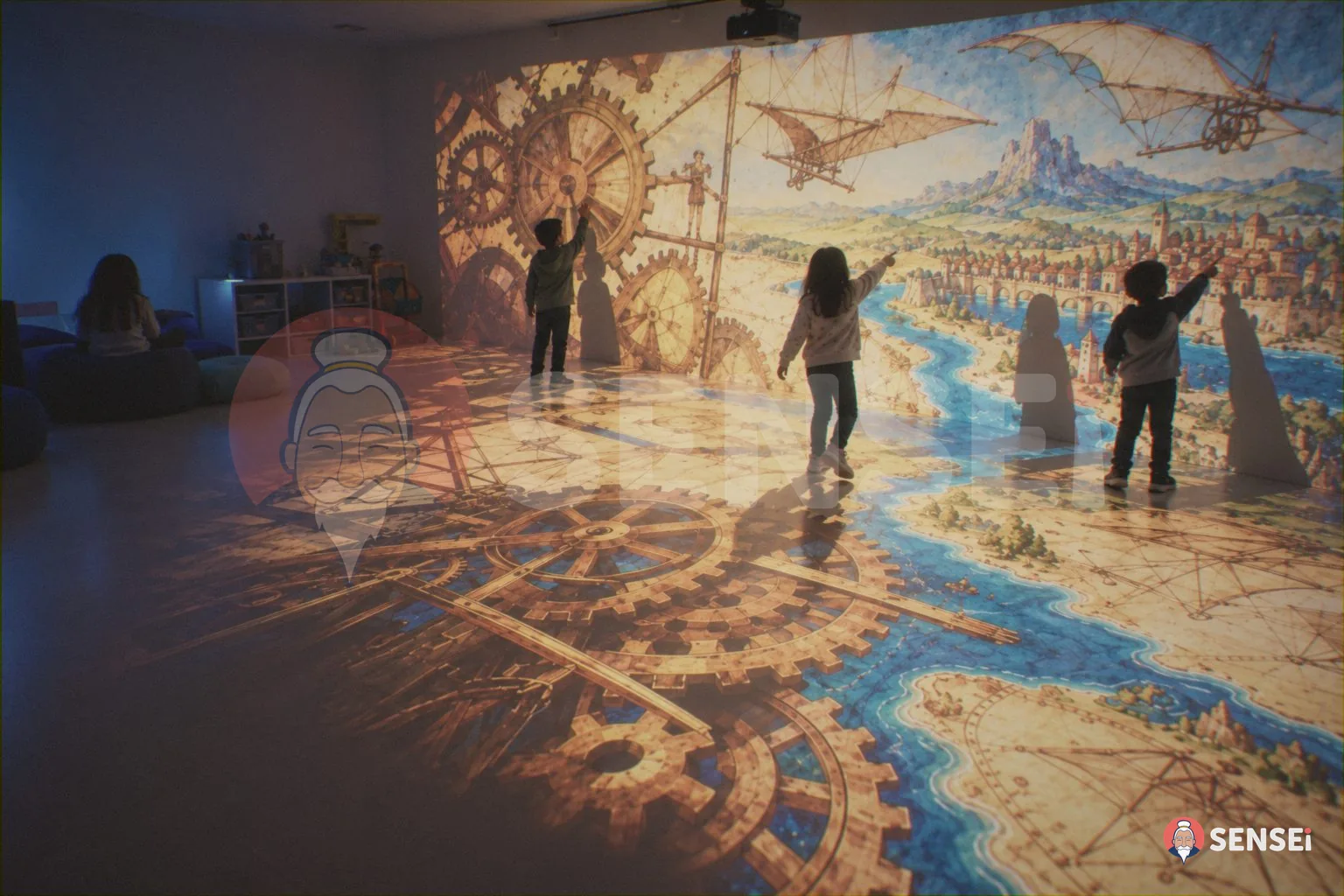
In an interactive multisensory classroom, walls and floor come to life: pupils act with their body, their voice or objects, and the environment responds with images, lights and sounds. The teacher chooses the activity, adjusts the level of stimulation and guides the group, often from a tablet.
In the SENSEi offer for primary school the motto is “Imagine. Learn. Create.”: the classroom becomes an active and inclusive space, where the lesson is lived. You can read more in SENSEi for primary school.
Why does moving help learning?
Research on embodied learning studies how the body takes part in building concepts. The research group from which SENSEi originates has been studying it for years. In a controlled study presented at the ACM CHI conference, 48 children aged 6 to 8 from a primary school learn in an immersive space, interacting through movements and gestures. The study reports educational value for the approach, including in comparison with traditional teaching. We describe it in The body that learns.
A second study, with 175 children aged 6 to 10, compares several ways of interacting (moving, touching, using objects, speaking) in an educational multisensory environment. Each modality has advantages and limits: this is why it is best to choose the interaction according to the goal. A third piece of work, on a mobile multisensory solution, suggests effects on engagement, collaboration and socialisation in the classroom. These are three of the more than 40 scientific publications collected on the Research page.
Activities by subject
The following activities usually last between 15 and 30 minutes and fit into a teaching unit that is already under way.
Italian
- The changing story: the wall shows the setting of a story; at each sequence the group chooses with a gesture how it continues. Works on sequencing, connectives, hypotheses.
- Word hunt: words appear on the floor; pupils jump onto nouns, verbs or adjectives depending on the instruction.
- Settings to describe: a forest, a market or a beach is projected; pupils gather sensory words (what I see, hear, smell) for a descriptive text.
Maths
- The number line on the floor: pupils move forwards and backwards for addition, subtraction and negative numbers.
- Shapes in motion: in small groups, pupils position themselves to form triangles, squares and projected symmetries.
- The market: a buying-and-selling scenario for problems with coins and mental arithmetic.
Science
- The water cycle: the environment changes with each phase (evaporation, condensation, rain); pupils trigger them with gestures.
- Ecosystems: step into a pond or a forest, observe food chains and classify animals.
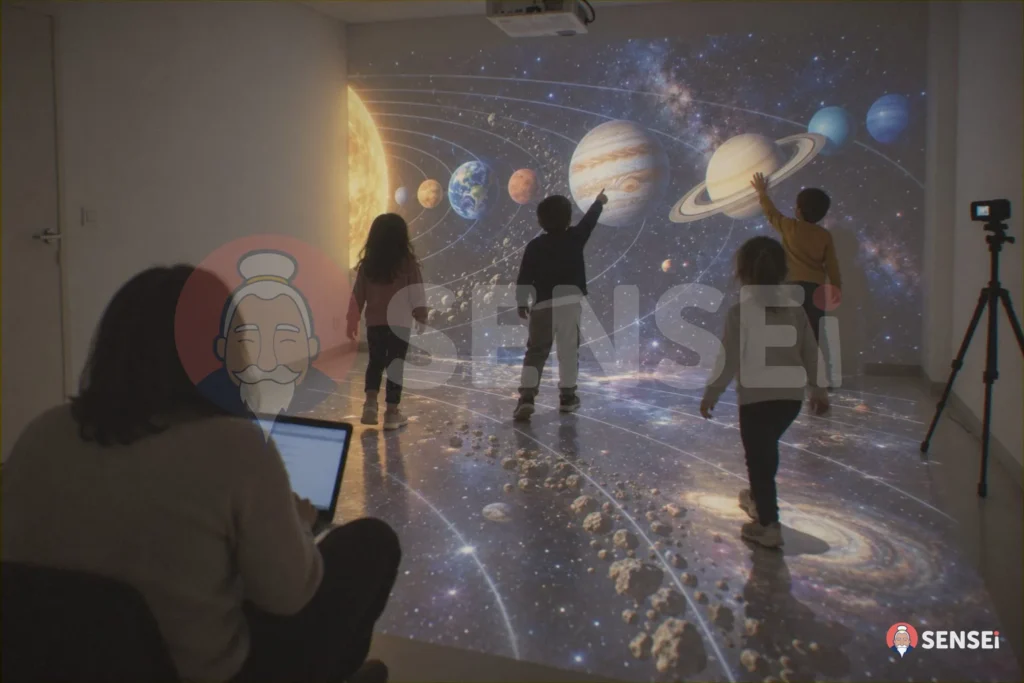
- The solar system: the planets on the walls; pupils put them in order and compare their sizes.
History and geography
- Time travel: a timeline on the floor; each step opens an image of a period.
- Italian landscapes: mountains, hills, plains and coast projected on the wall with their typical sounds; pupils compare climate and human activities.
- Orientation: a map on the floor to practise compass points and routes.
English
- Immersive Simon says: commands in the foreign language that trigger responses in the environment.
- Vocabulary room: objects from a room, the sea or the park appear with the audio of the word.
Music, art and physical education
- Orchestra of gestures: each area of the wall produces a sound; the group composes a rhythmic sequence.
- Inside an artwork: a painting projected across the whole wall to observe colours, lights and details, then recreate them.
- Movement circuits: balance, jumps and coordination on shapes projected on the floor.
Citizenship education
- The sustainable city: the group chooses where to put trees, cycle lanes and recycling, and watches the neighbourhood change.
- Emotions: colours and music to recognise and name emotions, supported by pictograms.
Many more ideas, from nursery to primary, are collected in Multisensory activities: 30 examples.
How do you organise a lesson in the multisensory classroom?
A three-step structure works well.
- Before (in class, 10 minutes): present the goal and go over the rules of the space.
- During (in the room, 15-30 minutes): activities in turns or in small groups; those who are not active observe and make suggestions.
- After (in class, 10-15 minutes): process the experience in words, with a drawing or a short text. This is where the experience becomes learning.
With large classes it is best to split the group: half in the room, half on a related activity in class, then swap. It is also useful to agree on a signal to stop everything and reduce lights and sounds.
How do you include every pupil?
An environment that speaks to several senses offers more ways to understand and to express oneself. This is the idea behind Universal Design for Learning (UDL), which proposes offering multiple means of engagement, representation, and action and expression. In SENSEi this translates into reverse inclusion: activities are designed starting from the most complex needs.
- Reduce stimulation for those who are sensitive to lights and sounds, even for just part of the lesson.
- Use pictograms for augmentative communication (SENSEi integrates ARASAAC).
- Assign different roles: who acts, who counts, who observes, who tells the story.
- Provide a calm corner near the room.
For autistic pupils you will find specific guidance in Sensory room and autism at school: practical activities.
Where do you get the content?
You do not need to start from scratch. SENSEi integrates resources that many teachers already use, such as YouTube, WordWall, Mozaik 3D, Wikipedia, Geopop, Google Arts & Culture and National Geographic. With Eureka you can create and share multisensory activities tailored to your own class.
How do you assess?
You can use the tools already in place: observation grids, short tests, self-assessment with smiley faces. SENSEi can produce reports on how the activities are going, useful for documenting the work and discussing it with colleagues and families. The teacher’s observation nevertheless remains central.
What changes for pupils and teachers?
For pupils, the lesson becomes an experience to live together: those who struggle with books find another way in, and shyer pupils take part with a gesture before they do so with their voice. For teachers, the room stops being a special event and becomes an everyday tool, in every subject.
At the ICS Leonardo da Vinci in Cornaredo the primary teachers work with more than 27 activity templates: the content changes, not the format, so each teacher brings their own subject into the room. At the IC Silvio Pellico in Arluno each school site has its own environment, close to the classrooms, designed on the basis of a focus group with the teachers.
Frequently asked questions
How many times a week is the multisensory classroom used?
It depends on how the school is organised. Many schools set up a rotating timetable between classes, with short, regular sessions.
Do teachers need specific training?
Yes, initial training helps make good use of the space. SENSEi offers training programmes and co-design of activities.
Can it be used with the whole class?
Yes, the system recognises several people at once. With large classes, however, it is best to work in groups.
Does the multisensory classroom replace the interactive whiteboard?
No, they are different tools. The interactive whiteboard is a surface to look at and touch; the multisensory classroom involves the body, space and several senses.
How much does it cost to set up?
It depends on the configuration and the space available. Contact us for an assessment.
Want to see it in action?
We will show you some subject-based activities directly in a SENSEi room. Book a demo.
Sources
- Gelsomini, Leonardi, Garzotto (2020), Embodied Learning in Immersive Smart Spaces, ACM CHI
- Cosentino, Gelsomini, Sharma, Giannakos (2023), Interaction Modalities and Children’s Learning in Multisensory Environments, ACM IDC
- Gelsomini et al. (2018), On the Effects of a Nomadic Multisensory Solution for Children’s Playful Learning, ACM ISS
- CAST, About Universal Design for Learning