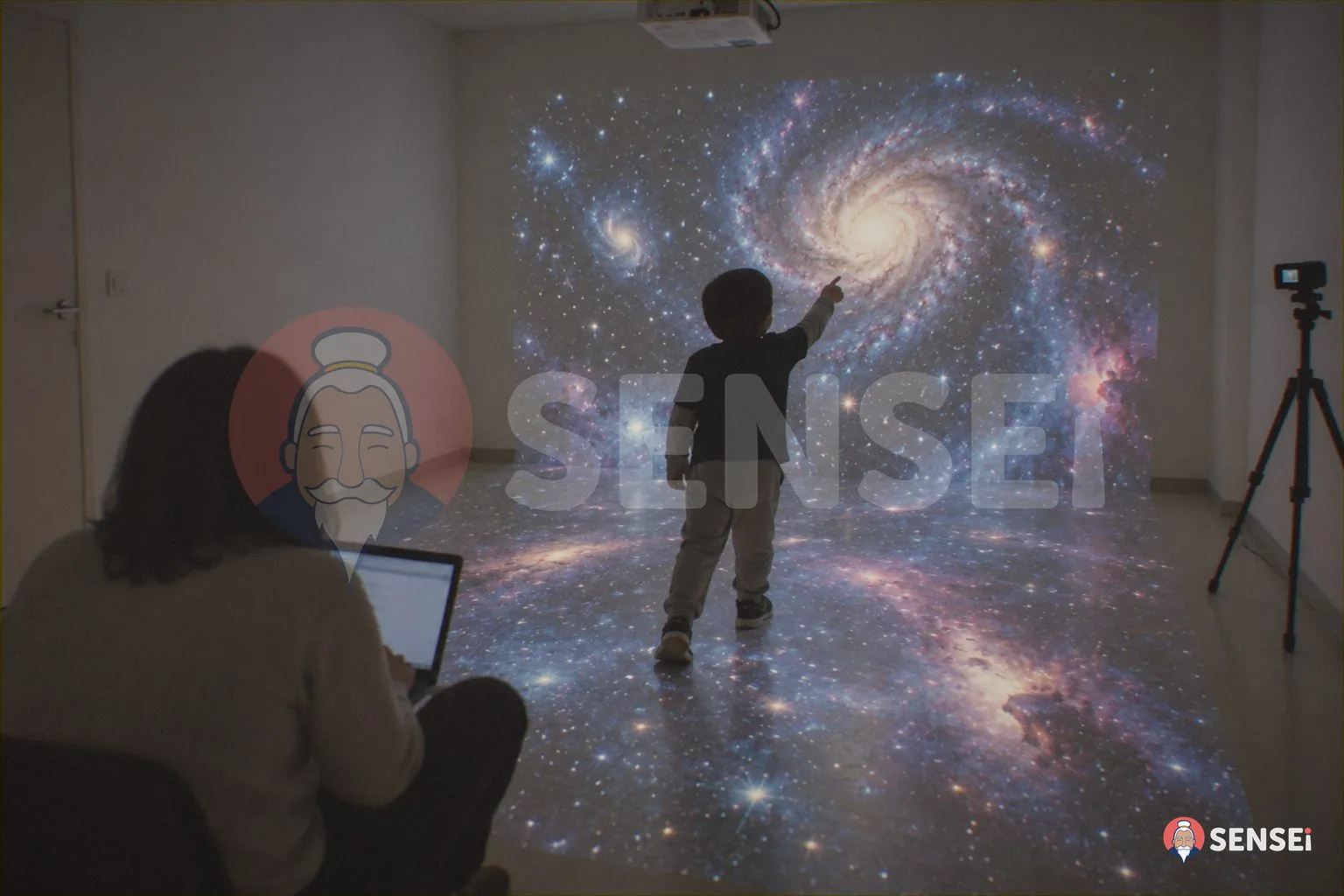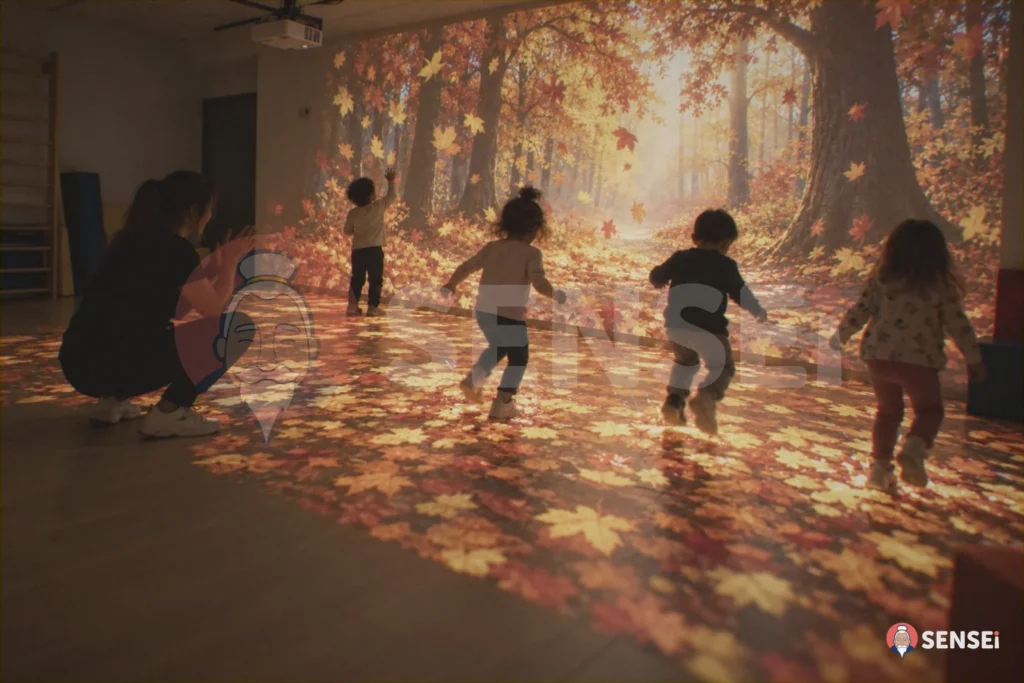
Autumn in the immersive room becomes an experience to move through with the whole body: leaves that fly away as the children pass, puddles to jump in, the rustling of the forest and real materials to touch such as dry leaves and warm fabrics. In this article you will find 10 ready-to-use activities for nursery and preschool, each with a goal, what is projected, sounds, materials and duration.
The sheets take place in a SENSEi magic room and can be adapted, in a simpler form, with ordinary images and materials. They are designed to support children as they return to nursery and school, when routines, groups and spaces are still new.
Why is autumn a precious season for the senses?
Autumn brings changes that children see, hear and touch: colours, rain, wind, shorter days. It is ideal for working on warm colours, cause and effect and descriptive language (rough, soft, wet).
Presenting the same theme through several consistent senses helps consolidate the experience: according to a review by Shams and Seitz, multisensory learning comes closer to natural conditions and is more effective than learning based on a single channel (Trends in Cognitive Sciences).
Immersive room and garden: an alliance worth nurturing
Italy’s national guidelines for early childhood education services recommend outdoor spaces connected to the classrooms that encourage exploring nature, free movement and sensory perception, and they give educational value to the daily routines (Eurydice, educational guidelines for Italy). The immersive room does not replace going out into the garden: it extends it.
A simple way to do this: collect leaves and pine cones during the morning outing and use them as materials in the afternoon activity.
How to use the sheets
- Each activity has a calm entry, an active phase and a calm closing.
- At nursery, work with small groups of 3-5 children and an educator close by.
10 autumn activities for the immersive room
1. Dancing leaves
- Goal: free movement, cause and effect, discovering warm colours.
- What is projected: a carpet of yellow, red and brown leaves on the floor; as the children pass, the leaves fly away and then settle again.
- Sounds: rustling leaves, a light wind.
- Materials to touch: a basket of dry leaves collected in the garden and cleaned, to scrunch and listen to.
- Duration: 10 minutes (babies: 5 minutes in arms or on the mat).
2. Rain and puddles
- Goal: coordination, two-footed jumping for the older ones, vocabulary (rain, drop, puddle).
- What is projected: a country road in the rain; jumping into a projected puddle sets off splashes and ripples.
- Sounds: rain, a “splash” with every jump, drops on the roof.
- Materials to touch: a rain stick, little rubber boots to touch, a waterproof sheet to rustle.
- Duration: 10-15 minutes.
3. The squirrel and the acorns
- Goal: object permanence, attention, the game of hiding and finding.
- What is projected: a forest on the wall; a squirrel hides acorns behind the trees; when a child points to or approaches the right tree, the acorn reappears.
- Sounds: a little surprise sound with each find, gentle forest music.
- Materials to touch: a plush squirrel, stuffed fabric acorns.
- Duration: 10 minutes.
At nursery, avoid real acorns and chestnuts: they are small and can be put in the mouth.
4. The mushroom forest
- Goal: counting, recognising big and small, colours.
- What is projected: a forest floor with mushrooms of different sizes; touching a mushroom with the foot makes it light up and a number is heard.
- Sounds: footsteps on the forest floor, the number spoken aloud, a little bird.
- Materials to touch: wooden or fabric mushrooms to line up from smallest to largest.
- Duration: 15 minutes (preschool).
5. The grape harvest
- Goal: fine motor skills, olfactory and tactile exploration, local traditions.
- What is projected: rows of vines with colourful bunches of grapes; when the children stretch their arms towards a bunch, it falls into the basket drawn on the floor.
- Sounds: folk music at low volume, the sound of bunches falling into the basket.
- Materials to touch: sealed bags with grapes to squash, a real bunch to smell and observe (not to be eaten at nursery without guidance from the kitchen).
- Duration: 15 minutes.
6. The birds fly away
- Goal: imitation, arm coordination, the concept of journeys and change.
- What is projected: an autumn sky; a flock of birds follows the movement of the children’s arms and flies towards the sun.
- Sounds: flapping wings, distant birdcalls.
- Materials to touch: large feathers to blow and send flying, light scarves.
- Duration: 10 minutes.
7. Glowing pumpkins
- Goal: cause and effect, colours, round shapes.
- What is projected: a vegetable patch with pumpkins of various sizes; when someone approaches a pumpkin, it lights up orange, green or yellow.
- Sounds: a different sound for each colour, calm music.
- Materials to touch: small real pumpkins (smooth and clean) or soft fabric pumpkins to roll.
- Duration: 10 minutes.
8. Morning fog
- Goal: waiting, observation, calm; discovering that what cannot be seen is still there.
- What is projected: a landscape covered in fog; by staying still and silent, the fog slowly lifts and trees, a little house and a cow appear.
- Sounds: a soft silence, then distant bells.
- Materials to touch: white tulle cloths to pass gently over the hands and face.
- Duration: 10 minutes.
Do not use steam or humidifiers near the devices: the fog is only projected.
9. The hedgehog and the chestnut
- Goal: tactile discrimination between rough, smooth and soft; descriptive language.
- What is projected: a hedgehog walking among the leaves; when the group comes closer it curls up into a ball, when the children stop it opens up again.
- Sounds: rustling, little footsteps, slow breathing when it curls up.
- Materials to touch: a soft-bristled brush (the hedgehog), a smooth ball (the chestnut), a fleece blanket (the den).
- Duration: 10-15 minutes.
10. Hibernation
- Goal: relaxation, breathing, a closing routine before rest time.
- What is projected: a den under the leaves; one by one the forest animals fall asleep; the light dims to a warm orange.
- Sounds: a lullaby, the slow breathing of the animals.
- Materials to touch: light blankets, cushions, a soft toy to keep close.
- Duration: 8-10 minutes.
How to adapt the activities to nursery and preschool ages
| Age | What changes | Recommended activities |
|---|---|---|
| Babies (3-12 months) | Experience lying down or in arms, slow stimuli, 5 minutes | Dancing leaves, Hibernation |
| Young toddlers (12-24 months) | Crawling and walking on the projections, cause and effect | Glowing pumpkins, Rain and puddles |
| Older toddlers (24-36 months) | First group games, imitation, first words | The squirrel and the acorns, The birds fly away, The hedgehog and the chestnut |
| Preschool (3-6 years) | Rules, counting, describing what they have done | The mushroom forest, The grape harvest, Morning fog |
Find out more in the guide to the immersive room at nursery and on the SENSEi for preschool page.
Safety: what to check in autumn
- Small fruits and seeds. Chestnuts, acorns and grapes can be put in the mouth: for children under three, use them only inside sealed bags or replace them with fabric versions.
- Leaves and natural materials. Collect them in clean areas, let them dry and check that there are no thorns or mould.
- Allergies. Ask families before using scents, fruit or plant materials.
- Lights. Lightning and storms must be slow: guidelines on photosensitive epilepsy recommend not exceeding 3 flashes per second (International Guidelines for Photosensitive Epilepsy).
- Sudden sounds. Lower the volume and announce loud sounds with an agreed gesture.
How to adjust stimuli during the activity
Adjusting the stimuli is as important as the content. Magika, the research project from which SENSEi derives, was designed with more than 30 specialists from care centres and schools precisely to give educators control over the level of the stimuli and their progression, and to personalise activities to the needs of each child (Magika, CHI). It is one of the works in a research journey that began at Politecnico di Milano and today counts more than 40 scientific publications.
In practice, from the tablet the educator can dim the light, remove a sound, slow down the leaves or stop everything in an instant. The most sensitive child stays in the group instead of leaving it.
What changes for children and educators?
A calendar of seasonal activities gives rhythm to the year. Children find familiar scenes again, anticipate what will happen and take part more; educators have a common thread for observing, sharing with families and linking the room to the garden and the classroom.
The schools that work with SENSEi tell the same story. At ICS IV Novembre in Cornaredo the magic room arrived in the preschools and has grown with a community of teachers. At IC Perlasca in Bareggio, the immersive environments, rethought together with the teachers, accompany children from preschool onwards.
How to create the activities with Eureka
With the Eureka platform you can build these activities starting from the educational goal: choose the scene, the interactions (steps, gestures, voice), the sounds and colours, and adjust intensity and duration. To continue through the year, you will find the activities for winter at nursery, for Christmas and more ideas in the 30 examples of multisensory activities.
Frequently asked questions
From what age can these activities be offered?
From the first months, with the necessary differences. Babies experience them lying down or in arms, with slow stimuli; from the age of two the first group games are introduced.
How often should the same activity be repeated?
At nursery, even several times a week: repetition helps children anticipate what happens and take part more.
Do the activities work for children with disabilities?
Yes, if adapted. A child who does not walk can make the leaves fly with a hand gesture, supported by the educator; the stimuli should be tailored to the individual child.
Can I link the activities to Halloween?
The sheets are designed to be secular and suitable for every class. If the setting wishes, the glowing pumpkins can be decorated playfully, without images that might frighten the youngest children.
Want to create your own autumn activities for nursery? Discover Eureka.
Sources
- Eurydice, Italy: educational guidelines (Linee pedagogiche per il sistema integrato zerosei and Orientamenti nazionali per i servizi educativi per l’infanzia)
- Shams L., Seitz A. R. (2008). Benefits of multisensory learning. Trends in Cognitive Sciences
- Gelsomini M. et al. (2019). Magika, a Multisensory Environment for Play, Education and Inclusion. CHI EA 2019
- International Guidelines for Photosensitive Epilepsy: Gap Analysis and Recommendations (2024). ACM Transactions on Accessible Computing