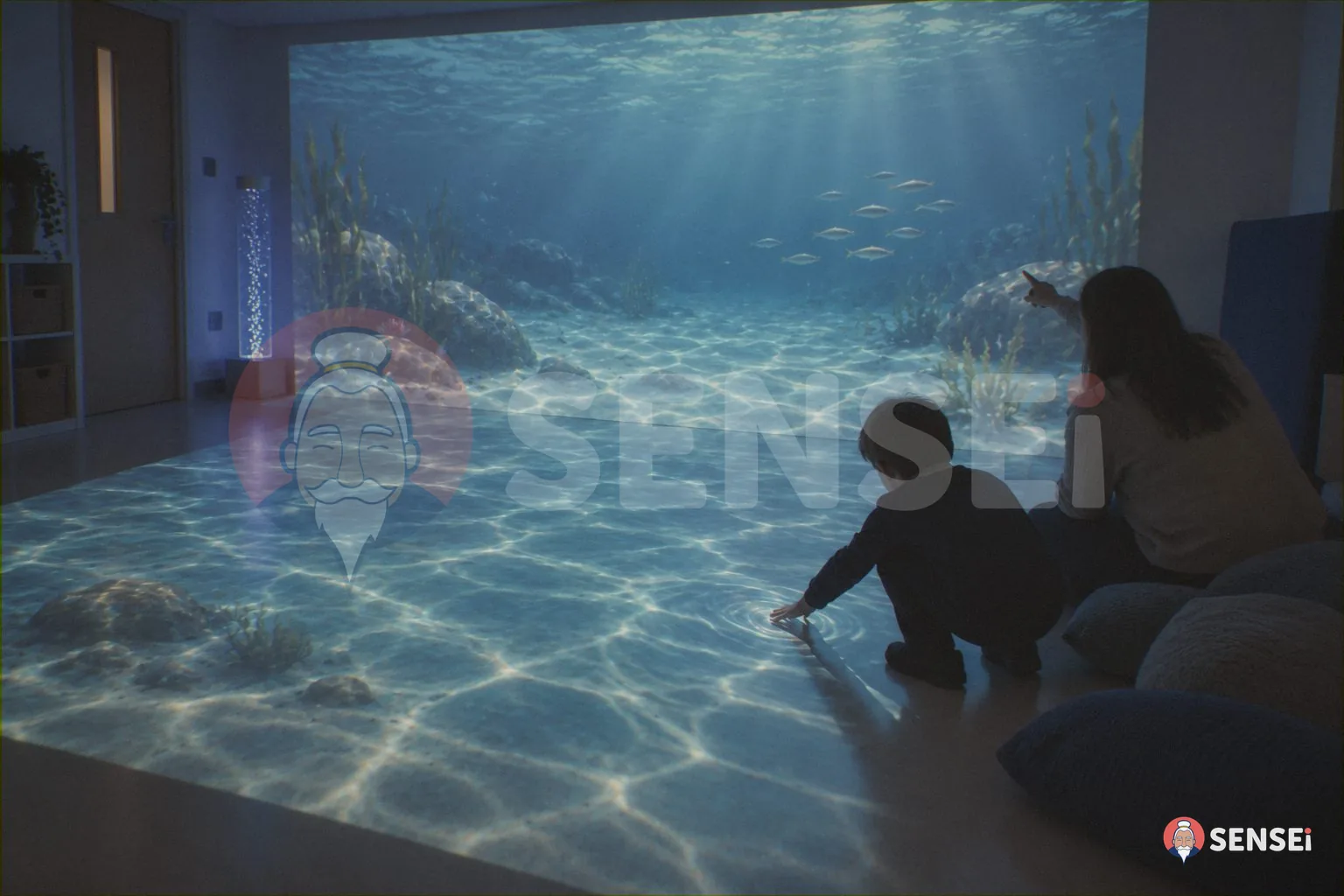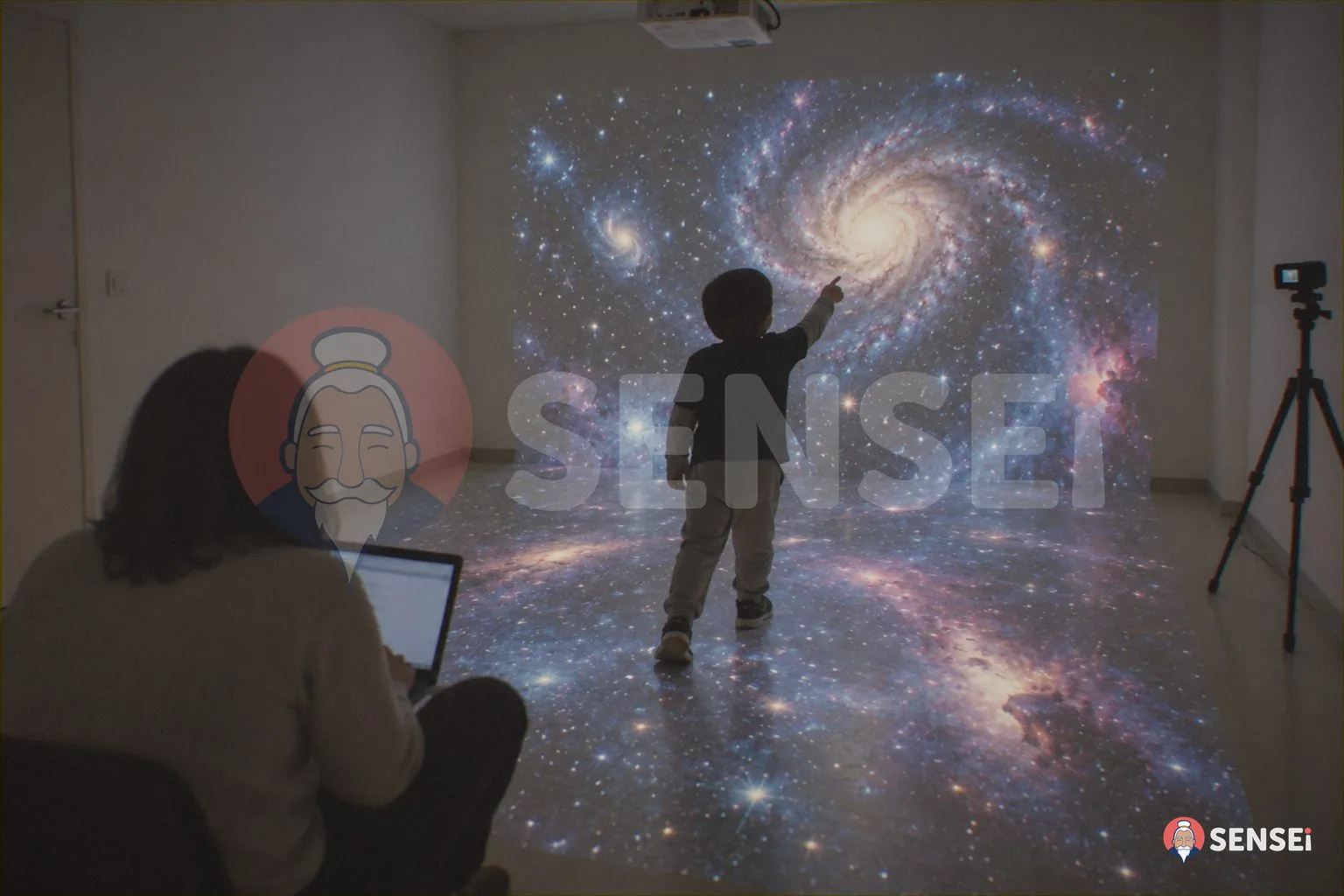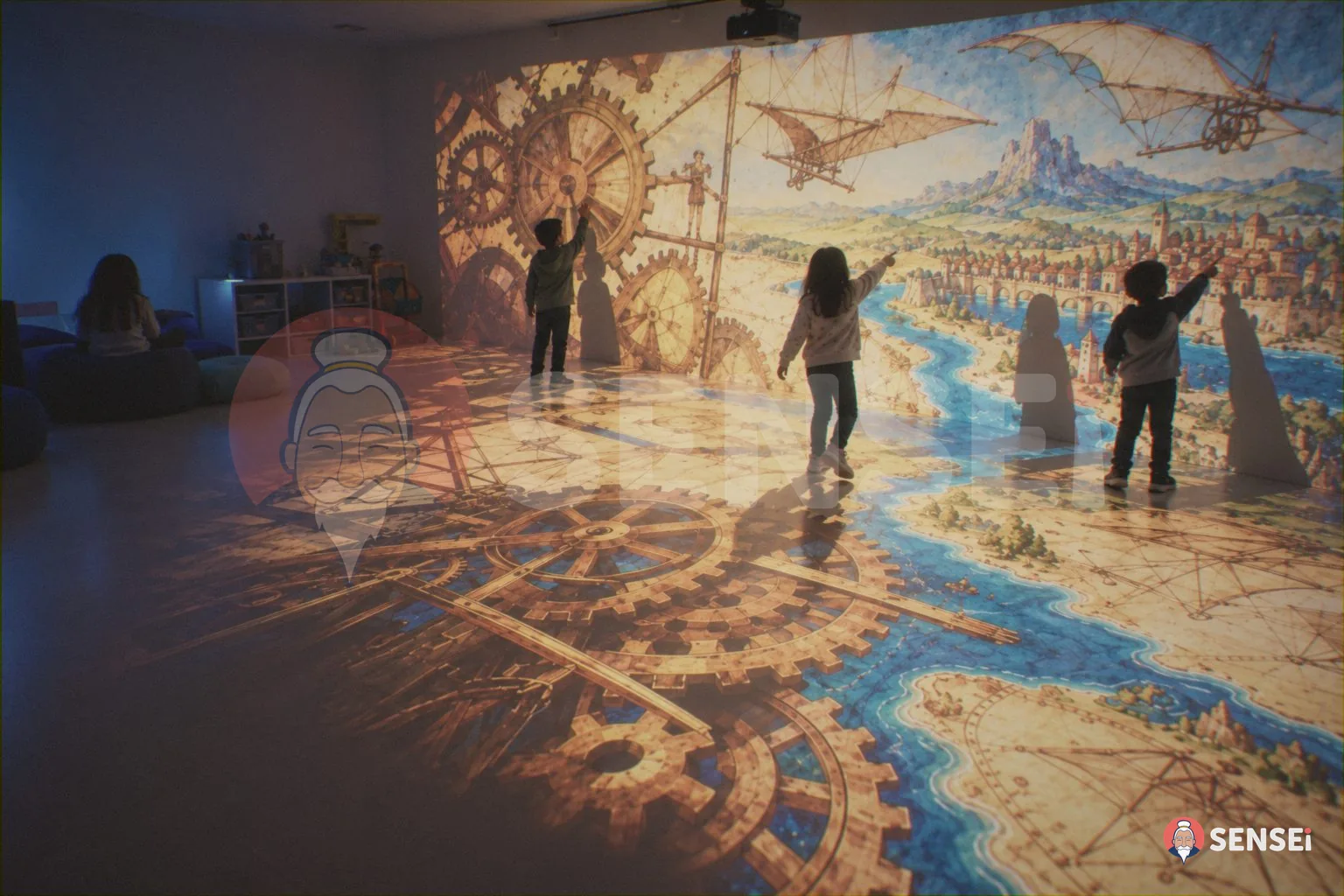

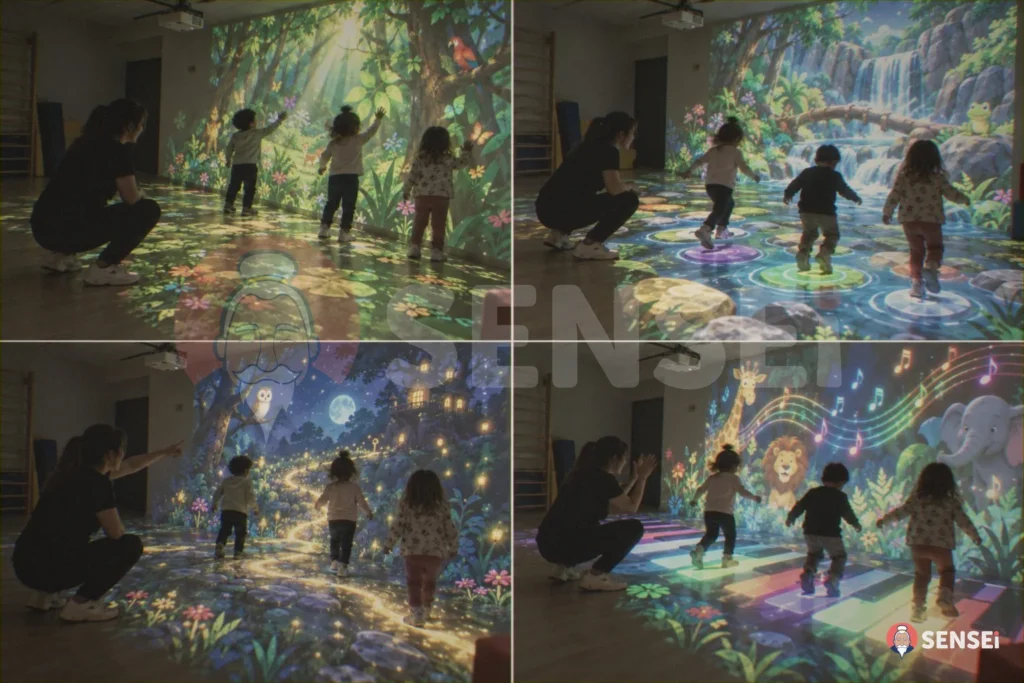
Multisensory activities are games and learning activities that engage several senses together (sight, hearing, touch, smell, movement) around a single goal. Here you will find 30 ready-to-use examples, divided between nursery, preschool and primary school, with the goal and the senses involved for each one.
Every activity can be done with simple materials. In an immersive room such as the SENSEi magic room the same ideas come to life: walls and floor respond to the children’s movements and the educator doses lights and sounds from a tablet. Many of these ideas come from years of research and work in schools.
How to use these examples
Before you start, three tips that apply to all ages:
- One goal per activity. The stimuli serve the goal, not the other way round.
- Calm start, active phase, calm close. This is the structure that helps children regulate themselves.
- Observe before increasing. If a child covers their ears or moves away, lower the intensity.
The underlying principle is supported by research: according to a review by Shams and Seitz, learning that combines several senses comes closer to natural conditions and can be more effective than learning based on a single channel (Trends in Cognitive Sciences). For the theory, read the post on multisensory teaching.
10 multisensory activities for nursery (0-3 years)
At nursery, activities are short (5-15 minutes), slow and repeated. What matters is discovery, contact with the adult and safety.
| Activity | What happens | Senses | Goal |
|---|---|---|---|
| 1. Breathing light | The room’s light slowly turns on and off, with a soft sound | Sight, hearing | Calm, shared attention |
| 2. Bubbles and colours | Soap bubbles in a light that changes colour | Sight, touch | Tracking with the eyes, reaching out |
| 3. The meadow under your feet | Grass projected on the floor and a soft green mat | Sight, touch, movement | Exploring by walking or crawling |
| 4. Who makes this sound? | An animal appears on the wall when its call is heard | Sight, hearing | Linking sound and image |
| 5. Light rain | Projected drops, the sound of rain, fabric sheets being shaken | Sight, hearing, touch | Discovery, first words (rain, water) |
| 6. Light peekaboo | A character hides and reappears on the wall | Sight | Object permanence, waiting |
| 7. Drums and waves | Beating a drum makes coloured waves appear | Hearing, sight, movement | Cause and effect |
| 8. Soft and rough | A basket of different fabrics, each with a sound and a colour | Touch, sight, hearing | Tactile discrimination |
| 9. Scent of orange | Images of citrus fruit and a real orange to smell | Smell, sight | Olfactory discovery |
| 10. Lullaby of stars | Slow stars on the ceiling, gentle music | Sight, hearing | Relaxation before sleep |
Seasonal activities for the youngest children are collected in the articles on autumn and winter, while the guide to the immersive room at nursery explains duration, groups and stimuli to avoid.
10 multisensory activities for preschool (3-6 years)
At preschool, activities can last 15-25 minutes, involve the group and introduce simple rules.
| Activity | What happens | Senses | Goal |
|---|---|---|---|
| 11. The body traffic light | Colours on the wall: green means run, yellow means walk, red means stop | Sight, movement | Self-regulation, following rules |
| 12. Coloured emotions | Each emotion has a colour, a piece of music and a face | Sight, hearing | Recognising and naming emotions |
| 13. Shape hunt | Circles, squares and triangles on the floor: jump onto the shape called out | Sight, hearing, movement | Recognising shapes |
| 14. The animal forest | Animals hidden among projected trees; children find them by pointing | Sight, hearing | Observation, vocabulary |
| 15. Inside the story | The room changes setting with each scene of the story | Sight, hearing, smell | Comprehension and narrative sequence |
| 16. Big and small | An animal grows if the children spread out, shrinks if they crouch down | Sight, movement | Concepts of size |
| 17. Group orchestra | Each area of the floor plays a different instrument | Hearing, movement | Rhythm, cooperation |
| 18. The garden of the seasons | The same tree changes with the seasons | Sight, touch | Cyclical time |
| 19. Mixing colours | Two children standing on two primary colours make the secondary colour appear | Sight, movement | Colours, collaboration |
| 20. The sea in a bag | Projected waves, sensory bags with blue gel, the sound of the sea | Sight, touch, hearing | Exploration, language |
More ideas for this age group are on the page SENSEi for preschool and in the articles on Carnival and summer.
10 multisensory activities for primary school (6-11 years)
At primary school, multisensory work supports subject content. The body becomes a tool for understanding.
| Activity | What happens | Senses | Goal |
|---|---|---|---|
| 21. The number line | A line on the floor: operations are solved with steps | Sight, movement | Calculation, number order |
| 22. Giant letters | Letters on the wall with sound; they are traced on rough letters | Sight, hearing, touch | Grapheme-phoneme correspondence |
| 23. The water cycle | Rain, evaporation, clouds; a mister to feel the humidity | Sight, hearing, touch | Science |
| 24. Journey through Italy | A map on the floor; typical music and images in each region | Sight, hearing, movement | Geography |
| 25. The solar system | Planets on the wall; children move in orbit around the Sun | Sight, movement | Science, proportions |
| 26. Fractions with the body | A projected pizza is divided into parts; children occupy the slices | Sight, movement | Fractions |
| 27. Inside the painting | An artwork on three walls with sounds from its period | Sight, hearing | Art, description |
| 28. The moving quiz | The answers are corners of the room: run to the right one | Sight, hearing, movement | Revision of any subject |
| 29. English at the market | A market on the wall; touch the products named in English | Sight, hearing, movement | Foreign language vocabulary |
| 30. Breath and light | The light expands on the in-breath and retreats on the out-breath | Sight, movement | Managing anxiety before tests |
For subject-based activities, read the article on the multisensory classroom in primary school.
What does research say about activities of this kind?
Many of the ideas above come from prototypes studied over the last ten years by the research group from which SENSEi originates, author of more than 40 scientific publications on multisensory experience, learning and inclusion.
- Magika, designed with more than 30 specialists from care centres and primary schools, combines digital worlds on wall and floor with physical objects and lights. Educators control the level of the stimuli and their progression (Magika, CHI).
- Ahù, a mobile multisensory solution, was studied in the classroom for cooperative and competitive games. The exploratory study points to its potential for engagement, collaboration, socialisation and learning (ISS).
- IMAGINE, an immersive space for learning through the body, was evaluated with 48 primary school children aged 6 to 8, including in comparison with traditional teaching (CHI).
What changes for children and educators?
A good repertoire of multisensory activities changes the way people are together. Children take the lead: they make things happen, wait their turn, collaborate to mix a colour or complete a story. Educators have a common language for designing, observing and documenting, and can repeat an activity exactly or with small variations.
You can see this in the schools that have been working with SENSEi for some time. At the ICS IV Novembre in Cornaredo the magic room has grown together with a community of preschool teachers. At the IC Silvio Pellico in Arluno there is an environment in each school site, designed with the teachers, plus an outdoor classroom.
How do you adapt the activities for children with special needs?
The starting point is reverse inclusion: you design with the child with the most complex needs in mind, so that the activity works better for the whole group.
- Reduce before adding: start with a single stimulus and add others only if the child is at ease.
- Offer more ways to take part: those who cannot walk can point, those who do not speak can choose with a card or a pictogram.
- Prepare in advance: show what will happen with pictures or a short sequence.
- Give control: whenever possible, let the child start or change the stimulus. The reason is explained in the post on interactive and passive rooms.
Frequently asked questions
Is special equipment needed?
No. All the activities can be started with everyday materials. An immersive room makes it easier to synchronise images, lights and sounds and to repeat the activity exactly or with variations.
How long should a multisensory activity last?
As a guide, 5-15 minutes at nursery, 15-25 at preschool, 20-40 at primary school, always with a calm close.
How many children at a time?
At nursery, small groups of 3-5 children. At preschool and primary school you can work with larger groups, sharing out roles.
Can I create my own activities?
Yes. In a SENSEi room, activities are created with the Eureka platform starting from a goal, including with the help of artificial intelligence, and adapted to the class.
Are the activities also suitable for autistic children?
Yes, if adapted: dosed stimuli, advance preparation, the option to leave the activity and to control it. Every child is different and observation remains the main tool.
Want to turn these ideas into interactive activities for your class? Discover Eureka.
Sources
- Shams L., Seitz A. R. (2008). Benefits of multisensory learning. Trends in Cognitive Sciences
- Gelsomini M. et al. (2019). Magika, a Multisensory Environment for Play, Education and Inclusion. CHI EA 2019
- Gelsomini M. et al. (2018). On the Effects of a Nomadic Multisensory Solution for Children’s Playful Learning. ISS 2018
- Gelsomini M., Leonardi G., Garzotto F. (2020). Embodied Learning in Immersive Smart Spaces. CHI 2020