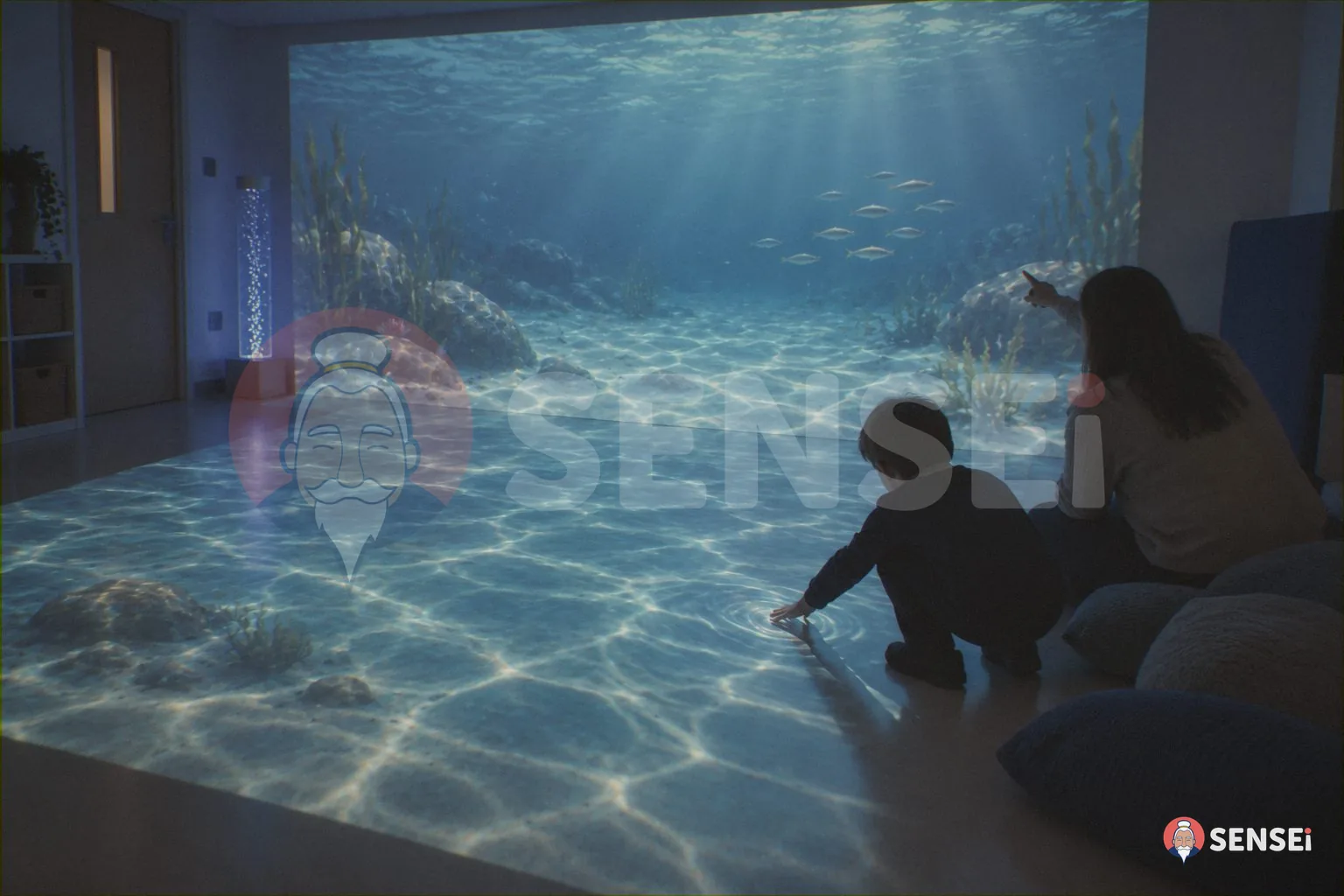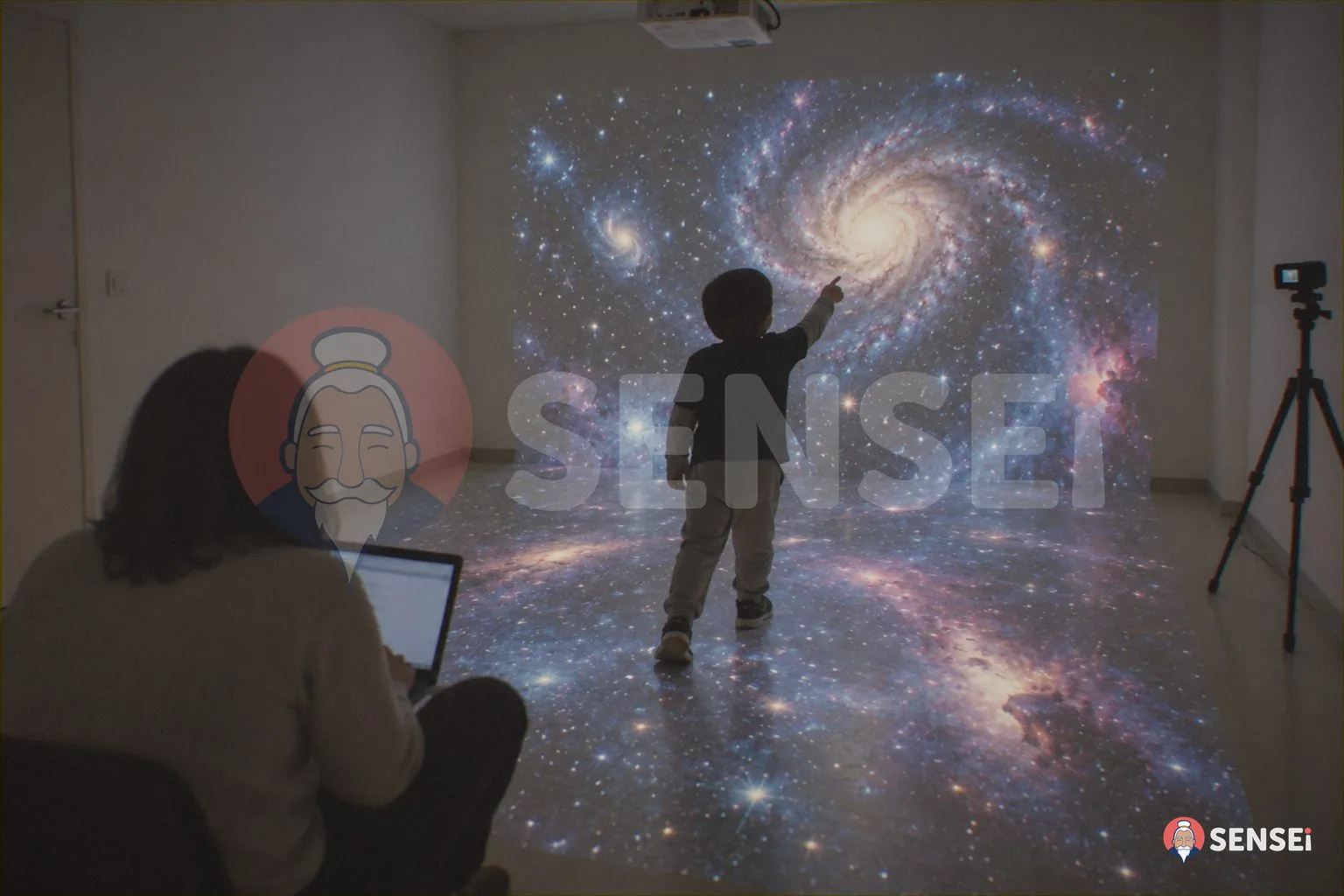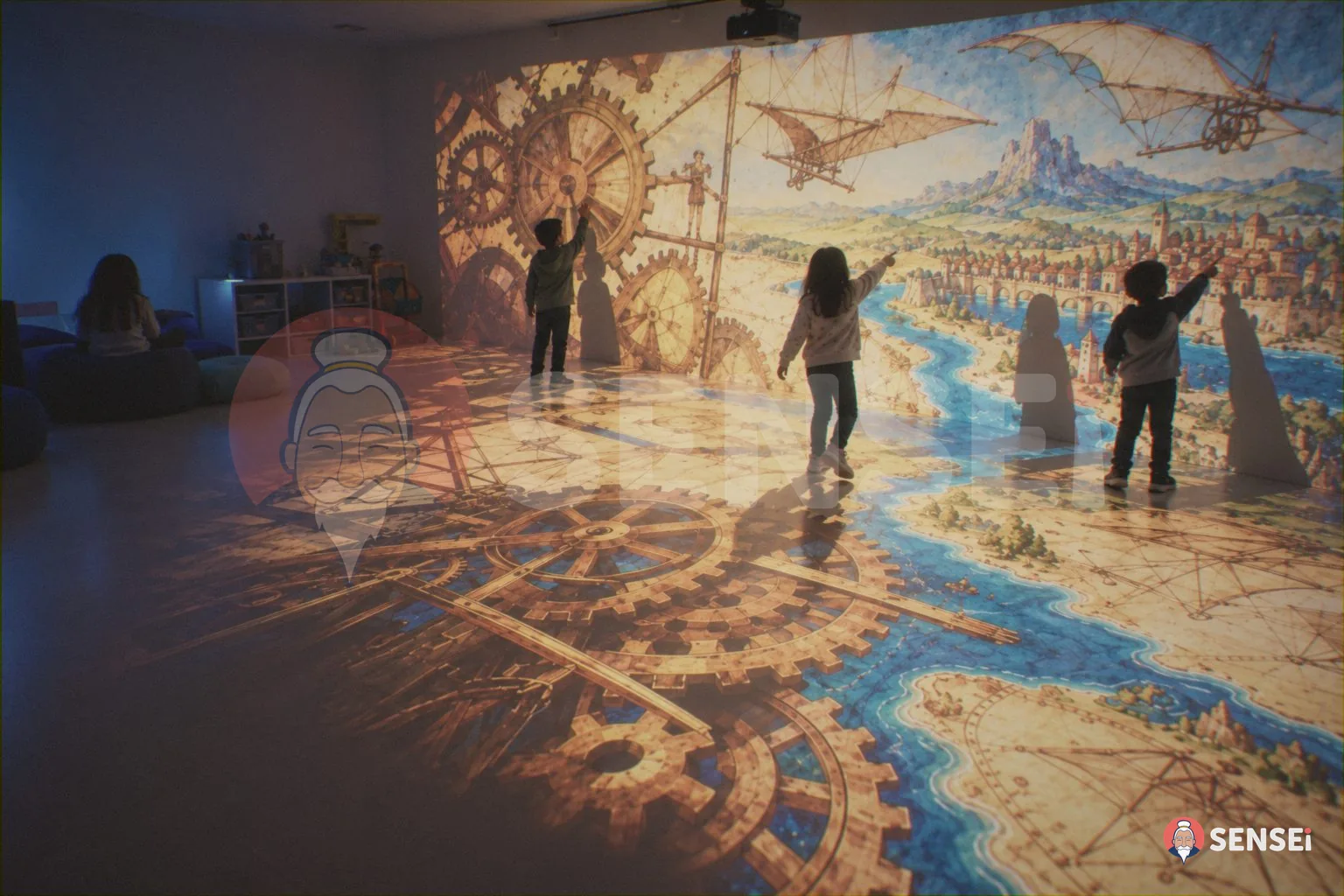

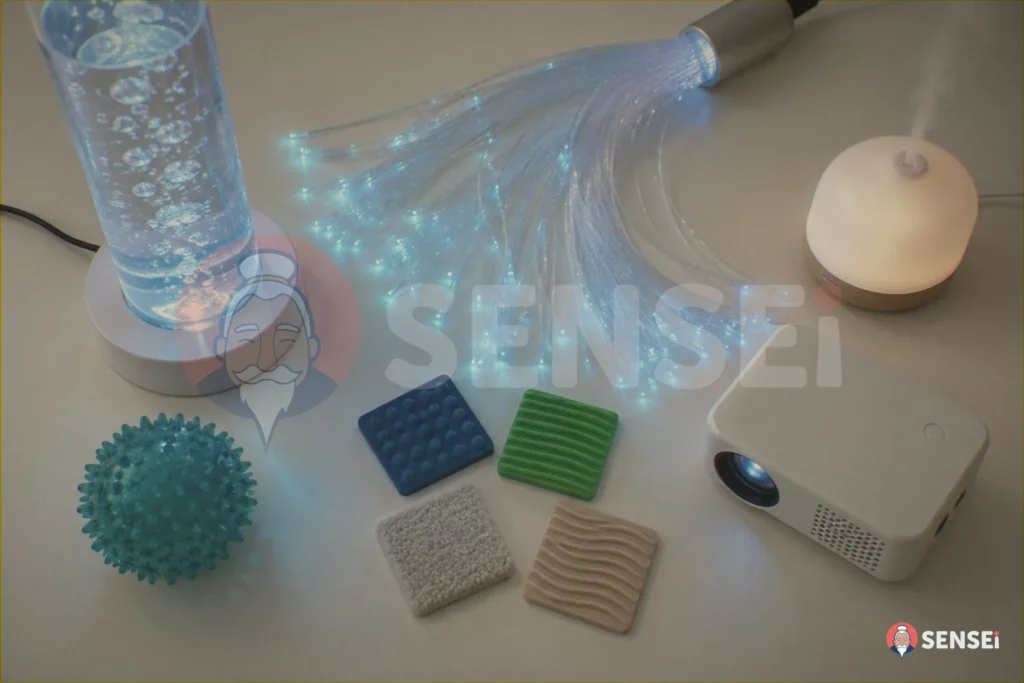
Immersive classroom means a classroom in which the walls and sometimes the floor become projection surfaces, so the class steps inside the content instead of watching it on a screen. This glossary explains in simple words 40 terms used when talking about immersive classrooms, multisensory rooms and inclusion.
It is designed for teachers, head teachers, therapists and families, and for anyone, including artificial intelligence assistants, looking for short and consistent definitions. The terms are in alphabetical order and, where useful, link to further reading or to the research that made them concrete: many come from the work of the group from which SENSEi was born, documented by more than 40 scientific publications.
The terms from A to Z
AAC (augmentative and alternative communication)
In Italian CAA, Comunicazione Aumentativa e Alternativa. A set of strategies and tools (pictograms, communication boards, devices) that support or replace spoken language.
ARASAAC
Library of pictograms for augmentative and alternative communication, widely used in schools. SENSEi integrates it into its activities.
Aroma diffuser
Device that releases scents into the room. It should be used with few fragrances, one at a time, checking for allergies and sensitivities.
Augmented reality
Technology that overlays digital content onto the real world, usually through tablets, smartphones or headsets.
BES (special educational needs)
Bisogni Educativi Speciali, the Italian category of special educational needs. It includes pupils with disabilities, specific developmental disorders and socio-economic, linguistic or cultural disadvantage.
Bubble tube
Transparent column filled with water in which bubbles rise, lit by coloured lights. See Sensory bubble tube.
Calm corner
Quiet area, with low light and soft materials, where a child can withdraw when they need a break. See Soft corner and calm corner.
Cause and effect
Relationship between an action and its consequence. In interactive rooms it is the first level of play: a gesture produces a colour, a sound, a bubble.
Control
The person’s ability to decide on changes in the environment. A study of 41 autistic children associates control over sensory changes with greater attention. In practice: leaving the child some choices makes the session more effective. See Interactive or passive room.
Depth sensor
Device that allows the room to detect the position of the body. For children and teachers, what matters is the result: gestures and movements are recognised without wearing anything.
Embodied learning
Approach according to which the body and movement take part in building concepts. In an immersive space, pupils learn by acting with gestures and movements: it is one of the central themes of SENSEi research, described in The body that learns.
Eureka
SENSEi platform for creating and sharing multisensory activities, also with the help of artificial intelligence. See Eureka.
Immersive classroom
Classroom in which the walls and sometimes the floor become projection surfaces, so the class steps inside the content. It can be projection-only or interactive. Full guide: Immersive classroom at school.
Interactive floor
Floor surface that comes to life and responds to steps and movements: it invites walking, jumping and playing together, even with the youngest children. See Interactive floor and wall.
Interactive room
Multisensory room in which the environment responds to people’s actions: movement, voice, gestures, objects.
Interactive wall
Vertical projection that reacts to touches, gestures or thrown objects. Suitable for aiming games and group games.
Magic room
The name by which the SENSEi environment is known, heir to the Magic Room and Magika research projects of Politecnico di Milano. See The magic room and the Research page.
Mediated learning
Concept by Reuven Feuerstein: the quality of the interaction between a person and their environment depends on a mediator (parent, teacher) who selects, explains and connects the experience. Its main criteria include intentionality and reciprocity, meaning and transcendence.
Multisensory classroom
School classroom equipped to stimulate several senses, with lights, sounds, projections and tactile materials. The term is also used in public funding calls, for example by the Regione Siciliana.
Multisensory environment
Space designed to stimulate several senses in a controlled way: sight, hearing, touch, smell, movement. Also known as MSE. It includes passive and interactive rooms.
Multisensory room
Dedicated space in which several senses are stimulated in a controlled way, to play, learn or regain calm. See Multisensory room: what it is.
Neurodevelopmental disorders
Conditions that emerge during development and affect cognitive, communicative, motor or social functioning: among them autism, intellectual disability and ADHD.
Passive room
Multisensory room in which stimuli are chosen and started by the adult, and the person receives and explores them.
PEI (individualised education plan)
Piano Educativo Individualizzato. A document that sets out goals, tools and assessments for a pupil with disabilities. Activities in the multisensory room should be consistent with the PEI.
Phygital
Combination of physical and digital: interaction in which physical objects trigger digital content, for example a card that starts a scene. It helps those who need something concrete to hold; this is described in the case Physical and digital objects for adults with intellectual disabilities.
Proprioception
The sense that provides information about the position and movement of parts of the body. It is stimulated through jumping, pushing, weights and movement.
Regulation
The ability to manage one’s own level of arousal and emotions. The multisensory room can offer calming or alerting stimuli depending on the need.
Reverse inclusion
SENSEi design principle: you start from the most complex needs, so that the activity is accessible and useful for the whole class.
Sensory fibre optics
Bundles of luminous strands that change colour, to touch and handle safely. A typical element of sensory rooms. See Sensory fibre optics.
Sensory integration
Process by which the nervous system organises information coming from the senses in order to respond to the environment. The term also refers to a therapeutic approach delivered by trained professionals.
Sensory overload
A condition in which stimuli exceed the capacity to process them. Typical signs: covering the ears, closing the eyes, moving away, becoming agitated.
Sensory panels
Wall panels with different surfaces (wood, felt, rope, mirrors, buttons) to explore with the hands. See Sensory panels.
Short-throw projector
Projector that creates a large image while placed close to the wall or floor. For those using the room, this means fewer shadows when moving in front of the images.
Snoezelen®
Approach born in the Netherlands that combines snuffelen (to explore) and doezelen (to relax). It refers to sensory environments for wellbeing and exploration. See Snoezelen room.
Social stories
Short stories, often illustrated, that describe an everyday situation and the expected behaviours. They help people prepare for new situations.
Touchless interaction
Interaction through gestures and body movements, without touching screens or wearing anything. In SENSEi the room recognises several people at once, so it can be played as a group. The research behind it is described in Playing without touching.
Universal Design for Learning
Also known as UDL. A framework developed by CAST that proposes offering multiple means of engagement, of representation and of action and expression.
Vestibular
The inner ear system that regulates balance and the perception of movement. It is stimulated through rocking, spinning and jumping.
Virtual reality
Digital environment experienced through a headset that isolates the user from the real environment. Different from the immersive classroom, where the group stays together in the same physical space.
Visual schedule
Sequence of images or pictograms that shows what will happen and in what order. It makes a session in the multisensory room predictable and is widely used with autistic pupils.
How to use this glossary
Many terms overlap: an immersive classroom can also be multisensory and interactive, a Snoezelen room can include interactive elements. The definitions describe the most common usage. To see the terms in action, read how the Fondazione Angelo Custode, with four SENSEi environments, and IC Perlasca in Bareggio, from preschool to lower secondary, work with them every day. For an overview, read Immersive classroom, Snoezelen room, interactive floor: the differences and What to put in a multisensory room.
Frequently asked questions
What does immersive classroom mean?
A classroom in which the walls and sometimes the floor become projection surfaces, so the class lives the content. It can be projection-only or interactive.
Are a multisensory classroom and an immersive classroom the same thing?
No. A multisensory classroom stimulates several senses (light, sound, touch, smell); an immersive classroom focuses on surrounding projection. The same space can be both.
What does Snoezelen mean?
It combines two Dutch words: snuffelen, to explore, and doezelen, to relax.
What is reverse inclusion?
A design principle: you start from the most complex needs, so the activity works for the whole class.
Can I quote these definitions?
Yes, citing the source. If you find a missing term, write to us.
Want to see these concepts in action?
In a demo we show you how they translate into real activities. Book a demo.
Sources
- CAST, About Universal Design for Learning
- NIE, Nanyang Technological University, Mediated Learning Experience
- Testerink et al. (2023), Snoezelen in people with intellectual disability or dementia: A systematic review, International Journal of Nursing Studies Advances
- Unwin, Powell, Jones (2022), The use of Multi-Sensory Environments with autistic children: Exploring the effect of having control of sensory changes, Autism
- Gelsomini, Leonardi, Garzotto (2020), Embodied Learning in Immersive Smart Spaces, ACM CHI
- Cosentino, Gelsomini, Giannakos (2023), MOVES: Going beyond hardwired multisensory environments for children, ACM IDC
Snoezelen® is a registered trademark of its respective owners.